
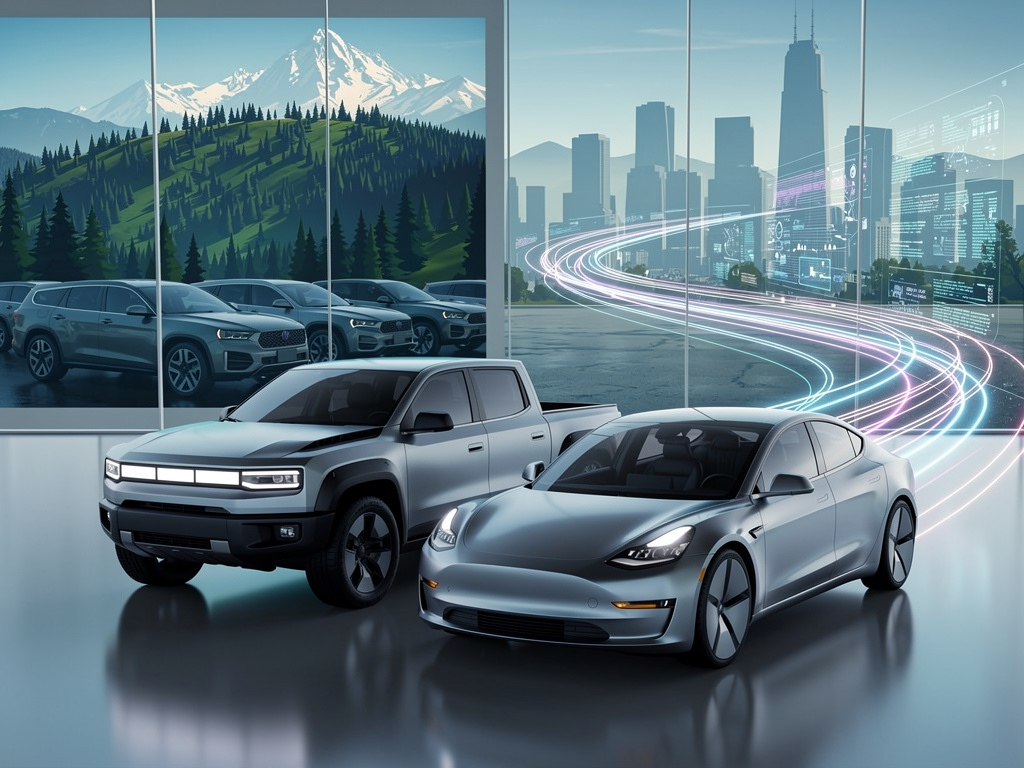
Washington state just handed Rivian and Lucid Motors something the auto industry's entrenched dealer networks have fought for decades to prevent: the legal right to sell cars directly to consumers.
Governor Bob Ferguson signed Senate Bill 5765 into law on March 28, 2025, making Washington the latest state to carve out exceptions to franchise dealer protection laws that have governed American car sales since the mid-twentieth century. The legislation specifically permits electric vehicle manufacturers that have never used franchise dealerships to sell and service their vehicles directly to buyers within the state. It's a narrow carve-out, but its implications stretch far beyond the Pacific Northwest.
The bill passed with bipartisan support. That alone tells you something about the shifting politics of EV sales in America.
According to Slashdot, which covered the signing, the new law applies exclusively to EV-only manufacturers that have no existing franchise dealer agreements in the state — a definition that neatly includes Rivian and Lucid while excluding legacy automakers like Ford or General Motors, which remain bound to their dealer networks regardless of whether they're selling electric or gas-powered vehicles. Tesla, which already secured its own direct-sales authorization in Washington through earlier legislation, operates under a separate legal framework.
This distinction matters enormously. The franchise dealer model isn't just a business arrangement — it's a legally enforced monopoly on how cars reach consumers in most of the United States. Every state has some version of franchise protection laws on the books, many dating back to the 1950s when lawmakers sought to protect small-business dealers from being squeezed by the Big Three automakers in Detroit. Those laws have proven remarkably durable. And remarkably useful to dealer associations that have become among the most powerful lobbying forces in state capitals across the country.
The Washington legislation represents a growing crack in that wall.
Rivian, which manufactures its R1T pickup and R1S SUV at a plant in Normal, Illinois, has been operating in a gray area in many states, using a patchwork of showrooms, service centers, and online sales to reach customers while tiptoeing around dealer franchise laws. The company currently sells directly in states that permit it and has fought legal and legislative battles in states that don't. Lucid, the Newark, California-based maker of the Lucid Air luxury sedan and the recently launched Gravity SUV, faces the same state-by-state gauntlet.
Washington's move gives both companies a clean legal path in a state with strong EV adoption rates. The state ranks among the top markets for electric vehicle registrations per capita in the nation, driven by a combination of environmental policy, consumer wealth in the Seattle metro area, and the state's zero-emissions vehicle mandate. For Rivian and Lucid, direct access to Washington buyers without the legal ambiguity is a material win.
But the dealer lobby isn't taking this quietly.
The National Automobile Dealers Association and its state affiliates have consistently argued that franchise dealers protect consumers by providing local accountability, competitive pricing through inter-dealer competition, and a service infrastructure that manufacturer-owned stores can't replicate at scale. They've also argued — with considerable justification in some cases — that direct sales by manufacturers create an inherent conflict of interest, since the entity setting the price is also the entity completing the transaction, with no independent advocate for the buyer.
These arguments have worked in many states. They failed in Washington.
The political dynamics here are instructive. Washington's legislature has been broadly supportive of EV adoption, having passed aggressive clean-vehicle standards and committed to phasing out sales of new internal combustion vehicles by 2035. Allowing EV-only manufacturers to sell directly aligns with that policy direction. Blocking them would have been ideologically inconsistent — forcing companies that make only electric vehicles to either find franchise partners willing to sell EVs (a notoriously difficult proposition, as many traditional dealers have been reluctant to invest in EV sales infrastructure) or simply not sell in the state at all.
That tension — between dealer protection laws and EV adoption goals — is playing out in statehouses nationwide. And the EV manufacturers are winning more often than they used to.
Texas remains the most prominent holdout. The state's dealer franchise laws are among the strictest in the country, and Tesla's long-running battle to sell directly there has become a symbol of the broader conflict. Rivian and Lucid face similar restrictions in Texas and several other states, though the legislative trend line has been moving in their favor. Colorado, Virginia, Ohio, and now Washington have all created pathways for direct EV sales in recent years.
The economics of direct sales are straightforward. By cutting out the dealer middleman, manufacturers capture the full retail margin on each vehicle, which can amount to thousands of dollars per unit. For companies like Rivian and Lucid — both of which are burning through cash as they try to scale production and reach profitability — that margin recapture is not a luxury. It's a survival mechanism. Rivian reported a net loss of $1.1 billion in the fourth quarter of 2024, and while the company has made significant progress in reducing its per-vehicle losses, every dollar of margin matters. Lucid's financial position is even more precarious in some respects, though the company benefits from substantial backing by Saudi Arabia's Public Investment Fund.
There's also the customer experience argument. Both Rivian and Lucid have built their brands around a direct relationship with the buyer — online configuration, transparent pricing, company-owned service centers. The franchise dealer model, with its negotiation-based pricing and variable service quality, doesn't fit the brand identity these companies are trying to build. Tesla proved that consumers, particularly younger and more affluent ones, prefer the direct model. Rivian and Lucid are betting on the same consumer preference.
So what happens next?
The Washington law is narrowly written, which is both its strength and its limitation. By restricting direct sales rights to manufacturers that have never had franchise agreements, the legislation avoids the politically explosive question of whether established automakers should also be able to bypass their dealer networks for EV sales. Ford, GM, and Stellantis would love that option. Their dealers, who have invested billions in facilities and inventory, would view it as an existential threat. That fight is coming, but it's not this fight.
For now, the immediate beneficiaries are Rivian and Lucid — and, by extension, any future EV-only startup that enters the market without franchise entanglements. The law essentially creates a two-track system: legacy automakers sell through dealers, EV-native companies sell direct. Whether that bifurcation is sustainable over the long term is an open question. If direct-sales EV companies consistently offer a better buying experience at lower transaction prices, the pressure on franchise dealers — and on the laws that protect them — will only intensify.
The dealer franchise system has survived for seventy years because it has powerful defenders and because, for most of that period, there was no viable alternative distribution model. That's no longer the case. Every state that opens a door for direct EV sales makes it harder for the next state to keep its door shut. Washington's decision won't be the last. And the dealer associations know it.
Rivian's stock ticked up modestly following the signing, though the move was likely too incremental to drive significant investor reaction on its own. Lucid saw similar muted market response. Wall Street is watching the broader trend, not individual state victories. But the trend is clear. The legal infrastructure that has governed American car sales for generations is being rewritten, one statehouse at a time.
Not with a bang. With a bill signing in Olympia.


 WebProNews is an iEntry Publication