
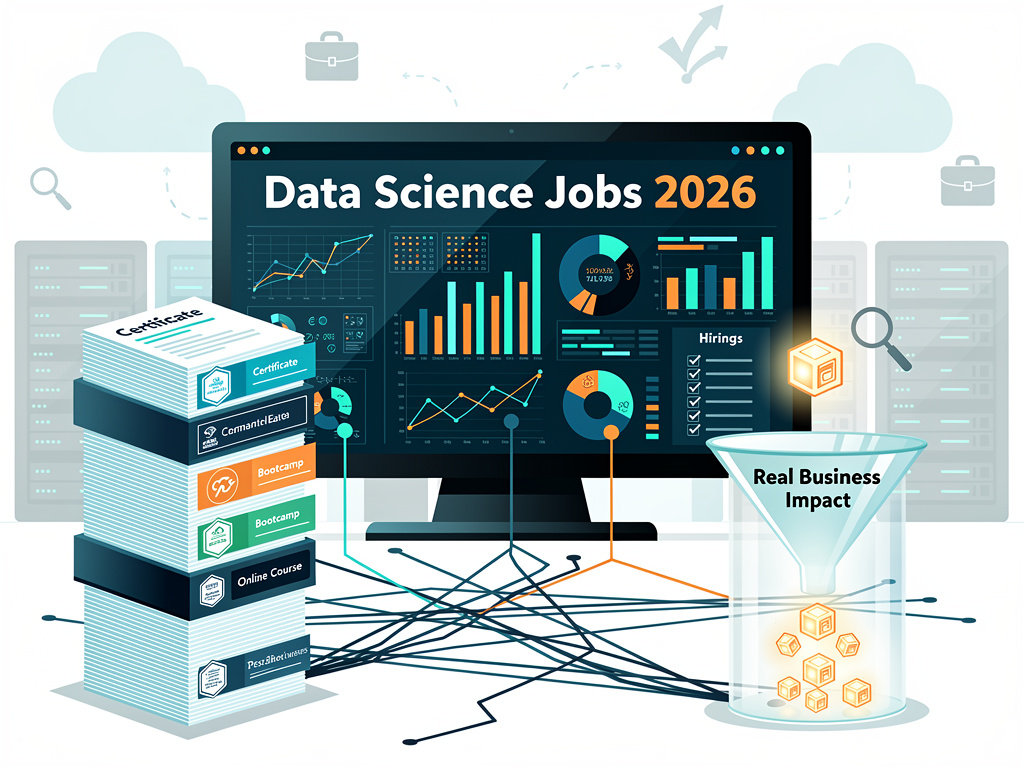
The data science employment market has reached an inflection point in 2026, where the traditional pathway of accumulating certifications and completing online courses has become increasingly disconnected from what employers actually seek. Despite unprecedented enrollment in data science programs and bootcamps, hiring managers report a widening gap between candidate qualifications on paper and the practical skills needed to drive business value. This disconnect has created a paradox where more people than ever are pursuing data science careers, yet companies struggle to find qualified candidates.
According to analysis from Towards Data Science, the primary obstacle facing aspiring data scientists isn’t a lack of education—it’s what the publication terms “useless learning.” The article argues that the very first thing candidates need to do to secure a data science position is to stop accumulating credentials that don’t translate into demonstrable business impact. This represents a fundamental shift from the advice that dominated the field just three years ago, when the emphasis was on obtaining as many certifications as possible.
The proliferation of online courses and bootcamps has created an oversupply of candidates with similar foundational knowledge but limited ability to apply that knowledge in complex, real-world business contexts. Industry veterans note that hiring managers can now expect dozens of applications from candidates who have completed the same Coursera specializations, earned identical certificates, and built nearly indistinguishable portfolios featuring the Titanic dataset and Boston housing price predictions. This commoditization of entry-level data science education has fundamentally altered the competitive dynamics of the job market.
The Shift From Credentials to Demonstrated Impact
What distinguishes successful candidates in 2026 is not their collection of certificates but their ability to demonstrate they’ve solved real problems with measurable outcomes. Employers are increasingly looking for evidence that candidates understand the business context surrounding data science work, can communicate findings to non-technical stakeholders, and have navigated the messy realities of working with imperfect data in production environments. The theoretical knowledge tested in most certification programs rarely addresses these practical challenges.
The emphasis on business impact reflects a maturation of the data science field itself. In the early days of the discipline, companies were willing to hire candidates with strong statistical and programming foundations and train them on business applications. Today, with data science teams embedded across organizations and expected to deliver immediate value, companies can no longer afford extensive onboarding periods. They need professionals who can hit the ground running, understand stakeholder needs, and translate business questions into analytical frameworks.
The Portfolio Problem: Why Generic Projects No Longer Suffice
The standard advice for breaking into data science has long centered on building a portfolio of projects to showcase technical skills. However, the saturation of cookie-cutter portfolios has rendered this approach largely ineffective. Hiring managers report seeing the same handful of datasets analyzed in similar ways across hundreds of applications, making it nearly impossible to differentiate candidates based on these projects alone. The Kaggle competition approach, while valuable for developing technical skills, rarely demonstrates the kind of end-to-end problem-solving that companies need.
What works instead is developing projects that mirror real business scenarios, complete with ambiguous problem statements, data quality issues, and the need to make recommendations despite uncertainty. Successful candidates in 2026 are those who can show they’ve worked on projects where the right question to ask wasn’t obvious, where data had to be collected or cleaned extensively, and where the analysis led to a specific decision or action. These projects often come from freelance work, contributions to open-source initiatives, or collaborations with small businesses or non-profits willing to provide real problems in exchange for free analytical support.
The Technical Skills Arms Race and Its Limitations
While the fundamentals of statistics, programming, and machine learning remain essential, the technical skills required for data science roles have become increasingly specialized and role-dependent. A candidate pursuing a position in natural language processing needs a dramatically different skill set than one focused on time-series forecasting for supply chain optimization. The generalist approach that characterized early data science education no longer aligns with how companies structure their teams and define roles.
This specialization creates a strategic challenge for aspiring data scientists: how to develop deep expertise in a specific area while maintaining enough breadth to remain adaptable as technologies and business needs evolve. The most successful candidates are those who identify a domain that aligns with their interests and market demand, then develop genuine expertise through sustained focus rather than superficial exposure to dozens of tools and techniques. This might mean becoming exceptionally proficient in causal inference methods, developing deep knowledge of recommendation systems, or mastering the specific challenges of working with healthcare data.
The Communication Gap That Derails Most Candidates
Technical proficiency, while necessary, is rarely sufficient for success in modern data science roles. The ability to communicate complex analytical findings to non-technical audiences has emerged as perhaps the most critical skill gap in the field. Companies report that many candidates can build sophisticated models but struggle to explain why their approach matters for business outcomes, what assumptions underlie their analysis, or what actions stakeholders should take based on their findings.
This communication challenge extends beyond presentation skills to encompass the entire process of stakeholder engagement. Effective data scientists in 2026 are those who can conduct discovery conversations to understand business problems, translate vague requests into well-defined analytical questions, manage expectations about what data can and cannot reveal, and build trust with decision-makers who may be skeptical of data-driven approaches. These soft skills are rarely taught in technical courses but are often the determining factor in whether a data science initiative succeeds or fails.
The Experience Paradox: Breaking Into the Field Without Prior Experience
The most frustrating challenge facing aspiring data scientists remains the classic catch-22: employers want candidates with experience, but gaining that experience requires getting hired. This paradox has intensified in 2026 as companies have become more selective and risk-averse in their hiring. The path forward requires creative approaches to gaining legitimate experience outside traditional employment.
Successful strategies include seeking data-adjacent roles within organizations and gradually taking on more analytical responsibilities, contributing to open-source data science projects where work is visible and collaborative, pursuing freelance or contract work even at reduced rates to build a track record, and developing deep domain expertise in an industry where data science is emerging but not yet saturated. The common thread across these approaches is demonstrating value before asking for a formal data science title.
The Role of Advanced Degrees in a Changing Market
The question of whether to pursue a master’s degree or PhD in data science, statistics, or a related field has become more nuanced. While advanced degrees once provided a clear advantage in the job market, their value now depends heavily on the specific program, the candidate’s career goals, and the alternatives available. Some employers still prefer or require advanced degrees for research-oriented roles, while others view them as less relevant than demonstrated ability to deliver business value.
The key consideration is whether a degree program provides access to resources, mentorship, and opportunities that wouldn’t be available through self-directed learning and professional experience. Programs that offer substantial research opportunities, industry partnerships, and access to cutting-edge problems can justify the investment. Those that primarily deliver content available in online courses may not. The decision should be based on a clear-eyed assessment of career goals and the specific advantages a particular program offers, not on a generic belief that more education automatically improves employability.
Navigating the AI Transformation of Data Science Work
The rapid advancement of artificial intelligence tools has fundamentally altered what it means to do data science work in 2026. Large language models can now generate code, suggest analytical approaches, and even interpret results, raising questions about which skills will remain valuable as automation capabilities expand. Rather than rendering data scientists obsolete, these tools are reshaping the role toward higher-level strategic thinking and domain expertise.
The data scientists who thrive in this environment are those who leverage AI tools to enhance their productivity while focusing their efforts on the aspects of work that require human judgment: understanding business context, identifying the right problems to solve, evaluating whether analytical approaches are appropriate for specific situations, and building trust with stakeholders. The technical barrier to entry for basic data manipulation and modeling has decreased, but the premium on business acumen and strategic thinking has increased correspondingly.
Building a Sustainable Career Path in Data Science
For those committed to pursuing data science careers despite these challenges, success in 2026 requires a fundamentally different approach than what worked even a few years ago. The focus must shift from credential accumulation to skill demonstration, from generic technical knowledge to specialized expertise, and from isolated learning to building a professional network and reputation. This means being more selective about educational investments, more strategic about project selection, and more proactive about creating opportunities to demonstrate value.
The path forward also requires realistic expectations about timelines and progression. Breaking into data science now typically takes longer than the three-to-six-month bootcamp promises suggest, often requiring one to two years of sustained effort to develop the combination of technical skills, domain knowledge, and demonstrated impact that employers seek. However, for those willing to invest that time strategically—focusing on real problems, building genuine expertise, and developing strong communication skills—the opportunities remain substantial. The field continues to grow, but success now belongs to those who can prove they deliver business value, not just those who can pass technical assessments.


 WebProNews is an iEntry Publication