
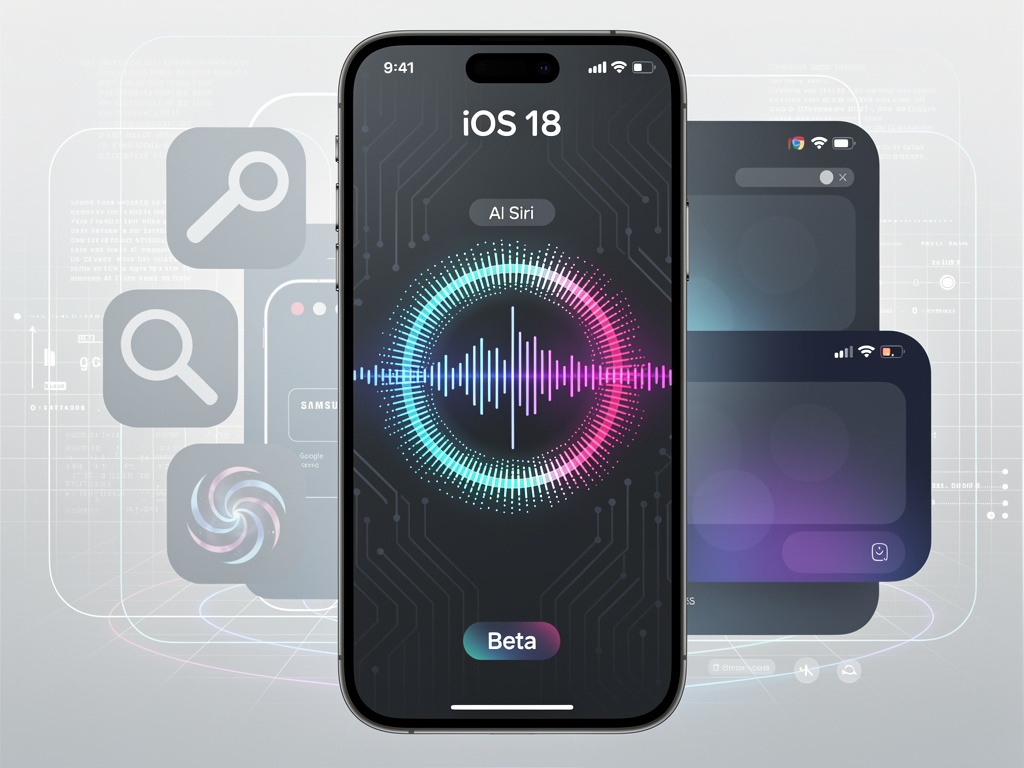
CUPERTINO, Calif. — For years, Apple’s Siri has been the digital assistant that time, and technology, seemed to forget. Once a revolutionary feature, it has since been lapped by more nimble and intelligent rivals from Google and Amazon, often becoming a punchline for its rigid, limited capabilities. Now, with the generative artificial intelligence arms race reshaping the tech industry, Apple is preparing its most significant countermove yet: a ground-up reinvention of Siri, set to be the centerpiece of its forthcoming iOS 18 software update.
The pressure on Apple is immense. Competitors, notably Samsung with its Galaxy AI features and Google with its deeply integrated Gemini model, have already fired their opening salvos, transforming smartphones into more proactive and capable companions. For Apple, which has built its empire on intuitive user experiences and cutting-edge innovation, falling behind in the AI era is not an option. The company is betting that a smarter, more deeply integrated Siri can not only close the gap but redefine user interaction with its devices, creating a powerful new moat around its lucrative ecosystem.
However, the path to this revitalized assistant is proving to be a cautious and deliberate one. The overhauled Siri is not expected to appear in the initial developer beta of iOS 18, which will follow the company’s Worldwide Developers Conference (WWDC) in June. Instead, according to a report from AppleInsider, the generative AI features will debut in a later beta release over the summer. This staggered rollout signals both the complexity of the technology and Apple’s desire to avoid the public missteps that have plagued its competitors, indicating a high-wire act of managing expectations while racing to deliver a polished, powerful final product this fall.
A Glimpse Under the Hood: The Technology Powering Siri’s Rebirth
At the heart of Siri’s transformation is a suite of AI technologies developed under an internal initiative codenamed “Project Greymatter.” This project is powered by Apple’s own large language models (LLMs), internally referred to as “Ajax,” which have been in development for years. Unlike the sprawling, cloud-based models that power services like ChatGPT, Apple’s primary strategy hinges on running its AI directly on the device. This on-device approach is a classic Apple play, prioritizing user privacy and security by processing personal data locally, rather than sending it to the cloud. It also promises significant speed advantages for many tasks, as it eliminates the latency of server communication.
This on-device focus is not just a philosophical choice but a technical one, designed to make AI a seamless and instantaneous part of the user experience. According to a Bloomberg report, the new capabilities will include features like auto-summarization of notifications and news articles, transcription of voice memos, and improved auto-replies in Mail and Messages. These features are designed to be part of what Apple calls “proactive intelligence,” making the iPhone a more helpful assistant without explicit user commands. Furthermore, Apple’s own research into models like ReALM (Reference Resolution As Language Modeling) shows significant progress in contextual understanding, with a VentureBeat analysis noting its ability to outperform models like GPT-4 in understanding on-screen and conversational context, a critical component for a truly hands-free assistant.
However, Apple acknowledges the limitations of on-device processing for more complex, world-knowledge queries. For these, the company is expected to adopt a hybrid model. While simpler tasks are handled on-chip, more demanding requests will be offloaded to the cloud. To bolster its cloud capabilities, Apple is reportedly in talks to partner with companies like Google to license its Gemini model or with OpenAI for its GPT technology. This pragmatic approach would allow Apple to leverage best-in-class cloud AI for specific functions while maintaining its core commitment to on-device privacy for personal data and everyday tasks.
The Strategic Imperative: Redefining the iPhone Experience
The stakes for the Siri overhaul extend far beyond simply catching up to the competition. For Apple, this is about fundamentally evolving the iPhone’s user interface. The new Siri is being engineered to take precise control of individual app functions using voice commands. This would allow users to execute complex, multi-step tasks that are currently impossible, such as asking Siri to “crop this photo and send it to Sarah” or “summarize the last five emails from my boss and create a to-do list.” This level of deep integration, if executed well, could represent the most significant change to iOS interaction since the introduction of the App Store.
This strategic shift is also a direct response to a changing market. With smartphone hardware innovation reaching a plateau, AI-driven software features have become the new battleground for differentiation. Samsung made this clear with the launch of its Galaxy S24 series, which heavily marketed a suite of “Galaxy AI” features, including live translation and generative photo editing, as detailed by CNET. By embedding powerful AI directly into the operating system, Apple aims to create a compelling reason for users to upgrade to new hardware, as many of the most advanced on-device AI features will likely require the neural processing power of its latest chips. Reports suggest that some of the top-tier AI functionalities in iOS 18 may be exclusive to the upcoming iPhone 16 models, creating a powerful new sales driver.
Ultimately, a supercharged Siri is critical for the long-term health of Apple’s ecosystem. A more capable assistant that seamlessly integrates with first- and third-party apps would deepen user lock-in, making the iPhone, iPad, and Mac even more indispensable. Success would not only re-establish Apple’s reputation as an innovator but also create a new platform for developers to build upon, potentially sparking a new wave of voice-first applications and services. Failure, however, would risk ceding the next generation of user interface to rivals and cementing the perception that Apple has lost its pioneering edge.
A High-Wire Act Ahead of a Global Debut
The decision to delay the new Siri’s inclusion in the initial iOS 18 beta underscores the immense challenge Apple faces. The company’s brand is built on delivering polished, intuitive products, and a buggy, unreliable, or “hallucinating” AI assistant released prematurely could do significant damage. Apple is keenly aware of the pitfalls experienced by its rivals and is proceeding with an abundance of caution, preferring to test the features extensively with developers before a wider public release. This period will be crucial for gathering feedback and refining the models to meet Apple’s high standards for performance and reliability.
There is also the question of hardware. The computational demands of running sophisticated LLMs on-device are substantial. As another Bloomberg report on Apple’s AI-focused chip strategy suggests, the full suite of AI features may require the advanced Neural Engine in the A18 chip, expected in the iPhone 16 Pro. This could create a tiered system where older devices receive a more limited set of AI enhancements, a strategy Apple has used in the past to push hardware upgrades while still providing some new software benefits to its massive existing user base.
As the tech world looks toward WWDC, the unveiling of iOS 18 will be one of the most closely watched events in Apple’s recent history. It represents more than just a software update; it is the public debut of Apple’s answer to the defining technological shift of this decade. The initial presentation will set the narrative, but the true test will come over the summer, as developers and early adopters finally get their hands on the reimagined Siri. The success of this ambitious project will likely determine whether Apple can redefine its core user experience and lead the charge in the era of personal, private, and truly intelligent computing.


 WebProNews is an iEntry Publication