
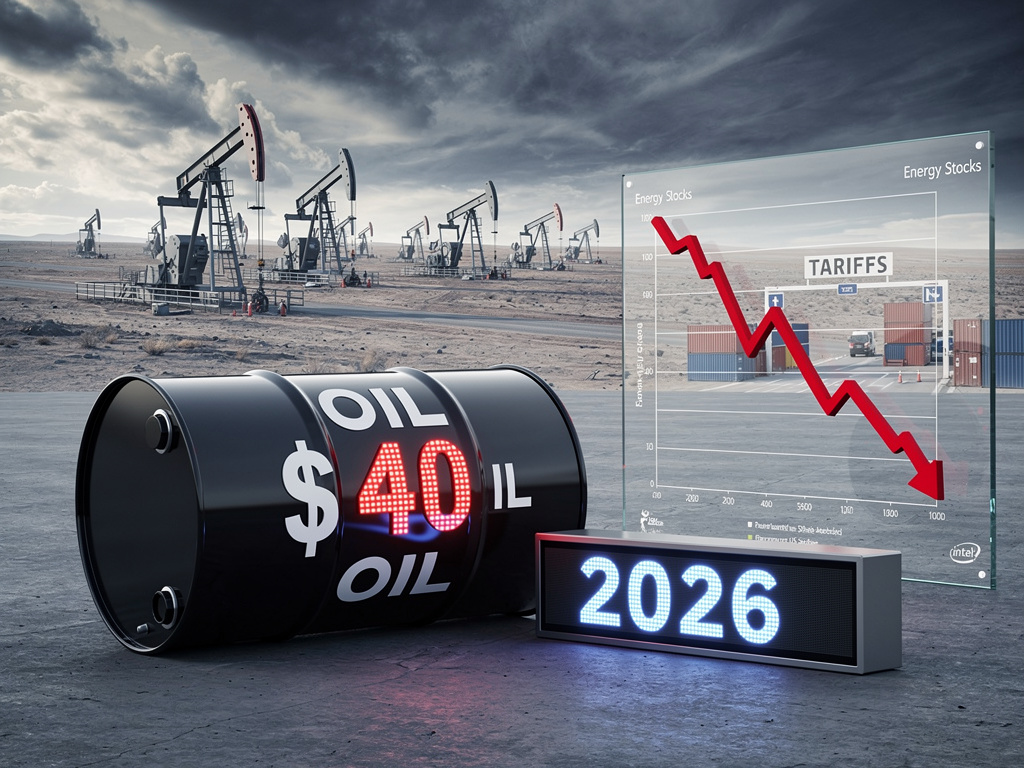
In the expansive machinery of global energy markets, a peculiar tension is building around the potential return of Donald Trump to the White House. While the former president has long campaigned on a platform of unbridled deregulation and aggressive fossil fuel expansion—epitomized by his signature "drill, baby, drill" rhetoric—market strategists are beginning to price in a counterintuitive outcome. Rather than a boon for the energy sector, a second Trump administration could precipitate a collapse in crude prices to levels not seen since the pandemic lockdowns, potentially dragging the commodity down to $40 a barrel by 2026.
This bearish forecast, highlighted in a recent analysis by Business Insider, suggests that the convergence of trade protectionism and supply-side saturation could create a perfect storm for the oil industry. The logic follows a stark economic trajectory: if the United States ramps up production into an already well-supplied market while simultaneously initiating trade disputes that dampen global demand, the floor under oil prices may disintegrate. For industry insiders, this presents a complex risk matrix where political support for drilling translates into financial headwinds for equities exposed to the price of crude.
A Collision of Supply and Tariffs
The core of this bearish thesis rests on the interaction between domestic energy policy and international trade strategy. Henning Gloystein, an analyst at Eurasia Group, notes that a renewed trade war—particularly one involving steep tariffs on Chinese imports—would likely decelerate global economic growth. Since China remains the world’s primary engine of oil demand growth, any tariff-induced slowdown in Beijing would ripple immediately through commodity markets. When reduced consumption meets the Trump administration’s stated goal of maximizing U.S. output, the surplus barrels would have nowhere to go but into storage, driving spot prices downward.
This creates a scenario where the geopolitical ambition to dominate energy markets cannibalizes the profitability of the very companies tasked with extraction. While consumers would undoubtedly welcome relief at the pump, the implications for the S&P 500’s energy sector are severe. Major integrated oil companies and independent shale producers have structured their balance sheets around crude prices hovering between $70 and $80. A slide toward $40 would force a rapid repricing of energy stocks, threatening dividends and buyback programs that have made the sector attractive to institutional capital in recent years.
The Shale Sector’s Profitability Wall
Wall Street’s relationship with U.S. shale producers has shifted fundamentally since Trump’s first term. During the 2016-2020 era, the industry was focused on growth at any cost, often burning cash to increase production volumes. Today, however, shareholders demand capital discipline, prioritizing free cash flow and returns over mere output statistics. A political mandate to flood the market conflicts directly with the financial mandates of the boardroom. If a Trump administration incentivizes production beyond what the market can absorb, it risks breaking the capital discipline that has restored the sector’s credibility with investors.
Furthermore, the breakeven price for many U.S. drilling operations has risen due to inflation in oilfield services and labor costs. While legacy wells might remain profitable at $50 or $60, new drilling activity becomes difficult to justify economically if prices plunge toward the $40 mark predicted by some analysts. This divergence creates a potential standoff between Washington’s desire for low consumer prices and the industry’s need for solvency. As reported by Reuters in their ongoing coverage of energy markets, U.S. producers are already wary of oversupply signals from OPEC+, making them reluctant foot soldiers in a government-led production surge.
Geopolitical Friction and the Iran Factor
Beyond domestic production, the geopolitical variables of a second Trump term introduce volatility that could swing prices in either direction. The former president’s approach to Iran—characterized by the "maximum pressure" campaign—could theoretically remove Iranian barrels from the market. Stricter enforcement of sanctions against Tehran would tighten global supply, acting as a counterbalance to rising U.S. output. However, the efficacy of such sanctions is debated. Much of Iran’s oil currently flows to China via the "dark fleet" of tankers, a trade route that has proven resilient against Western financial penalties.
If the administration fails to significantly curb Iranian exports while simultaneously escalating trade tensions with China, the market is left with the bearish side of the equation: steady supply and falling demand. Moreover, the broader Middle East dynamic remains fragile. As noted in recent analysis by Bloomberg, traders are increasingly sensitive to how U.S. foreign policy shifts might embolden or restrain regional actors. A chaotic foreign policy could spike the risk premium on oil, temporarily inflating prices even as structural fundamentals point downward.
The Green Energy Equity Shakeout
The ramifications of these policy shifts extend well beyond fossil fuels. A cornerstone of the Trump platform involves rolling back the Inflation Reduction Act (IRA), which has funneled billions into renewable energy projects. While the repeal of green subsidies might seem like a win for traditional energy, the correlation is not so linear. A collapse in oil and gas prices makes renewable alternatives relatively more expensive on an unsubsidized basis, potentially stalling the energy transition simply through market economics rather than legislation.
However, the stock market implications for the clean energy sector are stark. Companies heavily reliant on tax credits for wind, solar, and battery storage would face an immediate valuation shock. Investors are already rotating out of green energy stocks in anticipation of a regulatory freeze. Yet, some strategists argue that the renewable train has already left the station, driven by corporate net-zero commitments and state-level mandates that federal policy cannot easily override. The tension between federal retrenchment and private sector momentum will likely define the volatility of utilities and clean tech stocks through 2026.
Deflationary Oil Meets Inflationary Policy
Macroeconomists are observing a distinct contradiction in the proposed economic agenda. Tariffs are inherently inflationary, raising the cost of imported goods for American consumers. Conversely, a policy that successfully drives oil down to $40 is powerfully deflationary. Energy costs are a primary input for almost every sector of the economy; a crash in crude prices would lower transportation and manufacturing costs, potentially offsetting the inflationary bite of trade tariffs.
This tug-of-war places the Federal Reserve in a difficult position. If oil prices crash, headline inflation may drop, suggesting room for rate cuts. However, if tariff-driven core inflation remains sticky, the central bank may be forced to keep rates higher for longer, stifling growth. For the stock market, this uncertainty is toxic. Equity valuations thrive on predictability, and the prospect of a commodities crash occurring simultaneously with a trade war creates an environment where earnings forecasts become unreliable.
The Long-Term Supply Glut
Looking toward 2026, the structural reality of the oil market appears to be shifting toward surplus regardless of the U.S. election outcome. Non-OPEC production from Guyana, Brazil, and Canada continues to rise, adding to the global pool. If the U.S. accelerates this trend under a deregulation mandate, the world could face a glut reminiscent of the 1980s or 2014-2016. In those periods, prolonged low prices forced massive consolidation within the industry, wiping out smaller players and forcing majors to slash capital expenditures.
Investors holding energy positions must evaluate their exposure to this potential downturn. The high-dividend yields that have made energy stocks a haven during the recent inflationary period are predicated on healthy cash flows. A $40 oil environment would jeopardize those payouts, forcing a rotation into other sectors. As the political rhetoric heats up, the smart money is watching the futures curve, which is already beginning to flatten in anticipation of a world awash in crude.


 WebProNews is an iEntry Publication