
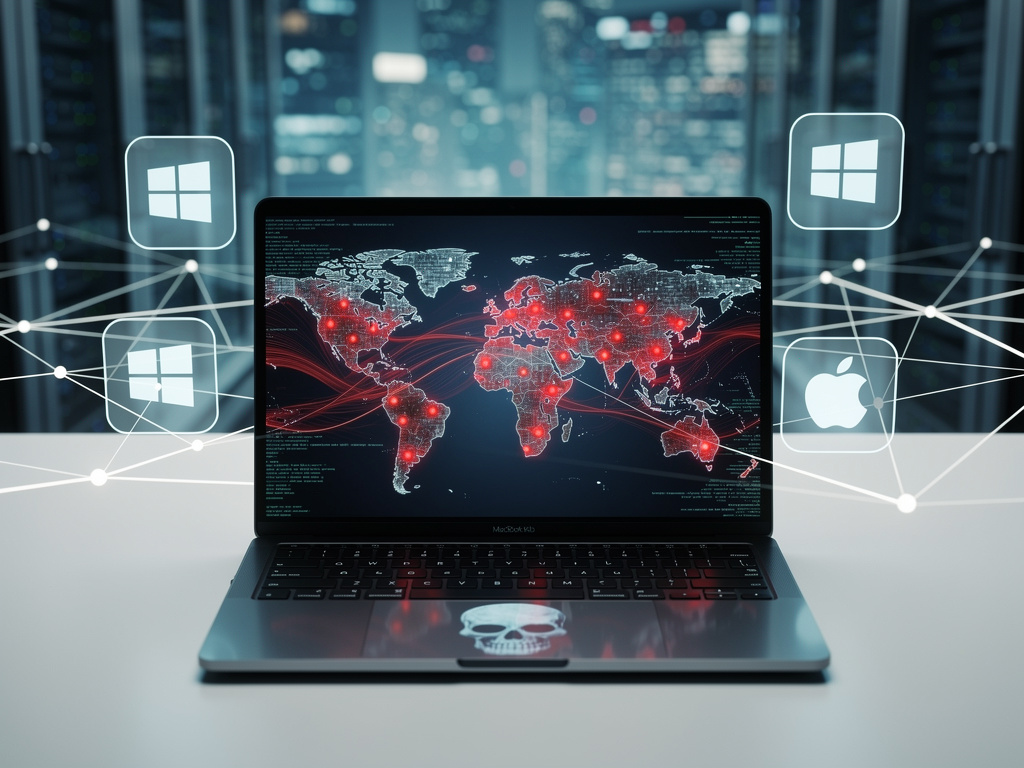
The cybersecurity world is witnessing a significant shift in threat actor behavior as infostealer malware, traditionally focused on Windows systems, has begun aggressively targeting macOS devices. Microsoft’s latest threat intelligence report reveals a concerning trend that challenges the long-held assumption that Apple users enjoy relative immunity from mainstream malware campaigns. This evolution represents not just a tactical adjustment by cybercriminals, but a fundamental transformation in how information-stealing operations are conducted across the digital ecosystem.
According to TechRadar, Microsoft’s Threat Intelligence team has documented a rapid expansion of infostealer campaigns beyond their traditional Windows focus, with macOS devices now firmly in the crosshairs of sophisticated threat actors. The shift comes as cybercriminals recognize the growing market share of Apple devices in enterprise environments and the valuable data these systems contain, from cryptocurrency wallets to corporate credentials.
The implications extend far beyond individual users. As organizations increasingly adopt hybrid device environments that include both Windows and macOS systems, the attack surface expands exponentially. Security teams that have historically concentrated their defenses on Windows-based threats now face the challenge of protecting a more diverse ecosystem, often with security tools and protocols that were never designed for cross-platform threat scenarios.
The Technical Mechanics Behind Cross-Platform Infostealer Operations
Modern infostealer malware has evolved from simple credential harvesting tools into sophisticated data exfiltration platforms capable of adapting to different operating systems. These malicious programs target browser-stored passwords, authentication cookies, cryptocurrency wallet files, and even system-level credentials that could enable further network penetration. The technical sophistication required to develop cross-platform variants demonstrates the professionalization of cybercrime operations and the substantial resources threat actors are willing to invest.
The architecture of contemporary infostealers typically involves modular components that can be customized for specific operating systems while maintaining a consistent command-and-control infrastructure. This allows threat actors to manage campaigns across multiple platforms from a single interface, streamlining operations and reducing the technical overhead traditionally associated with multi-OS attacks. The malware often employs anti-detection techniques specifically tailored to each operating system’s security features, from bypassing Windows Defender to evading macOS Gatekeeper protections.
The Economic Drivers Fueling Platform Diversification
The expansion into macOS territory is driven by clear economic incentives. Cybercriminal forums and dark web marketplaces have seen a surge in demand for macOS-specific malware and stolen credentials from Apple devices, with premium prices being paid for access to corporate MacBook data. This market dynamic reflects the reality that macOS users often include high-value targets such as executives, creative professionals, and technology workers who may have access to sensitive intellectual property or financial systems.
The cryptocurrency boom has particularly influenced this shift, as many digital asset traders and investors prefer macOS systems. Infostealer operators have recognized that targeting Mac users can yield substantial returns through the theft of cryptocurrency wallet credentials and private keys. The value proposition is compelling enough that malware-as-a-service providers have begun offering macOS-compatible variants of their products, lowering the barrier to entry for less technically sophisticated criminals.
Distribution Methods Exploiting User Behavior Patterns
Threat actors have adapted their distribution strategies to align with typical macOS user behavior. Rather than relying on the mass email campaigns common in Windows-focused attacks, macOS infostealers often spread through compromised software downloads, malicious browser extensions, and trojanized versions of popular applications. These distribution methods exploit the trust macOS users place in the platform’s curated software ecosystem and their sometimes diminished security vigilance compared to Windows users.
Social engineering tactics have become increasingly sophisticated, with attackers creating convincing replicas of legitimate software update notifications or disguising malware as productivity tools specifically marketed to Mac users. The use of stolen or fraudulent Apple Developer IDs to sign malicious applications adds an additional layer of credibility, allowing the malware to bypass initial security checks that would normally flag unsigned code. This technique demonstrates the lengths to which attackers will go to compromise systems previously considered relatively secure.
Enterprise Security Implications and Organizational Vulnerabilities
For enterprise security teams, the cross-platform evolution of infostealer malware presents unique challenges. Traditional security architectures often treat macOS endpoints as lower-risk assets, allocating fewer resources to their protection and monitoring. This assumption has created blind spots that sophisticated threat actors are now actively exploiting. Organizations that have embraced bring-your-own-device policies or offer employees a choice between Windows and macOS systems face particular risk, as their security posture must now account for threats that can move laterally across different operating systems.
The integration of macOS devices into enterprise environments has often outpaced the development of comprehensive cross-platform security strategies. Many organizations lack unified endpoint detection and response capabilities that provide consistent visibility and protection across their entire device fleet. This fragmentation allows infostealers to establish persistence on macOS systems while remaining undetected by security tools primarily calibrated for Windows threats. The stolen credentials can then be used to access cloud services, virtual private networks, and other resources regardless of the original compromise platform.
Detection Challenges and the Arms Race in Endpoint Security
Detecting infostealer infections on macOS systems requires different approaches than those employed for Windows environments. The file system structure, application sandboxing mechanisms, and system integrity protection features of macOS demand specialized detection logic and behavioral analysis capabilities. Security vendors have been racing to update their products with macOS-specific threat intelligence, but the rapid evolution of malware variants means that signature-based detection alone is insufficient.
Behavioral detection methods that identify suspicious processes attempting to access browser credential stores or keychain data have shown promise, but they also generate false positives that can overwhelm security teams. The challenge is compounded by the legitimate use of automation tools and scripts in macOS environments, which can exhibit behaviors similar to malicious activity. Advanced persistent threat groups have demonstrated the ability to modify their tactics specifically to evade behavioral detection systems, creating a continuous cycle of adaptation and counter-adaptation.
The Role of User Education in Cross-Platform Defense
Technical controls alone cannot fully address the infostealer threat, particularly as social engineering remains a primary infection vector. Organizations must invest in user education programs that specifically address the evolving threat environment for macOS users. This includes dispelling the myth that Macs are immune to malware and training users to recognize the signs of compromise, such as unexpected requests for keychain access or suspicious network activity.
The education challenge is particularly acute for users who have recently transitioned from Windows to macOS, as they may carry over security assumptions that no longer apply. These users might be less familiar with macOS-specific security indicators and more susceptible to attacks that exploit their incomplete understanding of the platform. Effective training programs must address platform-specific vulnerabilities while maintaining consistent security principles across the organization’s entire technology ecosystem.
Regulatory and Compliance Considerations
The expansion of infostealer threats to macOS has implications for regulatory compliance, particularly in industries subject to strict data protection requirements. Organizations that have based their compliance strategies on Windows-centric security frameworks may find themselves inadequately prepared to demonstrate due diligence in protecting sensitive data on macOS systems. Regulatory bodies are beginning to recognize that platform-agnostic security approaches are necessary, and future compliance audits are likely to scrutinize cross-platform security measures more closely.
Data breach notification requirements take on new complexity when stolen credentials from macOS systems are used to access protected information. Organizations must be able to trace the chain of compromise across different platforms and demonstrate that appropriate security measures were in place regardless of the endpoint operating system. This necessitates comprehensive logging and monitoring capabilities that extend uniformly across all devices, a requirement that many organizations are still working to implement fully.
Future Trajectories and Emerging Threat Vectors
The trajectory of infostealer evolution suggests that the current focus on macOS is merely one step in a broader expansion toward truly platform-agnostic malware operations. Security researchers anticipate that mobile operating systems, particularly iOS and Android, will become increasingly targeted as infostealers seek to compromise the full spectrum of devices that users employ to access sensitive information. The convergence of personal and professional device usage amplifies this risk, as credentials stolen from a personal device can often be used to access corporate resources.
Artificial intelligence and machine learning are likely to play dual roles in this evolution, both as tools for attackers to develop more adaptive malware and as defensive mechanisms to detect anomalous behavior across diverse platforms. The integration of AI-powered code generation tools has already lowered the barrier to creating cross-platform malware variants, allowing less skilled attackers to produce sophisticated threats. Simultaneously, defenders are leveraging similar technologies to identify patterns of malicious activity that transcend individual operating systems. The outcome of this technological arms race will significantly influence the cybersecurity posture of organizations in the coming years, making cross-platform threat awareness not just advisable but essential for survival in an increasingly hostile digital environment.


 WebProNews is an iEntry Publication