
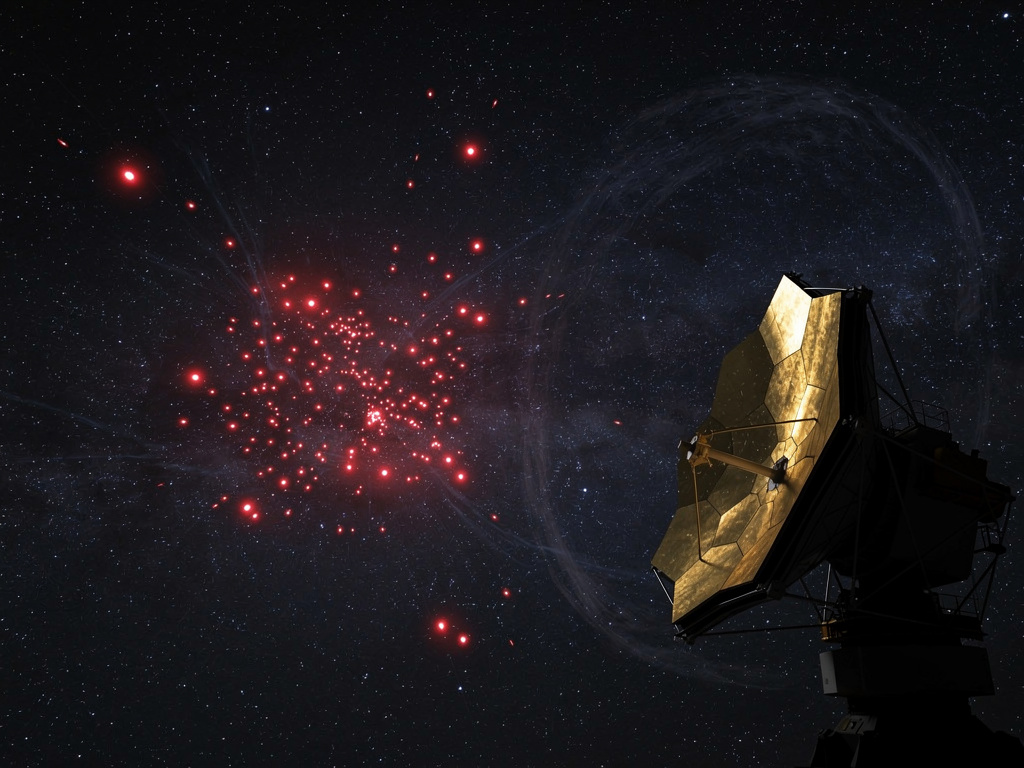
Astronomers analyzing data from the James Webb Space Telescope have encountered a phenomenon that defies conventional understanding of the early cosmos. Scattered across the telescope’s deep-field images are peculiar red dots—compact, intensely luminous objects that appear to have existed mere hundreds of millions of years after the Big Bang. These enigmatic structures are forcing astrophysicists to reconsider fundamental assumptions about how quickly massive galaxies and supermassive black holes could form in the universe’s infancy.
According to Futurism, these crimson anomalies represent some of the most perplexing discoveries in modern astronomy. The objects emit light that has been stretched into the red portion of the spectrum due to cosmic expansion, indicating their extreme distance and ancient origins. What troubles researchers is not merely their existence, but their apparent maturity and mass—characteristics that shouldn’t be possible given the limited time available for their formation in the early universe.
The James Webb Space Telescope, which launched in December 2021 and began science operations in mid-2022, was specifically designed to peer deeper into cosmic history than any previous observatory. Its infrared capabilities allow it to detect light from the universe’s first galaxies, which has been redshifted beyond the visible spectrum. Yet even mission planners didn’t anticipate finding such massive, evolved structures so early in cosmic time.
Challenging the Standard Model of Galaxy Formation
The prevailing cosmological model suggests that galaxy formation was a gradual process, beginning with small fluctuations in the density of matter shortly after the Big Bang. These fluctuations grew over millions of years, eventually collapsing under gravity to form the first stars and proto-galaxies. Supermassive black holes, the engines that power the brightest objects in the universe, were thought to require even longer timescales to accumulate sufficient mass.
The red dots challenge this timeline dramatically. Some of these objects appear to harbor black holes with masses equivalent to millions of suns, yet they exist when the universe was less than 5% of its current age. This presents what astronomers call a “timing problem”—there simply hasn’t been enough time for conventional formation mechanisms to produce such massive objects. Dr. Jeyhan Kartaltepe, an astronomer at the Rochester Institute of Technology who has studied early galaxies, noted in research published through NASA that these discoveries are “pushing the boundaries of our models.”
The implications extend beyond mere curiosity. If the standard model of hierarchical galaxy formation cannot account for these observations, astrophysicists may need to revise fundamental aspects of our understanding. Possible explanations include more efficient early star formation, different initial conditions in the early universe, or entirely novel formation pathways for supermassive black holes that bypass the need for stellar progenitors.
The Nature of the Red Dots: Galaxies, Black Holes, or Both?
Determining the precise nature of these red dots has proven challenging. Their compact size and intense luminosity suggest they might be active galactic nuclei—regions where supermassive black holes are actively consuming matter and emitting tremendous amounts of energy. However, their spectral characteristics also show evidence of stellar populations, indicating they’re not purely black hole-powered phenomena.
Spectroscopic analysis, which breaks down the light from these objects into its component wavelengths, reveals a complex picture. Some red dots show emission lines characteristic of gas heated by black hole accretion, while others display features consistent with young, massive stars. Many show signatures of both processes occurring simultaneously. This dual nature complicates efforts to model their formation and evolution, as it requires understanding two of the most energetic processes in the universe operating in tandem during the cosmos’s earliest epochs.
The density of these objects also raises questions. They appear to be more common in the early universe than current models predict. If each red dot represents a massive galaxy or black hole system, their abundance suggests that the efficiency of converting primordial gas into stars and black holes was significantly higher than previously thought. Alternatively, these objects might represent a transient phase in galaxy evolution that is rarely observed in the modern universe, making them appear more common than they actually were.
Technical Challenges in Observation and Analysis
Studying objects at such extreme distances pushes the James Webb Space Telescope to its operational limits. The light from these red dots has traveled for over 13 billion years, during which time the expansion of the universe has stretched their wavelengths significantly. What was once ultraviolet or visible light is now detected in the infrared, requiring sophisticated instruments and analysis techniques to interpret correctly.
The telescope’s Near Infrared Camera (NIRCam) and Near Infrared Spectrograph (NIRSpec) have been instrumental in these discoveries. NIRCam captures the initial images that reveal the red dots’ positions and basic properties, while NIRSpec provides the detailed spectroscopic data needed to determine their distances, compositions, and physical conditions. However, even with these advanced instruments, measuring accurate properties for such faint, distant objects requires extensive observation time and careful data reduction.
Contamination and confusion also complicate the analysis. The sky is crowded with foreground galaxies, and distinguishing truly ancient objects from more recent interlopers requires precise redshift measurements. Additionally, gravitational lensing by intervening matter can magnify and distort the appearance of distant objects, making it difficult to determine their intrinsic properties. Researchers must carefully model these effects to extract reliable information about the red dots themselves.
Theoretical Frameworks Under Revision
The discovery of these massive early structures has sparked intense theoretical activity. Astrophysicists are exploring various scenarios that might explain their existence without completely overturning established cosmology. One possibility involves “direct collapse” black holes, which form when massive clouds of primordial gas collapse directly into black holes without first forming stars. This mechanism could produce black hole seeds massive enough to grow to the observed sizes within the available time.
Another avenue of investigation focuses on the efficiency of early star formation. If the first generation of stars—composed almost entirely of hydrogen and helium—formed more rapidly and efficiently than later generations, they could have quickly built up substantial stellar masses. These stars, in turn, could have fed the growth of central black holes through rapid accretion. Some models also suggest that dark matter, the invisible substance that dominates the universe’s mass, might have played a more active role in early structure formation than previously recognized.
The cosmological parameters themselves are also under scrutiny. The rate of cosmic expansion, the density of matter and dark energy, and the amplitude of initial density fluctuations all influence how quickly structures can form. While the red dots don’t necessarily require changes to these fundamental parameters, they do constrain the range of acceptable values and may point toward subtle refinements in our cosmological model.
Implications for Future Observations
The James Webb Space Telescope’s mission is far from complete, and astronomers are planning extensive follow-up observations of the most intriguing red dots. Deeper spectroscopic studies will help determine their chemical compositions, providing clues about the nature of the stars within them and the history of star formation in the early universe. Multi-wavelength observations, combining Webb’s infrared data with observations from other telescopes, will paint a more complete picture of these mysterious objects.
Future space missions are also being designed with these discoveries in mind. Proposed observatories with even greater sensitivity and resolution could detect fainter, more distant objects, potentially revealing an entire population of early galaxies that current instruments can barely glimpse. Ground-based telescopes equipped with adaptive optics and next-generation instruments will complement space observations, providing different perspectives on these cosmic puzzles.
The red dots also highlight the importance of archival data. As analysis techniques improve and theoretical understanding deepens, researchers can return to existing Webb observations to extract new insights. The telescope’s data archive is becoming an increasingly valuable resource for the astronomical community, enabling discoveries that weren’t possible when the data was first collected.
Broader Context in Observational Cosmology
The red dot phenomenon exemplifies a recurring pattern in astronomy: new instruments reveal unexpected features of the universe, prompting revisions to existing theories. The Hubble Space Telescope, Webb’s predecessor, similarly challenged expectations with its deep-field observations, revealing galaxies at greater distances and earlier times than anticipated. Webb is now extending this frontier even further, probing epochs that were previously inaccessible to direct observation.
These discoveries also underscore the interconnected nature of astrophysical processes. Understanding the red dots requires synthesizing knowledge from multiple subfields: stellar evolution, black hole physics, galaxy dynamics, and cosmology itself. No single discipline can provide a complete explanation, necessitating collaboration across specialties and institutions. The complexity of these objects reflects the complexity of the early universe, where multiple physical processes operated simultaneously under extreme conditions.
As observational capabilities continue to advance, the boundary between the known and unknown shifts, but never disappears. Each answer generates new questions, and each discovery reveals new mysteries. The red dots are the latest in a long series of cosmic enigmas that drive the field forward, motivating both technological innovation and theoretical creativity. They remind us that despite centuries of astronomical progress, the universe still holds surprises that challenge our deepest understanding of its nature and history.


 WebProNews is an iEntry Publication