
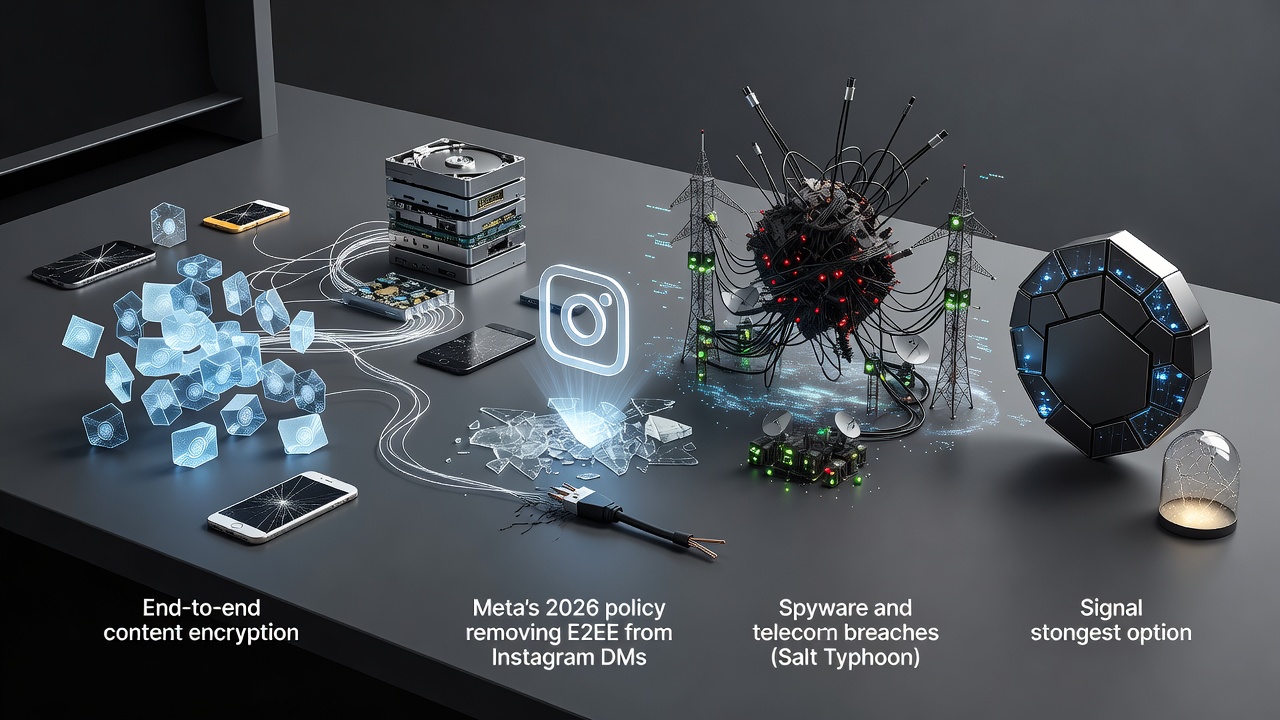
End-to-end encryption once stood as the gold standard for private digital talk. Billions of messages fly daily through apps like Signal, WhatsApp and iMessage, scrambled so only sender and receiver hold the keys. Yet that promise carries limits. Attackers still extract patterns. Companies dial back features. Devices betray everything.
A Lifehacker report published today lays out the gaps plainly. Encryption scrambles content. It leaves metadata exposed. Who messaged whom. When. From where. Those details paint pictures no cipher can hide. Backups stored in the cloud create another opening. Upload a chat history to iCloud or Google Drive without proper safeguards and the protection vanishes in transit.
Implementation differs sharply across platforms. WhatsApp turns on basic encryption by default but skips it for backups. Telegram encrypts most traffic yet keeps keys on its servers outside of opt-in Secret Chats. Group conversations there and in many other services often skip true end-to-end safeguards entirely. iMessage secures conversations between Apple devices. Enable iCloud backups without Advanced Data Protection and Apple holds the keys that unlock them. Signal comes closest to the ideal. It encrypts metadata aggressively and returns almost nothing when handed a subpoena. Still, both parties must run the app.
Corporate pullbacks add fresh doubt to long-term reliability.
Meta spent years touting default encryption across its services. In 2023 the company declared success for Messenger. Instagram Direct Messages received only an opt-in version tucked behind menus. Then came the reversal. Starting May 8, 2026, Instagram drops support for those encrypted chats. Users must download media and history before the cutoff. The company cited low adoption. Switch to WhatsApp, it advised.
Johns Hopkins cryptographer Matthew Green called the move dishonest. In a WIRED article from March 2026, Green noted Meta had publicly committed to default encryption for Instagram. “Public commitments to support privacy features are literally the only thing that we the public have,” he said. “If they’re worthless, then why should we assume we’ll continue to have end-to-end encryption in Messenger and WhatsApp?”
Davi Ottenheimer, a security executive, labeled the decision cynical. Meta designed the feature so few could find it, then killed it for low uptake. Internal documents reveal deeper tensions. In 2019, Meta’s head of content policy Monika Bickert wrote that default encryption plans were “so irresponsible,” according to Reuters reporting cited in the WIRED piece. The reversal arrives as governments in the UK, France and elsewhere push harder against encryption in the name of child safety and law enforcement access.
But device-level attacks expose the weakest link. Spyware like Pegasus can infect a phone and read messages before encryption or after decryption. Zero-click exploits require no user action. A single compromised endpoint renders the entire conversation visible. Physical access, keyloggers, or malware on a laptop synced to a phone creates the same breach. Encryption protects data in motion. It cannot secure the machines at either end.
Recent events underscore the risks of non-encrypted channels. The Salt Typhoon campaign, attributed to China, breached U.S. telecom systems and accessed customer data plus legal wiretap infrastructure. It spread to targets in more than 80 countries. Ordinary SMS and calls became readable. Even with E2EE apps, metadata from those systems can reveal who communicates with whom.
A New York Times Wirecutter guide updated in May 2026 drives the point home. Daniel Kahn Gillmor of the ACLU compared unprotected texts to postcards. “Everybody along the path can see them.” Thorin Klosowski from the Electronic Frontier Foundation added that everyone deserves private conversation with friends and family. Filippo Valsorda, a cryptography engineer, called E2EE table stakes for modern apps.
So what works better? Signal remains the top recommendation for most users. It minimizes collected data. It offers disappearing messages. Encrypted backups require a separate passphrase. WhatsApp provides solid default encryption and reaches far more people, though owned by Meta. Both beat plain SMS or RCS without full safeguards. Users should verify safety numbers or QR codes in sensitive chats. They should enable encrypted backups where available and keep devices updated.
And yet adoption of the strictest tools stays limited. Most people stick with default messaging. They accept green bubbles, blue bubbles, or the convenience of iMessage and RCS. Cross-platform RCS between iOS and Android gained encryption in recent years, but falls back to unencrypted SMS when unavailable. The average user rarely notices.
Metadata analysis poses a subtler threat. Even Signal cannot hide all timing and connection data. Sophisticated observers piece together social graphs, infer meetings, predict behavior. Law enforcement and intelligence agencies have sought ways to obtain such information without breaking encryption directly. Corporate retreats like Meta’s Instagram decision risk normalizing weaker standards. If one major player walks back a privacy promise, others may follow.
Proposals to add backdoors or client-side scanning for harmful content continue to surface. Cryptographers warn these create new attack surfaces. A flaw in one implementation could compromise millions. History shows that once weakened, encryption stays weakened. The Salt Typhoon breach demonstrated how telecom compromises expose vast troves of non-encrypted data. Similar logic applies to messaging.
Enterprise users face parallel concerns. Consumer apps lack audit logs, federation and metadata controls required in regulated industries. Some turn to specialized platforms that encrypt metadata more thoroughly. Yet the core tension persists. Strong privacy complicates content moderation, safety reporting and legal compliance. Weak privacy invites breaches and surveillance.
The Lifehacker piece ends on a practical note. E2EE protects message content effectively in many cases. It falls short against device compromise, metadata leakage and inconsistent rollout. Choose apps carefully. Verify connections. Protect backups. Treat encryption as one layer, not a complete shield.
Recent X discussions echo these warnings. Users highlight that many services store master keys for account recovery, creating single points of failure. Others point to decentralized approaches that avoid centralized servers altogether. The conversation continues as Meta’s May decision takes full effect and governments weigh new legislation.
Encryption delivers real value. Billions rely on it daily without incident. But insiders know the full picture includes these persistent cracks. Device security matters as much as protocol strength. Corporate incentives shift. Metadata tells stories. The next wave of secure messaging must address all three if the promise is to hold.


 WebProNews is an iEntry Publication