
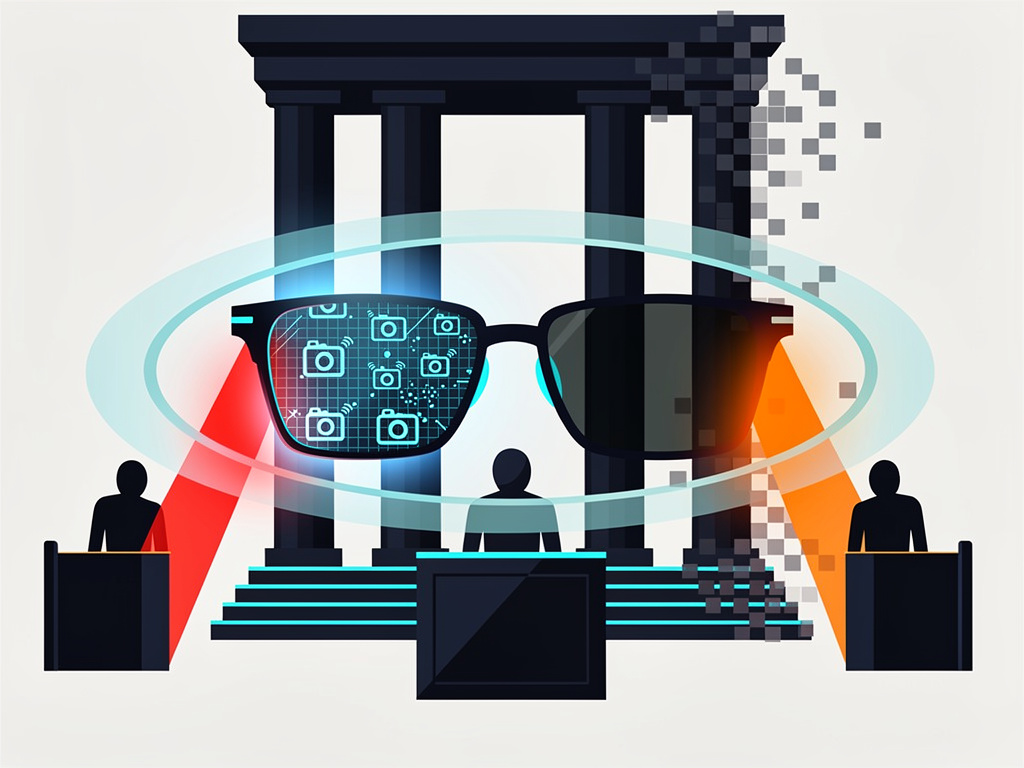
A man walks into a Philadelphia courtroom wearing a pair of Meta Ray-Ban smart glasses. He sits quietly in the gallery. No one notices anything unusual — the glasses look like any ordinary pair of Ray-Bans. But they’re recording everything. The judge. The jury. The witnesses. The defendants. And an AI assistant, accessible with a tap of the temple, can identify faces, transcribe proceedings, and analyze expressions in real time.
This isn’t a hypothetical. It’s already happening.
According to a detailed investigation by The Philadelphia Inquirer, AI-equipped smart glasses have entered courtrooms across Philadelphia, raising urgent questions about surveillance, privacy, and the integrity of judicial proceedings. The report documents instances in which individuals wore Meta’s Ray-Ban smart glasses — equipped with cameras, microphones, and integrated Meta AI — into active courtrooms without any objection or, in many cases, any awareness from court officials.
The implications are staggering. Courtrooms are among the most carefully controlled public spaces in American civic life. Judges have broad authority to restrict recording devices, photography, and electronic equipment. Federal courts ban cameras almost entirely. Many state courts impose strict limitations. Yet smart glasses, designed to be indistinguishable from regular eyewear, slip through these restrictions as if they don’t exist.
Because, functionally, they don’t.
Philadelphia’s court system, like most jurisdictions, relies on policies written for an era of visible, identifiable recording devices — smartphones held aloft, bulky video cameras, microphones with press logos. The Inquirer’s reporting reveals that no courthouse in the city has implemented screening protocols capable of detecting smart glasses. Metal detectors catch guns and knives. They don’t catch a pair of Ray-Bans with a 12-megapixel camera embedded in the right temple.
Meta launched its Ray-Ban smart glasses partnership in 2023, and the product has gained significant traction. The glasses can livestream to Facebook and Instagram, capture photos and video, play music, take calls, and — with the latest AI integration — answer questions about what the wearer is seeing. Point the glasses at a restaurant menu, and Meta AI can suggest dishes. Point them at a person, and the technology can, under certain conditions, surface information about that individual from publicly available sources.
Now point them at a witness testifying in a criminal trial.
The Philadelphia Inquirer’s investigation found that court administrators were largely unaware of the technology’s capabilities. Several judges interviewed expressed alarm when shown what the glasses could do. One senior judge, who declined to be named, told the Inquirer that existing court rules were “completely inadequate” to address the threat. Another called the situation “a ticking time bomb for witness intimidation.”
That phrase — witness intimidation — sits at the center of the most serious concerns. In criminal cases, particularly those involving gang violence, drug trafficking, and organized crime, witnesses already face enormous pressure not to testify. The ability to covertly record a witness’s face, voice, and testimony, then distribute that recording instantly via social media, represents a direct threat to the administration of justice. Prosecutors in Philadelphia told the Inquirer that they’ve long worried about smartphones being used for this purpose, but smart glasses make the problem orders of magnitude worse. A phone held up to record is visible. It can be confiscated. Smart glasses are invisible in plain sight.
And it’s not just witnesses at risk. Jurors, whose identities are protected by law in many proceedings, could be identified and targeted. Confidential informants attending hearings could be exposed. Undercover officers could be compromised. Victims of domestic violence, sexual assault, and stalking — people who come to court seeking protection — could find their faces and locations broadcast to their abusers’ networks without their knowledge.
The legal framework governing this technology is thin. The Fourth Amendment restricts government surveillance, not private recording. Most states, including Pennsylvania, have wiretapping statutes that require the consent of all parties to record a private conversation — Pennsylvania is a two-party consent state. But courtroom proceedings are generally considered public, which complicates the application of wiretapping laws. A person recording open court proceedings may not be violating wiretapping statutes at all, even if they’re violating court rules.
Court rules, however, carry their own enforcement power. Judges can hold individuals in contempt for violating courtroom decorum orders, and most jurisdictions have standing orders prohibiting unauthorized recording. The problem is detection. You can’t enforce a rule against a device you can’t see.
This tension between public access and covert surveillance technology has drawn attention from legal scholars and civil liberties organizations. The American Civil Liberties Union has historically defended the right to record police and public officials, arguing that transparency serves democracy. But the ACLU has also raised concerns about facial recognition technology and mass surveillance tools that disproportionately affect communities of color. Smart glasses sit uncomfortably at the intersection of these positions.
Meta, for its part, has taken a carefully calibrated public stance. The company’s acceptable use policies for Ray-Ban Meta glasses state that users should respect others’ privacy and comply with local laws. A small LED light on the glasses illuminates when the camera is active — a design choice Meta points to as a privacy safeguard. Critics call it laughable. The light is tiny, easily obscured, and virtually unnoticeable in a courtroom setting where attention is focused on the judge, the attorneys, and the witness stand. In a 2024 demonstration by Harvard students that went viral, researchers showed they could pair Meta Ray-Bans with facial recognition software to identify strangers in real time, pulling up their names, addresses, and phone numbers within seconds. Meta responded by saying the project violated its terms of service. But terms of service are not laws, and enforcement is essentially voluntary.
The broader technology industry is accelerating the problem. Meta isn’t alone. Google has re-entered the smart glasses market. Snap continues developing its Spectacles line. Startups like Brilliant Labs, with its Frame AI glasses, and Solos, with its AirGo Vision, are pushing the form factor further. Apple’s Vision Pro, while bulky today, signals the company’s long-term interest in face-worn computing. The trajectory is clear: within a few years, AI-equipped glasses will be commonplace, inexpensive, and even more discreet than they are now.
Courts are not ready.
Some jurisdictions have begun to act, but the response has been fragmented and slow. The Inquirer reported that Philadelphia’s First Judicial District had not, as of the article’s publication, issued any updated guidance addressing smart glasses or AI-enabled wearable devices. A spokesperson for the courts told the paper that the matter was “under review.” In New York, a handful of judges have begun including smart glasses in their standing orders prohibiting electronic devices, but enforcement remains an open question. No major federal court has issued a comprehensive policy.
The Judicial Conference of the United States, which sets policy for the federal court system, has maintained its longstanding ban on cameras in federal courtrooms — a policy that dates to the 1946 trial of Bruno Hauptmann and has been reaffirmed repeatedly. But that ban was conceived for visible cameras. The Conference has not addressed wearable devices with embedded recording capabilities. Legal observers expect the issue to reach the Conference’s agenda within the next year, but federal judicial policymaking moves deliberately, and any new rules could take years to implement.
State courts, which handle the vast majority of criminal and civil cases in the United States, are even more varied in their approaches. Some states give individual judges broad discretion over courtroom technology. Others have statewide rules that haven’t been updated in decades. The result is a patchwork of policies that provides no coherent answer to a technology that doesn’t respect jurisdictional boundaries.
Meanwhile, the technology keeps advancing. Meta’s most recent AI updates allow the glasses to provide real-time contextual information about objects, text, and environments in the wearer’s field of vision. The company has described this as a “hands-free AI assistant.” In a courtroom, that assistant could theoretically analyze a witness’s body language, flag inconsistencies in testimony compared to prior statements available online, or identify individuals entering and leaving the courtroom by cross-referencing social media profiles. None of this requires any special technical skill from the wearer. Just put on the glasses and ask.
Defense attorneys have taken notice — and not entirely with alarm. Some criminal defense lawyers see potential advantages in wearable AI technology. If a defendant’s family member can record proceedings that the defense believes are being conducted unfairly, that recording could become evidence of judicial misconduct or prosecutorial overreach. In jurisdictions where public defenders are overwhelmed and under-resourced, AI-assisted transcription and analysis could theoretically help level the playing field. These arguments carry weight in a system where the balance of resources between prosecution and defense is already deeply unequal.
But prosecutors and judges counter that the risks overwhelmingly outweigh any such benefits. The integrity of the trial process depends on the court’s ability to control the courtroom environment. Witnesses must feel safe enough to testify truthfully. Jurors must be free from outside influence and intimidation. The moment those guarantees erode, the system breaks down. And in cities like Philadelphia, where witness intimidation is already a persistent and sometimes lethal problem, the stakes are not abstract.
Between 2019 and 2023, Philadelphia saw dozens of cases in which witnesses were threatened, assaulted, or killed in connection with their cooperation with law enforcement, according to data compiled by the Philadelphia District Attorney’s Office and reported by multiple local outlets. The introduction of a covert, AI-powered recording device into this environment is not a theoretical concern. It’s a practical one, with potentially fatal consequences.
So where does this leave the courts? The honest answer is: scrambling. Legal institutions are structurally slow to adapt to technological change. The adversarial system, with its emphasis on precedent and incremental evolution, is poorly suited to addressing a technology that doubles in capability every eighteen months. By the time a court issues a ruling on today’s smart glasses, tomorrow’s version will have rendered the ruling incomplete.
Some legal scholars have proposed technology-neutral rules — prohibitions on any device capable of recording, regardless of form factor, with enforcement through random screening and penalties severe enough to deter violations. Others have suggested requiring manufacturers to build in geofencing capabilities that would disable recording functions in designated locations like courtrooms, a proposal that Meta and other companies have so far resisted. Still others argue that the answer lies not in banning the technology but in embracing transparency — allowing cameras in all courtrooms, as many advocates have long urged, so that covert recording loses its unique power.
Each approach has serious drawbacks. Technology-neutral bans are difficult to enforce without invasive screening procedures that could themselves raise constitutional concerns. Geofencing depends on voluntary cooperation from technology companies and could be circumvented by determined bad actors. And full courtroom transparency, while appealing in principle, doesn’t address the specific dangers of witness identification and juror exposure in sensitive cases.
The Philadelphia Inquirer’s reporting has brought these questions into sharp focus, but the problem extends far beyond one city. Every courthouse in the country faces the same vulnerability. Every jurisdiction that hasn’t updated its rules for the age of wearable AI is operating on borrowed time.
And time, in this case, is not on the side of the courts. Meta has sold millions of Ray-Ban smart glasses. The next generation, expected later this year, will reportedly feature even more advanced AI capabilities, improved camera resolution, and longer battery life. Competitors are racing to match or exceed Meta’s offerings. The consumer market for smart glasses is projected to reach $15 billion by 2028, according to industry analysts at IDC and Counterpoint Research.
Every one of those devices is a potential courtroom surveillance tool. Not because their owners intend to undermine justice — most buyers want hands-free directions and the ability to take photos without pulling out a phone — but because the capability exists, and capability, once deployed at scale, inevitably finds its way into adversarial contexts. The history of technology adoption is unambiguous on this point. If a tool can be used for surveillance, it will be.
The question for the American judicial system is whether it will respond before the damage is done, or after. Philadelphia’s experience suggests the answer may already be too late for some. But the conversation, at least, has begun. What happens next will depend on whether judges, legislators, and technology companies can find common ground on a problem that none of them fully controls — and all of them helped create.


 WebProNews is an iEntry Publication