
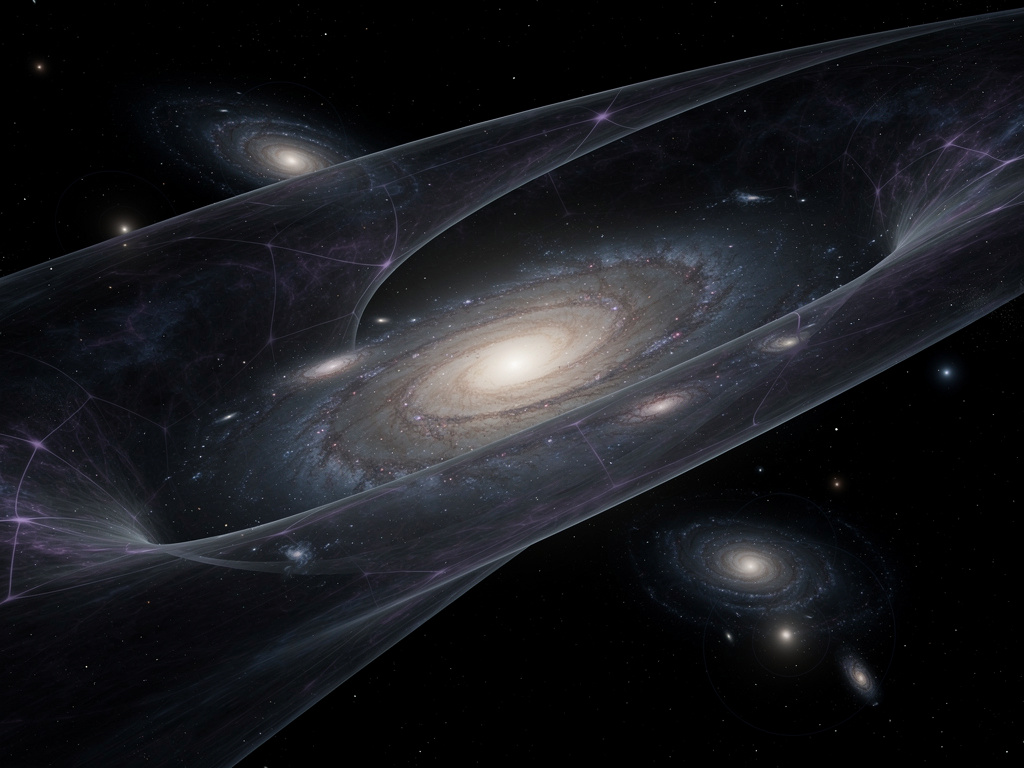
In a discovery that challenges conventional models of cosmic structure, astronomers have identified evidence suggesting that our galaxy—and potentially countless others—may be embedded within vast, sheet-like formations of dark matter. This finding, which emerged from sophisticated computational simulations and observational data, represents a paradigm shift in how scientists conceptualize the invisible scaffolding that holds the universe together.
The research, which has sent ripples through the astrophysics community, indicates that dark matter—the mysterious substance comprising approximately 85% of the universe’s total mass—may not distribute itself in the spherical halos previously assumed. Instead, according to Futurism, these cosmic structures appear to organize themselves into expansive, planar configurations that stretch across millions of light-years, fundamentally altering our understanding of how galaxies form, evolve, and interact with their cosmic environment.
This revelation carries profound implications for multiple fields of study, from cosmology to particle physics, and may ultimately influence how researchers approach the search for dark matter particles themselves. The sheet-like architecture suggests a level of cosmic organization that previous models failed to predict, raising questions about the fundamental forces and processes that govern structure formation in the universe.
Rethinking the Architecture of the Invisible Universe
Traditional models of dark matter distribution have long relied on the concept of spherical or ellipsoidal halos—diffuse clouds of invisible matter that surround galaxies and galaxy clusters. These models, developed over decades of theoretical work and observational astronomy, suggested that dark matter settled into relatively symmetric structures under the influence of gravity. The new findings challenge this assumption at its core, proposing instead that dark matter organizes along preferential axes, creating sheet-like or filamentary structures that fundamentally differ from earlier predictions.
The implications of this structural reorganization extend far beyond mere geometry. If galaxies truly reside within dark matter sheets rather than halos, the dynamics of galactic rotation, the patterns of satellite galaxy distribution, and even the merger histories of galactic systems may need to be reexamined through this new lens. The sheet configuration could explain certain observational anomalies that have puzzled astronomers for years, including unexpected patterns in the distribution of satellite galaxies around the Milky Way and other large spiral systems.
Computational Breakthroughs Reveal Hidden Patterns
The discovery emerged from advanced computational simulations that model the evolution of cosmic structure from the early universe to the present day. These simulations, which require massive computing resources and sophisticated algorithms, track billions of dark matter particles as they interact gravitationally over cosmic timescales. By running multiple scenarios with varying initial conditions and physical parameters, researchers can identify patterns that emerge consistently across different models—patterns that may reflect genuine features of our universe.
What makes these recent simulations particularly compelling is their unprecedented resolution and scope. Modern supercomputers can now model dark matter dynamics at scales ranging from individual galaxy clusters down to the structures surrounding dwarf galaxies, all within a single computational framework. This multi-scale approach has revealed that sheet-like structures appear not as isolated anomalies but as a fundamental organizational principle of dark matter throughout cosmic history, from the earliest epochs of structure formation to the present day.
Observational Evidence Supports Theoretical Predictions
While dark matter itself remains invisible to direct observation, its gravitational effects leave telltale signatures that astronomers can detect and measure. Gravitational lensing—the bending of light from distant objects by intervening mass—provides one of the most powerful tools for mapping dark matter distribution. Recent surveys utilizing this technique have identified elongated structures and preferential alignments in the dark matter distribution that align with the sheet-like architecture predicted by the new simulations.
Additionally, the velocities and positions of galaxies within large-scale structures provide indirect evidence for the underlying dark matter configuration. When galaxies move through space, their trajectories are governed primarily by the gravitational pull of dark matter rather than the visible matter we can see in stars and gas. By carefully mapping these galactic motions across vast cosmic volumes, researchers have identified patterns consistent with galaxies moving within sheet-like structures rather than spherical halos, lending observational support to the theoretical predictions.
The Physics Behind the Sheets
Understanding why dark matter would organize into sheets rather than more symmetric structures requires delving into the physics of cosmic structure formation. In the early universe, tiny quantum fluctuations in the density of matter were amplified by cosmic expansion and gravitational attraction. These initial irregularities weren’t randomly distributed but showed preferential orientations determined by the complex interplay of expansion, gravity, and the initial conditions set during the cosmic inflation period immediately after the Big Bang.
As the universe evolved, these preferential directions became amplified through a process known as gravitational instability. Regions of slightly higher density attracted more matter, growing denser over time, while underdense regions became increasingly empty. The key insight is that this process doesn’t operate uniformly in all directions. Instead, matter tends to collapse more rapidly along certain axes, creating structures that are compressed in one or two dimensions while remaining extended in others—precisely the sheet-like and filamentary patterns now being identified in dark matter distributions.
Implications for Galaxy Formation and Evolution
If galaxies truly formed within dark matter sheets, this environmental context would have profoundly influenced their development. The sheet geometry would create preferential directions for matter accretion, potentially explaining why many galaxies show rotational axes aligned with larger cosmic structures. It could also influence the rate at which galaxies acquire new material, as matter falling onto a galaxy from within a sheet would arrive with different angular momentum characteristics than matter falling in from all directions equally.
The sheet structure may also help explain the “satellite plane problem”—the puzzling observation that many galaxies, including our own Milky Way, have satellite galaxies arranged in thin, planar distributions rather than spherical clouds. If the parent galaxy resides within a dark matter sheet, satellites forming from material within that same sheet would naturally inherit its planar geometry, providing a straightforward explanation for an otherwise mysterious pattern.
Challenges to Detection and Verification
Despite the compelling theoretical and computational evidence, directly confirming the existence of dark matter sheets presents formidable challenges. Dark matter interacts only through gravity and possibly through extremely weak forces that have thus far eluded detection, making it impossible to observe directly through electromagnetic radiation. All evidence must therefore come from indirect gravitational effects, which can be difficult to disentangle from other astrophysical phenomena.
Future observational campaigns will need to employ increasingly sophisticated techniques to map dark matter distribution with sufficient precision to distinguish between sheet-like and halo-like configurations. Next-generation gravitational lensing surveys, combined with detailed mapping of galactic velocities and positions across vast cosmic volumes, may provide the necessary data. Additionally, upcoming missions designed to map the cosmic microwave background with unprecedented precision could reveal subtle signatures of the primordial conditions that gave rise to sheet-like structures.
Redefining the Search for Dark Matter Particles
The discovery of dark matter sheets doesn’t just affect our understanding of cosmic structure—it may also influence the experimental search for dark matter particles themselves. If dark matter organizes into sheets, the local density and velocity distribution of dark matter particles passing through Earth could differ significantly from what spherical halo models predict. This has direct implications for direct detection experiments, which attempt to observe the rare interactions between dark matter particles and ordinary matter in ultra-sensitive detectors.
Experiments designed under the assumption of a spherical dark matter halo might need to recalibrate their expectations for particle velocities and flux rates if the solar system actually resides within a dark matter sheet. The directional dependence of dark matter particle arrival could become a crucial signature, potentially helping experimentalists distinguish genuine dark matter signals from background noise and other confounding factors.
The Broader Cosmic Context
The sheet-like organization of dark matter fits within a broader understanding of cosmic structure as a “cosmic web”—a vast network of filaments, sheets, and nodes that spans the observable universe. This web-like structure, visible in large-scale galaxy surveys, represents the end result of billions of years of gravitational evolution acting on the initial density fluctuations imprinted during the universe’s first moments. The recognition that individual galaxies may reside within sheet-like components of this web adds a new level of detail to this picture.
This discovery also highlights the continuing evolution of our cosmological models. Each generation of observations and simulations reveals new layers of complexity in how the universe organizes itself across different scales. The transition from simple spherical models to sheet-like structures represents not a failure of earlier theories but rather a refinement made possible by improved computational capabilities and observational techniques. As technology continues to advance, we can expect further revisions and additions to our understanding of dark matter’s role in shaping cosmic structure, each bringing us closer to a complete picture of the invisible architecture that underlies everything we see in the night sky.


 WebProNews is an iEntry Publication