
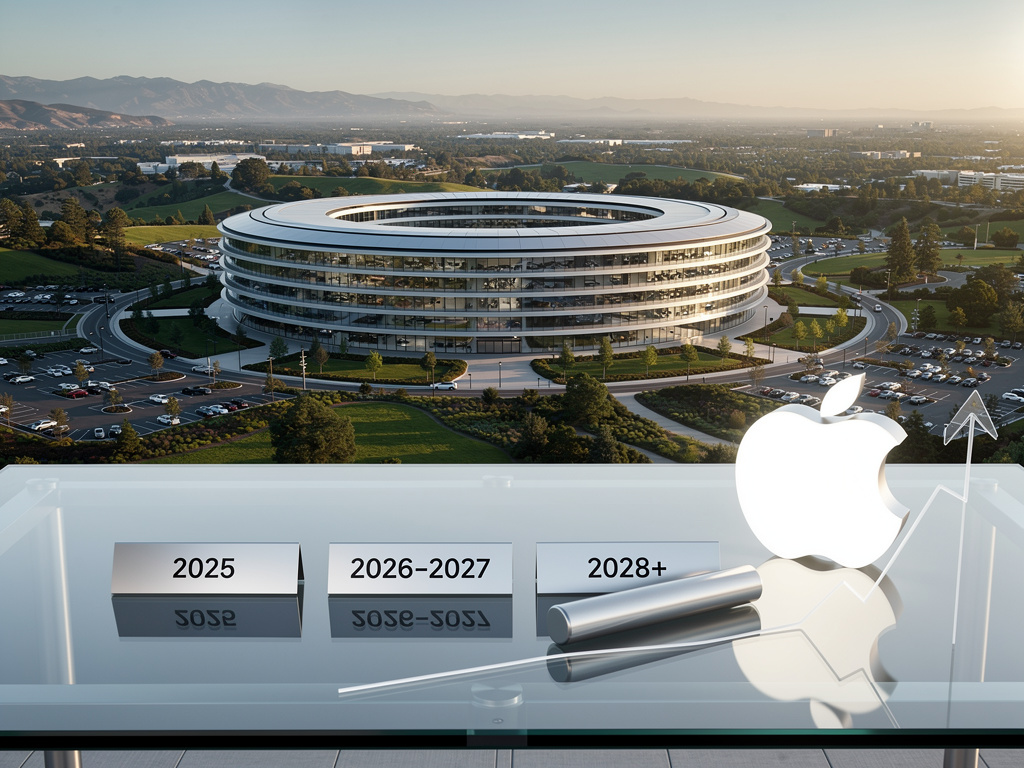
CUPERTINO, Calif.—For more than a decade, Tim Cook has presided over the most successful run in corporate history, transforming Apple Inc. from a $350 billion electronics maker into a nearly $3 trillion global titan of technology and culture. His tenure has been a masterclass in operational excellence, yet inside the gleaming circular walls of Apple Park, an inevitable and delicate process is underway: planning for the post-Cook era. The question of who will next helm the world’s most valuable company, and when, has moved from a whisper in the boardroom to a subject of intense, if guarded, speculation among investors and company insiders.
Mr. Cook, now in his mid-60s, has skillfully deflected direct questions about his retirement, but has left a trail of clues. In a 2021 interview, he admitted he would “probably not” be at Apple in ten years, a statement that set a soft deadline on his historic stewardship. More concrete are the financial timelines. A significant tranche of Mr. Cook’s massive equity award, granted in 2020 and valued at over $100 million annually, is set to fully vest through 2025, with a final payout contingent on Apple’s stock performance. According to a Reuters report on the CEO’s compensation, these packages are carefully structured to ensure leadership stability, making the 2025-2028 window a focal point for analysts predicting a transition.
A Capstone for a Celebrated Career
For years, a key part of the succession puzzle was Mr. Cook’s long-stated desire to oversee the launch of one more major product category, a final punctuation mark on a career largely defined by perfecting and scaling the visions of his predecessor, Steve Jobs. That product is now widely understood to be the Apple Vision Pro. The mixed-reality headset, which began shipping in early 2024, represents Apple’s biggest gamble in a decade and a product personally championed by the CEO. Its launch serves as a potential capstone, allowing Mr. Cook to hand over the reins with a new foundational technology platform in place, ready for his successor to nurture into a mainstream success, much as he did with the Apple Watch.
The internal calculus at Apple is famously opaque, but the company has been deliberately grooming a new generation of leaders. The most critical part of this succession planning, as detailed in reporting by MacRumors, involves identifying a successor who can maintain the operational discipline that has become Apple’s hallmark. The board, led by Chairman Arthur Levinson, is not merely looking for a caretaker but a leader capable of navigating immense global challenges, from antitrust regulation to complex supply chain geopolitics, particularly in China.
The Field Narrows to a Clear Frontrunner
For a long time, the mantle of heir apparent rested on Chief Operating Officer Jeff Williams, a Cook protégé whose role mirrored the CEO’s own path to the top. However, Mr. Williams’s retirement from the company at the end of 2023, as reported by Bloomberg, decisively reshuffled the deck and cleared the path for a younger executive. His departure has sharpened the focus onto one name that is now consistently cited by company insiders as the most likely candidate: John Ternus.
Mr. Ternus, Apple’s senior vice president of Hardware Engineering, has enjoyed a meteoric rise. He now commands the division responsible for the company’s most important products, including the iPhone, Mac, and iPad. He has become increasingly visible, taking on prominent roles in Apple’s slickly produced keynote events. Insiders describe him as well-liked, pragmatic, and deeply respected by Mr. Cook. His leadership of the complex and critically acclaimed transition to Apple Silicon in the Mac lineup demonstrated both his engineering prowess and his ability to execute on a long-term, company-defining strategy. His elevation to the top job would signal a continuation of the current focus on operational excellence and meticulous product refinement.
Assessing the Alternative Leadership Models
While Mr. Ternus is the clear favorite, Apple’s bench is deep. Craig Federighi, the charismatic senior vice president of Software Engineering, is another powerful figure. As the public face of iOS and macOS, he is beloved by developers and consumers for his engaging presentation style. A Federighi promotion would represent a shift, placing a pure software visionary at the helm for the first time. However, his relative lack of hardware and operations experience makes him a less conventional choice to run a company whose fortunes are still inextricably tied to manufacturing and logistics. Deirdre O’Brien, who leads both Retail and People, is another key member of the executive team, but is not seen as a primary contender for the CEO position.
The choice between a leader like Ternus and one like Federighi goes to the heart of the board’s central dilemma: Should the next CEO be another operational genius in the mold of Tim Cook, or is it time for a product-focused visionary more akin to Steve Jobs? Mr. Cook’s success has proven that operational mastery can create staggering value. He built a services division from a rounding error into a Fortune 50-sized business and navigated a trade war with China while doubling down on production in the region. According to a profile in the Wall Street Journal, Mr. Ternus is viewed internally as the candidate who could best continue this legacy of steady, disciplined execution.
The Immense Burden of the World’s Biggest Job
Whoever takes over will inherit a company at the zenith of its power but facing a formidable array of challenges. Regulators in both the United States and Europe are circling, with lawsuits targeting the App Store’s dominance and its tightly controlled ecosystem. The U.S. Department of Justice filed a landmark antitrust suit against the company in March 2024, representing one of the most significant legal threats in Apple’s history, as reported by CNBC. The next CEO will spend a significant portion of their time managing this regulatory siege.
Furthermore, the geopolitical chessboard is more complex than ever. Apple’s deep entanglement with Chinese manufacturing and its vast Chinese consumer market create a delicate balancing act that requires immense diplomatic skill. The pressure to find the “next big thing” also never subsides. The Vision Pro is a bold bet, but its path to becoming a revenue driver on the scale of the iPhone is long and uncertain. The next leader must not only manage the present behemoth but also place the right bets on artificial intelligence, autonomous systems, and other future technologies to ensure Apple’s growth for the next generation.
An Enduring Legacy and an Unwritten Future
Tim Cook’s ultimate legacy may be the creation of a durable system and culture that can outlast his own tenure. He has methodically built a team and an operational structure designed for resilience. The transition, when it comes, is expected to be a seamless and well-choreographed event, a stark contrast to the uncertainty that followed the departure of Steve Jobs. The company has a formal succession plan in place and has been cultivating its future leaders for this very moment.
The final decision rests with Apple’s board, which will weigh the need for continuity against the allure of a strategic pivot. The choice will send a powerful signal about the company’s future priorities. For now, Mr. Cook remains firmly in command, steering the ship with the same steady hand that has defined his era. But the preparations for a new captain are well underway, as Apple readies itself for its most significant leadership change of the 21st century.


 WebProNews is an iEntry Publication