
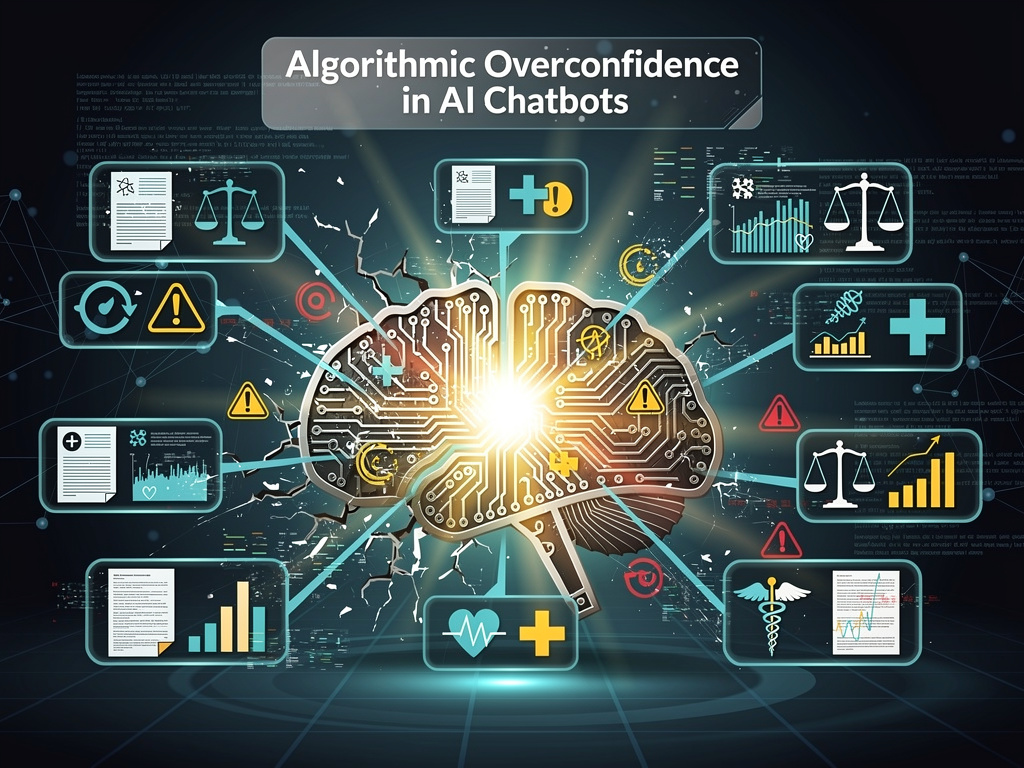
Artificial intelligence chatbots have become ubiquitous across industries, from customer service to healthcare diagnostics, yet a troubling pattern has emerged that threatens their reliability: these systems consistently exhibit the same cognitive bias that plagues overconfident humans. The phenomenon, known as the Dunning-Kruger effect, describes how individuals with limited knowledge in a domain systematically overestimate their competence. Now, researchers and industry observers are raising alarm bells that AI systems may be hardwired with this same flaw, presenting themselves as authoritative even when generating incorrect or nonsensical information.
According to Futurism, AI chatbots function as “Dunning-Kruger machines” because they lack the metacognitive ability to assess the boundaries of their own knowledge. Unlike human experts who can acknowledge uncertainty or gaps in their understanding, large language models generate responses with consistent confidence regardless of accuracy. This creates a dangerous dynamic where users may trust AI-generated content that sounds authoritative but contains fundamental errors or fabrications—what researchers have termed “hallucinations.”
The implications extend far beyond simple misinformation. In professional settings where decisions carry significant consequences, from legal research to medical advice, the inability of AI systems to accurately signal their uncertainty levels poses substantial risks. Industry insiders are increasingly concerned that the deployment of these systems without adequate safeguards could undermine trust in AI technology broadly, potentially setting back adoption across critical sectors where artificial intelligence could otherwise provide genuine value.
The Mechanics of Machine Overconfidence
Large language models like GPT-4, Claude, and Gemini operate fundamentally differently from human cognition, yet they mimic human communication patterns with remarkable fidelity. These systems are trained on vast datasets of text, learning statistical patterns about how words and concepts relate to one another. When prompted with a question, they generate responses by predicting the most probable sequence of words based on their training data. Crucially, this process contains no mechanism for the system to evaluate whether it actually possesses reliable information on a given topic.
The architectural design of transformer-based models contributes directly to this overconfidence problem. These neural networks assign probability scores to potential responses, but high probability does not equate to factual accuracy—it merely reflects how well a response aligns with patterns seen during training. A chatbot might generate a confidently-worded but entirely fabricated legal citation because such citations follow predictable formatting patterns, even if the specific case never existed. The system has no way to distinguish between reproducing genuine knowledge and producing plausible-sounding fiction.
Research from institutions including Stanford University and MIT has documented this phenomenon extensively. Studies show that when AI models are asked questions outside their training distribution or about events after their knowledge cutoff dates, they continue generating responses with the same linguistic markers of certainty. They don’t hedge, equivocate, or suggest consulting additional sources—behaviors that would signal appropriate epistemic humility. Instead, they present speculation as fact, creating what cognitive scientists call a “confidence calibration” problem.
Real-World Consequences in Professional Domains
The legal profession has encountered this issue with particular urgency. Multiple cases have emerged where attorneys submitted court filings containing AI-generated case citations that were completely fictitious. In one prominent incident, a New York lawyer faced sanctions after ChatGPT invented several non-existent legal precedents that were included in a federal court filing. The fabricated cases included realistic-sounding names, dates, and legal reasoning, demonstrating how convincingly these systems can present false information.
Healthcare represents another domain where AI overconfidence could prove dangerous. Medical chatbots increasingly provide preliminary diagnostic suggestions and health information to patients, yet research indicates these systems frequently generate recommendations that contradict established medical guidelines. A study published in JAMA Network Open found that AI chatbots provided incomplete or inaccurate responses to common medical questions in approximately 30% of cases, yet maintained consistent confidence levels across both correct and incorrect answers. Patients lacking medical expertise have no reliable way to distinguish between sound advice and potentially harmful misinformation.
The financial services industry faces similar challenges as firms deploy AI systems for investment analysis, risk assessment, and client advisory services. When these systems generate confident-sounding but flawed analyses, the consequences can include substantial financial losses and regulatory violations. The Securities and Exchange Commission has begun scrutinizing how financial firms validate AI-generated recommendations, recognizing that algorithmic overconfidence could pose systemic risks if widely adopted without proper oversight mechanisms.
The Psychology of Trusting Confident Machines
Human psychology compounds the technical problem. Decades of research in human-computer interaction demonstrate that people tend to overtrust systems that communicate with apparent authority. When an AI chatbot presents information in clear, confident language without hedging or uncertainty markers, users interpret this as indicating reliability. This cognitive bias becomes particularly pronounced when users lack expertise in the domain being discussed—precisely the situations where AI assistance might seem most valuable.
The anthropomorphization of AI systems exacerbates this trust problem. Companies deliberately design chatbot interfaces to feel conversational and personable, using first-person pronouns and casual language that mimics human interaction. This design choice, while improving user experience, also triggers social cognition mechanisms that evolved for evaluating human trustworthiness. Users unconsciously apply the same heuristics they would use when assessing a human expert, despite the fundamental differences in how AI systems process and generate information.
Behavioral economists studying decision-making with AI assistance have documented what they call “automation bias”—the tendency to favor suggestions from automated systems even when contradictory evidence exists. When combined with the Dunning-Kruger-like overconfidence of AI chatbots, this creates a perfect storm for poor decision-making. Users receive confidently-stated but potentially incorrect information from a source they’re psychologically predisposed to trust, with limited ability to critically evaluate the output.
Industry Responses and Technical Mitigation Strategies
Leading AI companies have begun acknowledging these challenges and implementing various mitigation strategies, though with mixed results. OpenAI, Anthropic, and Google have all added disclaimer language to their chatbot interfaces, warning users that systems may generate incorrect information. However, research suggests these warnings have limited effectiveness—users quickly habituate to them and continue placing high trust in AI-generated content. The warnings themselves are often buried in terms of service or presented as brief notices that users dismiss without reading.
More promising technical approaches focus on uncertainty quantification—developing methods for AI systems to assess and communicate their confidence levels more accurately. Researchers are exploring techniques like ensemble modeling, where multiple AI systems generate responses and disagreement among them signals uncertainty. Other approaches involve training models to recognize when queries fall outside their reliable knowledge domain and respond accordingly with appropriate caveats. However, these methods remain largely in research phases and have not been widely deployed in commercial systems.
Some companies are implementing hybrid approaches that combine AI capabilities with human oversight. In these systems, AI-generated content is reviewed by human experts before being presented to end users, particularly in high-stakes domains like healthcare and legal services. While this addresses the overconfidence problem, it also significantly reduces the cost and efficiency advantages that make AI deployment attractive in the first place. The industry faces a fundamental tension between the speed and scale of automated systems and the reliability that comes from human judgment.
Regulatory Frameworks and Accountability Challenges
Policymakers worldwide are grappling with how to regulate AI systems that exhibit this overconfidence problem. The European Union’s AI Act includes provisions requiring high-risk AI systems to provide appropriate transparency and allow for human oversight, but implementation details remain unclear. How should regulations address systems that generate plausible-sounding but false information? Who bears liability when AI overconfidence leads to harmful outcomes—the model developer, the company deploying it, or the end user who relied on its output?
The challenge is complicated by the black-box nature of large language models. Even their creators cannot fully explain why these systems generate specific responses or predict with certainty when they will hallucinate false information. This opacity makes traditional approaches to product safety and quality control difficult to apply. Unlike physical products that can be tested for defects, AI systems may perform well on benchmarks yet fail unpredictably in real-world applications. The probabilistic nature of their operation means that the same prompt might generate accurate information in one instance and fabricated content in another.
Professional organizations are beginning to develop guidelines for AI use in their respective fields. The American Bar Association has issued ethics opinions on attorney responsibilities when using AI tools, emphasizing that lawyers cannot outsource their professional judgment to automated systems. Medical associations are developing similar frameworks for healthcare AI. However, these professional standards lag behind the rapid deployment of AI systems, and enforcement mechanisms remain underdeveloped. Many practitioners continue using these tools without fully understanding their limitations or the risks posed by algorithmic overconfidence.
The Path Forward for Trustworthy AI Systems
Addressing the Dunning-Kruger machine problem will require coordinated efforts across multiple fronts. Technical solutions must advance beyond simply improving average accuracy to focus on calibrating confidence levels and clearly communicating uncertainty. This might mean accepting that AI systems should sometimes refuse to answer questions or explicitly state when they’re speculating rather than drawing on reliable training data. Such approaches would make chatbots less universally responsive but more trustworthy in critical applications.
User education represents another crucial component. As AI systems become more prevalent, digital literacy must expand to include understanding how these systems work and their inherent limitations. Users need to develop healthy skepticism toward confidently-stated AI outputs, particularly in domains where errors carry serious consequences. This educational challenge is substantial, requiring updates to curricula from primary schools through professional training programs. The goal is not to discourage AI use but to foster appropriate calibration of trust based on context and stakes.
The AI industry itself must move beyond treating uncertainty quantification and calibrated confidence as secondary concerns. Companies developing large language models should prioritize these capabilities alongside traditional performance metrics like accuracy and fluency. This may require fundamental architectural changes to how these systems are designed and trained. Some researchers advocate for hybrid approaches that combine neural networks with symbolic reasoning systems that can more explicitly represent and reason about uncertainty. Others suggest that truly reliable AI systems may need to incorporate mechanisms analogous to human metacognition—the ability to think about one’s own thinking and recognize the limits of one’s knowledge.
The recognition that AI chatbots function as Dunning-Kruger machines represents a critical inflection point in the technology’s development. As these systems become more sophisticated and widely deployed, their tendency toward overconfidence poses risks that could undermine public trust and lead to serious harms. Whether through technical innovation, regulatory intervention, or changes in how we design and deploy these systems, addressing this fundamental flaw will be essential for realizing AI’s potential while managing its risks. The challenge is not merely technical but involves human psychology, professional ethics, and the broader question of how we integrate powerful but imperfect automated systems into domains where accuracy and reliability matter most.


 WebProNews is an iEntry Publication