
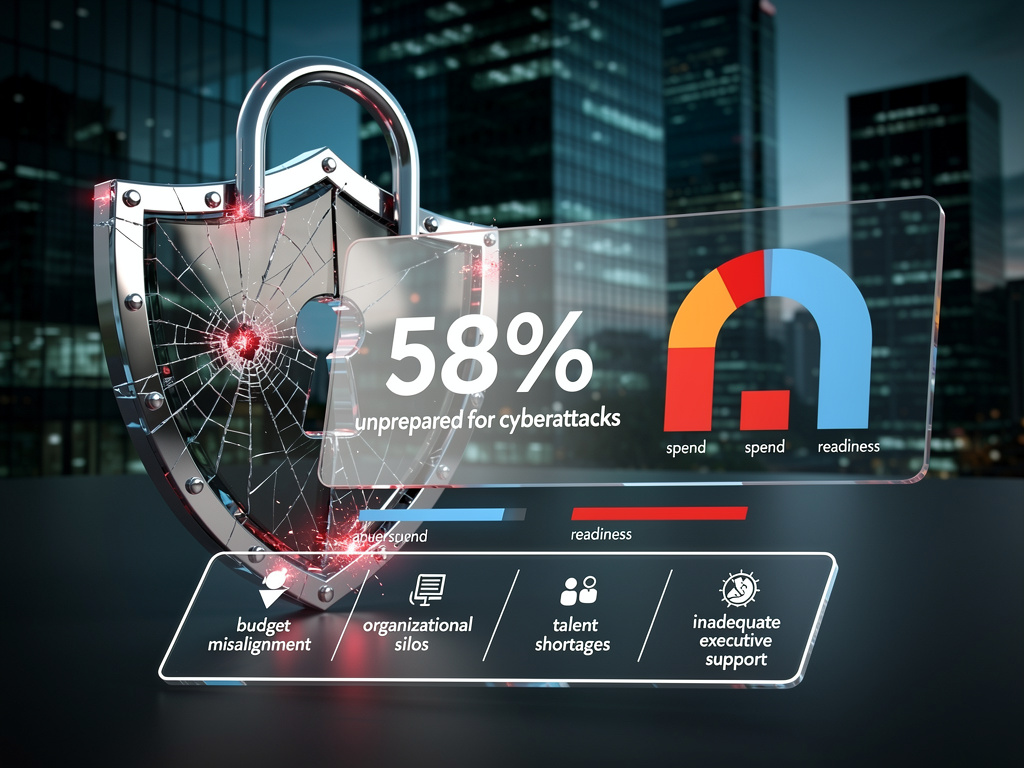
A troubling paradox has emerged in corporate cybersecurity: despite record spending on security tools and personnel, most chief information security officers lack confidence in their organizations’ ability to withstand a major cyberattack. According to recent research, 58% of CISOs believe their companies are unprepared to respond effectively when—not if—a breach occurs. This stark admission reveals a growing chasm between security investments and actual readiness, raising urgent questions about where enterprise security strategies are falling short.
The disconnect stems from four fundamental challenges that consistently undermine even well-funded security programs. These obstacles—ranging from organizational silos to talent shortages—create a perfect storm that leaves companies vulnerable despite their best intentions. As cyber threats grow more sophisticated and attackers increasingly target critical infrastructure and supply chains, understanding these barriers has become essential for boards, executives, and security leaders trying to protect their organizations in an increasingly hostile digital environment.
The Budget Paradox: More Money, Same Problems
Despite cybersecurity budgets reaching unprecedented levels, many CISOs find themselves unable to translate spending into meaningful security improvements. CSO Online reports that the first major obstacle is the misalignment between security spending and actual risk reduction. Organizations often invest in flashy new technologies without addressing fundamental security hygiene issues or ensuring proper integration with existing systems.
The problem isn’t necessarily insufficient funding—it’s how that money gets allocated. Many companies fall into the trap of purchasing point solutions that create additional complexity rather than reducing it. Each new security tool requires configuration, monitoring, and expertise, yet many organizations lack the personnel to manage their existing security stack effectively. This leads to what industry insiders call “shelfware”—expensive security products that sit unused or underutilized because teams lack the bandwidth or knowledge to implement them properly.
Organizational Silos Sabotage Security Efforts
The second critical barrier identified in the research is the persistent problem of organizational fragmentation. Security can no longer function as an isolated department; it requires coordination across IT, development, operations, legal, compliance, and business units. Yet many companies still operate with rigid departmental boundaries that prevent the cross-functional collaboration essential for effective cyber defense.
According to CSO Online, CISOs frequently struggle to gain visibility into shadow IT projects, cloud deployments initiated by individual business units, and development pipelines that bypass security reviews. When marketing launches a new customer-facing application without consulting security, or when a business unit signs a contract with a third-party vendor without proper due diligence, the CISO’s carefully constructed security architecture develops blind spots that attackers can exploit. These gaps often remain invisible until a breach occurs, at which point the damage is already done.
The Talent Shortage Reaches Critical Levels
The third challenge plaguing security organizations is the severe shortage of skilled cybersecurity professionals. This isn’t a new problem, but it has intensified dramatically as the threat environment has become more complex. Organizations need security analysts who can interpret threat intelligence, incident responders who can contain breaches quickly, and architects who can design resilient systems—but qualified candidates remain scarce and expensive.
The talent crisis extends beyond simply finding warm bodies to fill positions. Many organizations struggle to retain the security professionals they do manage to hire. Burnout rates in cybersecurity roles are alarmingly high, driven by constant alert fatigue, the pressure of defending against sophisticated adversaries, and the expectation of 24/7 availability. When experienced security personnel leave, they take institutional knowledge with them, forcing organizations to restart the learning curve with new hires who may take months to become fully effective.
Executive Buy-In Remains Elusive
Perhaps the most frustrating obstacle for CISOs is the fourth issue: difficulty securing genuine executive support and board-level engagement. While most C-suites and boards now acknowledge cybersecurity as a business risk, many still struggle to understand the technical nuances well enough to make informed decisions about security investments and priorities. This knowledge gap creates a communication barrier where CISOs find themselves unable to articulate security needs in business terms that resonate with leadership.
The problem manifests in several ways. Security initiatives often get deprioritized when they conflict with business objectives like speed to market or user convenience. CISOs may receive approval for security budgets but lack the authority to enforce security policies across the organization. When security requirements slow down a major revenue-generating project, business leaders may pressure IT teams to find workarounds, undermining the CISO’s authority and creating security debt that accumulates over time.
The Measurement Challenge Compounds the Crisis
Underlying all four obstacles is a fundamental challenge: the difficulty of measuring security effectiveness. Unlike sales or manufacturing, where success metrics are straightforward, cybersecurity operates largely in the realm of prevented incidents—events that didn’t happen because security controls worked as intended. This makes it extraordinarily difficult for CISOs to demonstrate return on investment or prove that their programs are working.
When executives ask “Are we secure?” there’s no simple answer. Security exists on a spectrum, and the goal isn’t perfect security (which is impossible) but rather appropriate risk management given the organization’s threat model and risk tolerance. Yet many boards and executives still expect binary answers to complex questions, creating unrealistic expectations that set CISOs up for failure. The lack of standardized security metrics across industries further complicates matters, making it difficult for organizations to benchmark their security posture against peers or industry standards.
Real-World Consequences of Unpreparedness
The consequences of these systemic failures are playing out in real time. Ransomware attacks continue to cripple organizations across every sector, from healthcare systems forced to divert ambulances to manufacturers shutting down production lines. Supply chain attacks like the SolarWinds breach demonstrate how a single compromised vendor can provide attackers with access to thousands of downstream victims. Nation-state actors are pre-positioning malware in critical infrastructure, creating the potential for catastrophic disruptions.
What makes the current situation particularly concerning is that many of these attacks succeed not because of sophisticated zero-day exploits, but because organizations fail at basic security fundamentals. Attackers frequently gain initial access through unpatched vulnerabilities, compromised credentials, or social engineering—all preventable with proper security hygiene. The gap between what organizations know they should do and what they actually implement remains dangerously wide.
Breaking the Cycle: Path Forward for Security Leaders
Addressing these four obstacles requires a fundamental shift in how organizations approach cybersecurity. Rather than treating security as a technical problem to be solved with technology purchases, companies need to recognize it as an organizational capability that requires cultural change, executive commitment, and sustained investment in both tools and people.
Security leaders are beginning to adopt new approaches that show promise. Some organizations are embedding security professionals directly into business units and development teams, breaking down silos through physical proximity and shared objectives. Others are investing heavily in security automation to address the talent shortage, using technology to handle routine tasks so human analysts can focus on complex threats requiring judgment and creativity. Progressive CISOs are also changing how they communicate with boards, moving away from technical jargon toward risk-based discussions that frame security decisions in business terms executives understand.
The Regulatory Response Accelerates
Regulatory pressure is also forcing organizations to take security preparedness more seriously. New SEC rules require public companies to disclose material cybersecurity incidents within four days and provide annual reports on their cybersecurity risk management programs. The European Union’s Digital Operational Resilience Act (DORA) imposes strict requirements on financial institutions’ ability to withstand cyber disruptions. These regulations create legal and financial consequences for inadequate security preparedness, giving CISOs additional leverage when making the case for security investments.
However, regulation alone won’t solve the underlying issues. Compliance and security, while related, are not synonymous. Organizations can check all the regulatory boxes while still maintaining vulnerable systems and ineffective security programs. The real solution requires leadership commitment to building genuine security capabilities, not just achieving compliance checkmarks.
Rethinking Success Metrics and Accountability
Moving forward, organizations need better frameworks for measuring security effectiveness and holding leaders accountable for security outcomes. This means developing metrics that go beyond simple compliance checklists to measure actual resilience—how quickly can the organization detect an intrusion, contain a breach, and restore operations? How effectively do security controls reduce the attack surface? How well do employees recognize and report suspicious activity?
Some forward-thinking organizations are conducting regular breach simulations and tabletop exercises that test not just technical controls but also decision-making processes, communication protocols, and crisis management capabilities. These exercises often reveal gaps that don’t show up in vulnerability scans or compliance audits—such as unclear chains of command during incidents, inadequate backup systems, or communication breakdowns between technical and business teams.
The Human Element Cannot Be Ignored
Ultimately, the most critical factor in security preparedness is the human element. Technology alone cannot protect organizations; people must make good decisions about security tradeoffs, recognize threats, and respond effectively when incidents occur. This requires ongoing security awareness training that goes beyond annual compliance videos to create genuine behavior change. It requires building a security culture where employees feel empowered to raise concerns and report suspicious activity without fear of punishment.
The 58% of CISOs who believe their organizations are unprepared for a cyberattack are sounding an alarm that boards and executives ignore at their peril. Addressing the four fundamental obstacles—misaligned spending, organizational silos, talent shortages, and inadequate executive engagement—requires sustained commitment and cultural change that extends far beyond the security department. As cyber threats continue to evolve and intensify, organizations that fail to bridge the gap between security spending and actual preparedness will find themselves increasingly vulnerable in a digital environment where the question is not whether an attack will occur, but when—and whether the organization can survive it.


 WebProNews is an iEntry Publication