
In the high-stakes world of systems programming, where every nanosecond and byte of memory counts, the choice of a programming language is a strategic decision with far-reaching consequences. For years, the domain has been dominated by C++, a language offering granular control at the cost of notorious complexity and memory-safety pitfalls. Now, a new contender, Rust, is rapidly gaining ground, and one of its most potent, yet often misunderstood, features is at the heart of its appeal: closures.
While many languages offer anonymous functions, Rust’s implementation is a masterclass in its core philosophy of providing high-level, ergonomic abstractions without sacrificing low-level performance. These are not mere syntactic conveniences; they are a fundamental tool, intricately woven with the language’s famed ownership model and compiler, to deliver code that is both expressive and blazingly fast. For engineers and technology leaders building the next generation of cloud infrastructure, financial trading platforms, and embedded devices, understanding how Rust achieves this feat is critical to harnessing its competitive edge.
A Precise Abstraction: The Three Faces of a Rust Closure
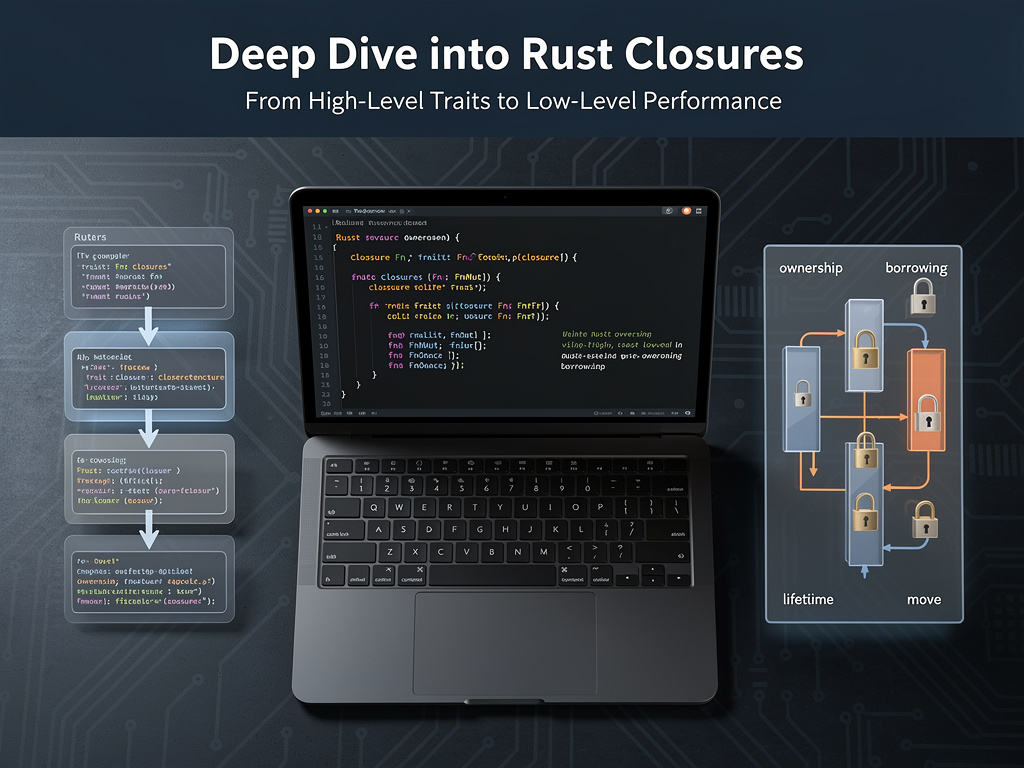
At first glance, a Rust closure looks simple—an anonymous function that can capture variables from its surrounding environment. However, the true innovation lies in how the Rust compiler analyzes a closure’s behavior to assign it one of three specific traits: `Fn`, `FnMut`, or `FnOnce`. This is not a choice left to the developer but an inference made by the compiler, ensuring the most efficient and safest possible implementation is used automatically. This classification system is the bedrock of the feature’s power and safety.
As detailed in a technical breakdown by software engineer Antoine van de Crème, the compiler’s decision hinges on how the closure interacts with its captured variables. If it only reads the captured data, borrowing it immutably, it implements the `Fn` trait. If it needs to modify the captured environment, it implements `FnMut`, taking a mutable borrow. Finally, if the closure consumes the captured variables, taking ownership of them, it implements `FnOnce`, a trait signifying it can only be called a single time. This granular, compile-time distinction prevents entire classes of data races and bugs common in concurrent programming.
The Compiler’s Inner Workings: Desugaring for Zero Cost
The term “zero-cost abstraction” is a cornerstone of Rust’s value proposition, and closures are a prime example. The magic happens during compilation, in a process known as desugaring. The Rust compiler effectively translates each closure into a custom, anonymous struct tailored specifically to its needs. This struct holds the captured variables as its fields, and the compiler then implements the appropriate trait—`Fn`, `FnMut`, or `FnOnce`—for that struct, placing the closure’s logic within the trait’s `call` method.
This means that when a closure is called, there is no dynamic dispatch or virtual function overhead involved. It is a direct, static call to a method on a struct, an operation as efficient as calling any other function. This compile-time transformation ensures that developers can write clean, high-level code using iterators, filters, and maps without paying a runtime performance penalty. This principle is so central that it is a key feature explained in The Rust Programming Language, the official guide, which notes that this design allows abstractions to be as fast as if you had written the lower-level code by hand.
Ownership in Focus: The Power of the `move` Keyword
The interplay between closures and Rust’s ownership system is where the language’s safety guarantees truly shine, particularly in multithreaded contexts. By default, closures borrow the variables they capture. However, this can be problematic when a closure needs to outlive the function it was created in, a common scenario when spawning a new thread. If the thread’s closure holds a reference to data on the main function’s stack, that data could be deallocated while the thread is still running, leading to a dangling pointer and undefined behavior.
To solve this, Rust provides the `move` keyword. Placing `move` before the closure’s parameter list forces it to take ownership of any captured variables, moving them into the closure’s internal struct. This guarantees that the data will live as long as the closure itself, making it safe to send across threads. This explicit control is a powerful tool for preventing subtle concurrency bugs that are notoriously difficult to debug in other systems languages, giving developers confidence when writing complex parallel code.
From Theory to Production: Closures in the Wild
The practical impact of this design is evident across the Rust ecosystem. In asynchronous programming, libraries like Tokio, which power a significant portion of the modern cloud-native infrastructure, rely heavily on closures for defining tasks and futures. The `async` blocks themselves are conceptually similar to closures, capturing their environment to be executed later by a runtime. This enables developers to write non-blocking I/O code that is both highly concurrent and memory-safe.
Similarly, in data processing and manipulation, Rust’s iterator methods—`map`, `filter`, `fold`—are ubiquitous. These methods take closures as arguments, allowing for expressive and highly efficient data transformation pipelines. Because each closure is compiled down to specialized code, chaining these iterator methods together often results in machine code that is just as performant as a manually written `for` loop, a fact that has been repeatedly demonstrated in performance benchmarks. Major technology firms like Amazon Web Services have publicly discussed their adoption of Rust for performance-critical services, citing its efficiency and safety features as key drivers.
The Unseen Advantage in a Competitive Market
For technology leaders and engineering managers, the implications of Rust’s closure design extend beyond pure performance. The clarity and safety it provides translates directly into developer productivity and reduced maintenance overhead. The compiler’s strict, upfront checks catch errors at compile time that might otherwise surface as critical, hard-to-reproduce bugs in production, saving valuable engineering hours and protecting system stability.
As software systems become more distributed and concurrent, the guarantees provided by Rust’s ownership model, enforced through features like closures, become a significant strategic asset. It allows teams to build more ambitious, highly parallel systems with greater confidence. The ability to abstract complex operations into clean, reusable closures without a performance trade-off empowers developers to focus on business logic rather than wrestling with the low-level intricacies of memory management and thread safety, ultimately accelerating the delivery of robust and reliable software.


 WebProNews is an iEntry Publication