
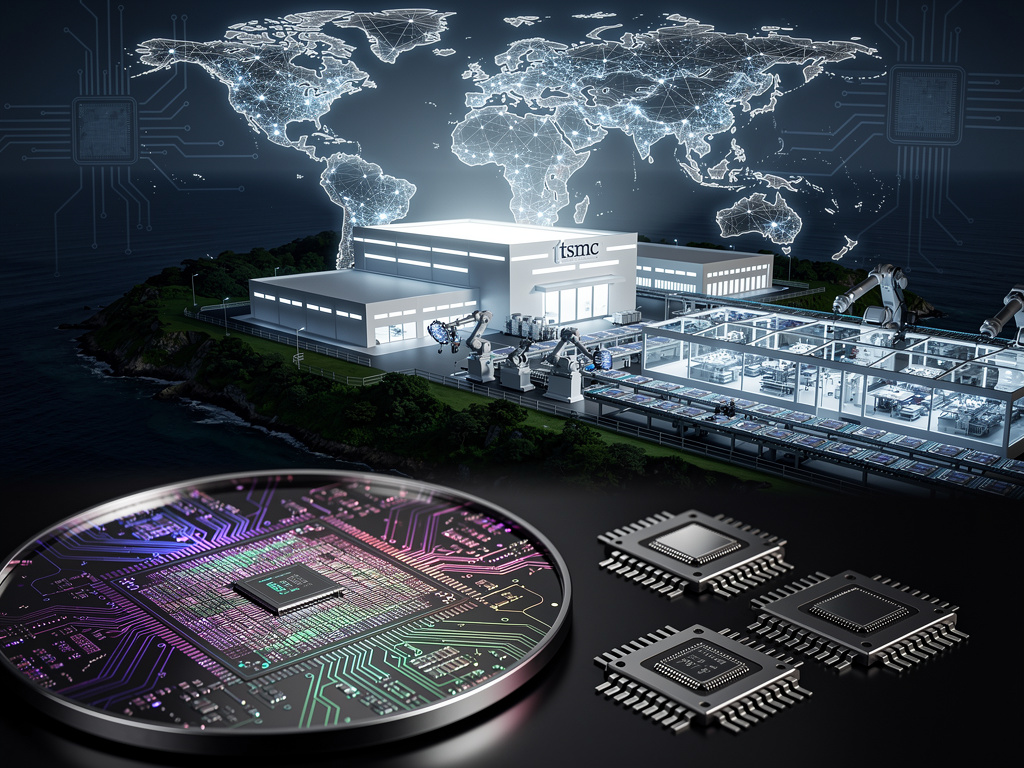
Somewhere in the humid sprawl of Hsinchu Science Park in Taiwan, a company most consumers have never heard of manufactures the silicon brains inside nearly every artificial intelligence system on the planet. Taiwan Semiconductor Manufacturing Company — TSMC — doesn’t design chips. It doesn’t sell them under its own brand. It simply makes them. And that single function has made it arguably the most strategically important corporation in the world.
The numbers are staggering. TSMC commands more than 60% of the global semiconductor foundry market and an estimated 90% share of the most advanced chips — the ones required to train and run AI models from OpenAI, Google, Meta, and every other company racing to dominate artificial intelligence. Every major AI chip designer, from Nvidia to AMD to Amazon’s in-house Annapurna Labs, depends on TSMC’s fabrication plants to turn their blueprints into working silicon. No TSMC, no AI boom. It’s that straightforward.
As MSN reported, TSMC’s position amounts to a chokehold on the AI industry — not through any malicious intent, but through decades of relentless capital investment, engineering excellence, and a business model that every competitor has tried and failed to replicate at comparable scale. The company has become the gatekeeper, the single point through which the entire global AI supply chain must pass.
That concentration of power didn’t happen overnight.
TSMC was founded in 1987 by Morris Chang, a semiconductor veteran who recognized that the industry was bifurcating. Some companies would design chips. Others would manufacture them. Chang bet his career on the manufacturing side, and for years it looked like a modest wager. The real money, the real glamour, seemed to reside with the designers — Intel, with its famous bunny-suited engineers, or Qualcomm, with its mobile ambitions. But Chang understood something fundamental: as chip designs grew more complex, the cost of building and maintaining fabrication plants would soar beyond what most companies could justify. The designers would need someone to build for them. TSMC would be that someone.
Fast forward nearly four decades and the bet has paid off beyond anything Chang could have imagined. TSMC’s revenue hit approximately $87.1 billion in 2024, driven overwhelmingly by demand for AI-related chips. Its market capitalization has at various points exceeded $900 billion, placing it among the most valuable companies on Earth. And its technological lead over rivals like Samsung Foundry and Intel Foundry Services has, if anything, widened in recent years.
The reason is physics. And money. Lots of money.
Manufacturing chips at the leading edge — currently 3-nanometer technology, with 2-nanometer in development — requires equipment costing hundreds of millions of dollars per unit, cleanrooms that make hospital operating theaters look filthy by comparison, and process engineering knowledge accumulated over decades and guarded ferociously. TSMC spent over $30 billion on capital expenditure in 2023 alone. It plans to spend even more going forward. These aren’t numbers that competitors can easily match, and even if they could write the checks, they’d still face a years-long lag in developing the institutional expertise that makes TSMC’s yields — the percentage of functional chips per wafer — consistently superior.
Intel, once the undisputed king of semiconductor manufacturing, has struggled mightily with its own foundry ambitions. Its attempt to catch up to TSMC’s process technology has been plagued by delays and billions in losses. Samsung, the other major advanced foundry player, has faced persistent yield problems at its most advanced nodes. Neither company appears poised to seriously challenge TSMC’s dominance in the near term.
So what does this mean for the AI industry? Everything.
Consider Nvidia, the company most closely associated with the AI revolution. Nvidia designs the H100 and its successor chips that power the data centers training large language models. But Nvidia doesn’t own a single fabrication plant. Every one of those chips is manufactured by TSMC. When demand for AI accelerators surged in 2023 and 2024, Nvidia’s ability to fulfill orders was constrained not by its own design capacity but by TSMC’s production schedule. The same dynamic applies to AMD, whose MI300X AI accelerators compete with Nvidia’s offerings, and to the growing list of hyperscalers — Amazon, Google, Microsoft, Meta — designing custom AI silicon.
They all line up at the same door.
This dependency has profound geopolitical implications. Taiwan sits roughly 100 miles off the coast of mainland China, which considers the island a breakaway province. Any military conflict in the Taiwan Strait wouldn’t just be a humanitarian catastrophe — it would instantly sever the world’s access to advanced chip manufacturing. The U.S. government recognized this vulnerability years ago, which is why the CHIPS and Science Act, signed into law in 2022, allocated $52.7 billion to boost domestic semiconductor production. TSMC itself is building three fabrication plants in Arizona, with the first expected to begin production soon. But even when those plants are operational, they’ll represent a fraction of TSMC’s total capacity — and they won’t manufacture the company’s most advanced chips, at least not initially.
Recent reporting has underscored just how entangled TSMC has become with American national security interests. The U.S. government has pressured TSMC to restrict shipments of advanced chips to Chinese companies, particularly Huawei, which has been subject to escalating export controls since 2020. TSMC has complied, cutting off Huawei’s access to its most advanced nodes. But this compliance comes with its own risks: it pushes China to accelerate development of its own foundry capabilities, primarily through Semiconductor Manufacturing International Corporation (SMIC), and it puts TSMC in the uncomfortable position of serving as an instrument of American foreign policy while being headquartered in a territory that America doesn’t officially recognize as a sovereign nation.
The irony is thick.
Meanwhile, the demand curve shows no sign of flattening. TSMC reported record first-quarter revenue in 2025, with AI-related orders driving much of the growth. The company’s Chip-on-Wafer-on-Substrate (CoWoS) advanced packaging technology — critical for assembling the complex multi-chip modules used in AI accelerators — has become a bottleneck in its own right. TSMC has been aggressively expanding CoWoS capacity, but demand continues to outstrip supply.
And the competitive moat keeps deepening. TSMC’s upcoming 2-nanometer process, expected to enter volume production in 2025 or early 2026, will use gate-all-around (GAA) transistor architecture for the first time, a significant leap from the FinFET designs that have dominated for a decade. Apple, Nvidia, and Qualcomm are all expected to be early adopters. The transition to GAA transistors is extraordinarily difficult — it requires essentially reinventing key aspects of the manufacturing process — and TSMC’s ability to execute this transition at scale will likely cement its lead for years to come.
There’s a question that industry analysts have debated for years: Is TSMC too big to fail, or too concentrated to be safe? The answer, uncomfortably, is both. The company’s dominance delivers extraordinary efficiency — centralizing the world’s most advanced manufacturing in one organization means that the staggering R&D costs are amortized across a massive customer base, keeping per-chip costs lower than they would be in a fragmented market. But that same centralization creates a single point of failure that keeps Pentagon planners and corporate risk officers awake at night.
Some diversification is underway. Beyond the Arizona plants, TSMC is building a facility in Kumamoto, Japan, in partnership with Sony and other Japanese firms, and has announced plans for a plant in Dresden, Germany, backed by European Union subsidies. These moves will distribute some production capacity geographically. But the most advanced processes — the ones that matter most for AI — will remain concentrated in Taiwan for the foreseeable future. The knowledge, the supply chains, the thousands of engineers who’ve spent careers perfecting these processes — none of that replicates quickly.
For the companies building AI’s future, TSMC’s dominance creates a strategic calculus that shapes every product roadmap and every capacity negotiation. Nvidia CEO Jensen Huang has publicly praised TSMC’s manufacturing prowess while privately navigating the reality that his company’s growth trajectory is fundamentally bounded by what TSMC can produce. The same is true for Lisa Su at AMD and for the silicon teams at every major cloud provider.
There are no easy alternatives. Intel’s foundry business, now operating under the Intel Foundry Services brand and led by a team trying to execute one of the most ambitious turnarounds in corporate history, won’t be a credible competitor at the leading edge for several years at minimum. Samsung continues to invest heavily but hasn’t demonstrated the consistent yields needed to win large AI chip contracts. And China’s SMIC, despite impressive progress, remains at least two full technology generations behind TSMC — a gap that U.S. export controls on advanced lithography equipment are designed to maintain.
So TSMC sits at the center of everything. Not by accident, not by government decree, but by decades of disciplined execution in the most capital-intensive and technically demanding manufacturing discipline humans have ever devised. The AI boom has transformed it from a critical but somewhat obscure industrial supplier into a company whose production decisions ripple through global markets, foreign policy debates, and the strategic plans of the world’s most powerful technology firms.
Morris Chang, now retired, once said that TSMC’s founding was based on a simple insight: specialization wins. The world’s AI ambitions now depend on whether he was right — and on whether a single company, on a single island, can continue to deliver the silicon that makes all of it possible.
That’s a lot of weight for one set of shoulders.


 WebProNews is an iEntry Publication