
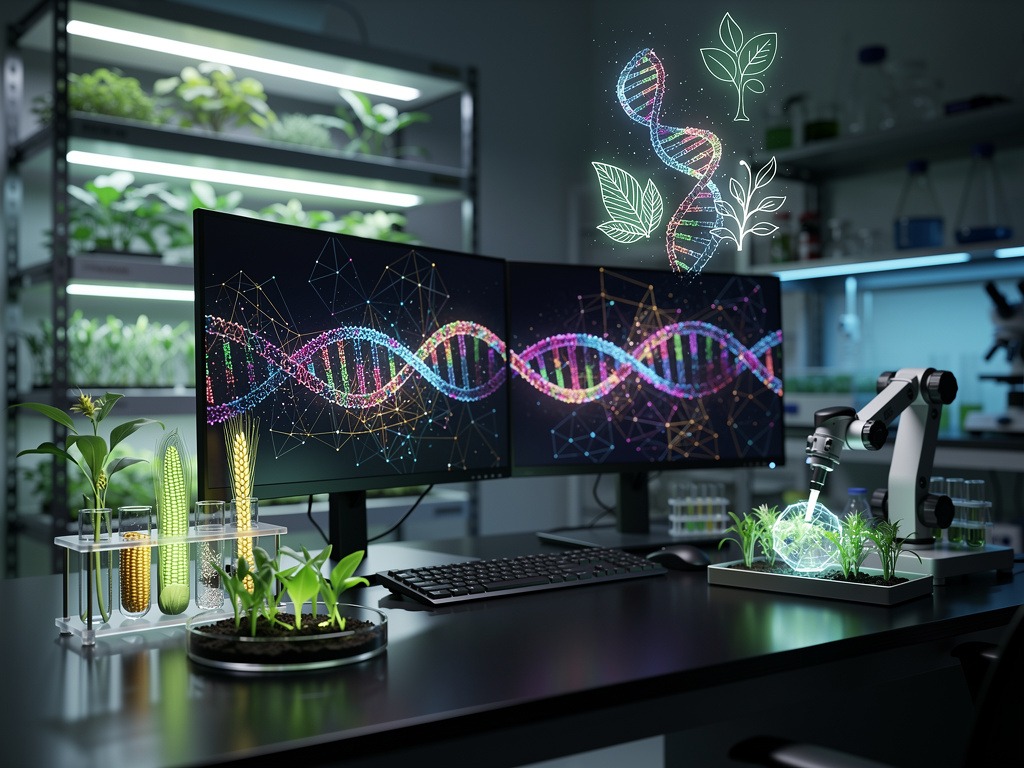
Every organism on Earth — from the bacteria in your gut to the redwoods of Northern California — runs on the same underlying programming language. DNA. Four nucleotide bases. A, T, C, G. Arranged in sequences billions of characters long, these molecular instructions have governed life for roughly 3.8 billion years. Now a growing number of researchers and startups are betting that the same AI architectures powering ChatGPT and Google’s Gemini can learn to read, interpret, and even write that biological code.
The implications for agriculture could be staggering.
As TechRadar reported, foundation models trained on genomic data are emerging as a powerful new tool in plant biology, capable of predicting gene function, identifying traits, and accelerating crop breeding timelines that once stretched across decades. The concept borrows directly from natural language processing: if DNA is a language, then large language models should, in theory, be able to learn its grammar. And early results suggest they can.
The analogy isn’t superficial. Human language models like GPT-4 are trained on vast corpora of text, learning statistical patterns — which words follow which, how meaning accumulates across sentences and paragraphs. Genomic foundation models do something remarkably similar. They ingest enormous volumes of DNA sequences and learn the statistical relationships between nucleotides, between genes, between regulatory regions and the proteins they ultimately produce. The training data isn’t Reddit posts and Wikipedia articles. It’s the genomes of thousands of plant species, each one a document written in the same four-letter alphabet.
This matters because plant genomics has historically been brutally slow. Identifying which genes control drought tolerance in wheat, or which regulatory sequences influence yield in rice, has traditionally required years of painstaking field trials, crosses, and phenotyping. Genetic modification — whether through conventional breeding or newer techniques like CRISPR — demands that scientists first understand what specific stretches of DNA actually do. And for the vast majority of plant genomes, that understanding remains incomplete.
Foundation Models Meet Four Billion Years of Evolution
The core insight driving this work is transfer learning. A model trained broadly on genomic data from many species can develop a general understanding of how DNA works — how promoters regulate transcription, how coding sequences relate to protein structure, how non-coding regions influence gene expression. That general knowledge can then be fine-tuned for specific tasks: predicting how a particular mutation in maize will affect kernel size, or identifying candidate genes for salt tolerance in barley.
Several organizations are pursuing this approach with serious resources. InstaDeep, the London- and Tunis-based AI company acquired by BioNTech in 2023, has been developing nucleotide transformer models trained on reference genomes spanning multiple kingdoms of life. Their models, as described in published research, can predict gene expression levels and identify functional elements in DNA sequences the model has never seen before. This zero-shot capability — making accurate predictions about organisms not in the training data — is what separates foundation models from traditional bioinformatics tools, which typically require species-specific training.
Google DeepMind’s AlphaFold already demonstrated the power of AI in biology by solving the protein folding problem, a challenge that had vexed structural biologists for half a century. Genomic foundation models aim to do something analogous but upstream: rather than predicting how a protein folds, they predict what a stretch of DNA does and how changes to that sequence will ripple through an organism’s biology.
The agricultural stakes are enormous. The United Nations projects the world will need to produce roughly 60% more food by 2050 to feed a population expected to exceed 9.7 billion. Climate change is simultaneously shrinking the arable land available and intensifying the droughts, floods, and heat waves that destroy crops. Traditional plant breeding — crossing high-performing varieties and selecting the best offspring over many generations — simply can’t move fast enough.
Genomic selection, which uses DNA markers to predict which plants will perform best without waiting for them to grow, has already accelerated breeding cycles considerably. But it relies on statistical associations between markers and traits, not on a deep understanding of gene function. Foundation models promise something more: a mechanistic understanding of the genome that could allow breeders to make targeted, precise modifications with far greater confidence.
Consider the challenge of drought tolerance. It’s not controlled by a single gene. Dozens, perhaps hundreds of genes interact with each other and with environmental signals to determine how a plant responds to water stress. Some regulate root architecture. Others control stomatal opening. Still others govern osmotic adjustment at the cellular level. Untangling these interactions through conventional genetics is a monumental task. But a foundation model trained on thousands of plant genomes — having learned the grammar of how regulatory networks operate — could potentially identify the key nodes in that network far more quickly.
That’s the promise. The reality, for now, is more nuanced.
Plant genomes are notoriously complex. Wheat’s genome is five times larger than the human genome. Maize is riddled with transposable elements — stretches of DNA that copy and paste themselves throughout the genome, creating enormous variation between individuals. Many crop species are polyploid, meaning they carry multiple copies of every chromosome, which makes sequence analysis exponentially harder. These aren’t trivial computational challenges. They’re fundamental biological complexities that any model must contend with.
From Lab Bench to Field: The Commercialization Race
Despite the technical hurdles, commercial interest is accelerating. Bayer Crop Science, Syngenta, and Corteva Agriscience have all invested in AI-driven genomics platforms. Smaller companies like Inari Agriculture, based in Cambridge, Massachusetts, are using AI and gene editing in tandem to develop new seed varieties with improved yield and sustainability traits. Inari’s approach — which the company describes as “SEEDesign” — uses computational models to identify beneficial genetic variations, then implements those changes using multiplex gene editing.
The convergence of cheaper DNA sequencing, more powerful compute, and transformer-based AI architectures has created a window of opportunity that didn’t exist even five years ago. Sequencing a plant genome that would have cost millions of dollars in 2010 can now be done for a few thousand. Cloud computing platforms from AWS, Google Cloud, and Microsoft Azure provide the GPU clusters needed to train billion-parameter models. And the transformer architecture — the same “attention mechanism” that powers GPT-4 — turns out to be remarkably well-suited to learning long-range dependencies in DNA sequences, where a regulatory element thousands of base pairs away from a gene can profoundly influence its expression.
Not everyone is convinced the hype matches the science. Some plant biologists argue that genomic foundation models, while impressive on benchmark tasks, haven’t yet demonstrated the kind of real-world impact that would justify the breathless comparisons to ChatGPT. Predicting gene function in silico is one thing. Translating that prediction into a crop variety that performs better in a farmer’s field — across different soils, climates, and management practices — is another entirely.
There’s also the data problem. While genomic databases have grown enormously, they’re still biased toward a handful of well-studied species: Arabidopsis, rice, maize, wheat, soybean. The so-called “orphan crops” that feed hundreds of millions of people in Sub-Saharan Africa and South Asia — crops like teff, millet, cassava, and cowpea — remain severely underrepresented. A foundation model trained predominantly on major commodity crops may not generalize well to these species, potentially widening rather than narrowing the agricultural technology gap between wealthy and developing nations.
And then there are the regulatory questions. Gene-edited crops face a patchwork of regulations worldwide. The European Union still largely treats gene-edited organisms under its strict GMO framework, though reform efforts are underway. The United States has taken a more permissive approach, exempting many gene-edited crops from USDA oversight if the genetic changes could have occurred through conventional breeding. If AI-driven genomics accelerates the pace of genetic modification, regulatory frameworks will need to keep up — and history suggests they won’t.
Still, the trajectory seems clear. The cost of inaction — in the face of climate change, population growth, and declining biodiversity — is too high. And the potential of AI to compress decades of breeding progress into years is too compelling to ignore.
What’s particularly striking about genomic foundation models is their potential to unify plant biology in a way that previous tools couldn’t. Traditional genomics was fragmented. Researchers working on rice had their own datasets, tools, and models. Those working on wheat had theirs. Cross-species insights were hard-won and often unreliable. A foundation model trained on the full breadth of plant genomic diversity could, in principle, transfer knowledge from well-studied species to poorly studied ones. It could recognize conserved regulatory patterns that evolution has preserved across hundreds of millions of years of divergence. It could, in short, read the universal language of life more fluently than any human researcher.
That’s not a small thing.
The parallel to large language models in tech is instructive in another way, too. When GPT-3 launched in 2020, skeptics questioned whether a model trained on internet text could really “understand” language. It couldn’t, in any philosophically rigorous sense. But it could perform useful tasks — summarizing documents, answering questions, writing code — well enough to transform entire industries. Genomic foundation models may follow the same path. They don’t need to truly “understand” biology in the way a molecular biologist does. They need to be useful. They need to make accurate enough predictions, often enough, to accelerate the work of breeders and geneticists in measurable ways.
Early evidence suggests they’re getting there. Researchers at institutions including the Technical University of Munich and the University of Toronto have published work showing that transformer-based models can predict gene expression from DNA sequence alone with accuracy that matches or exceeds traditional methods. Models from Genentech and the Broad Institute have demonstrated the ability to predict the effects of genetic variants on protein function. And as more plant genomes are sequenced and added to training datasets, the models’ performance on plant-specific tasks is expected to improve substantially.
The next few years will be telling. If genomic foundation models can demonstrate clear, reproducible gains in breeding efficiency — faster development of drought-tolerant varieties, more precise identification of yield-boosting alleles, better predictions of genotype-by-environment interactions — then adoption will accelerate rapidly. Seed companies, which operate on thin margins and long development timelines, have powerful incentives to embrace any technology that shortens the path from discovery to market.
But if the models plateau, if their predictions prove too noisy to guide real-world breeding decisions, then the technology may settle into a more modest role: one tool among many in the plant breeder’s toolkit, useful but not transformative.
The smart money, for now, is on the former. The biological world’s source code is written in a language that AI is increasingly capable of reading. The question isn’t whether these models will change plant science. It’s how fast, how deeply, and who will benefit.


 WebProNews is an iEntry Publication