
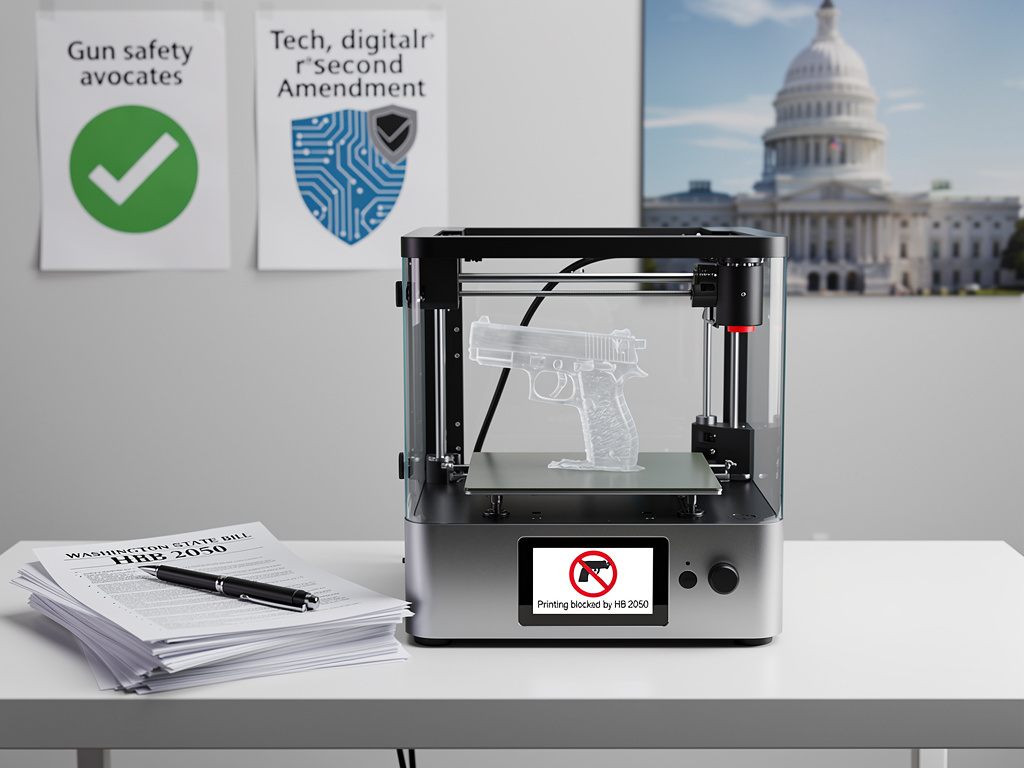
OLYMPIA, Wash. — A new legislative battleground is taking shape in the Pacific Northwest, one that exists not in a gun store or at a firing range, but in the digital code that powers the burgeoning world of 3D printing. A bill introduced in the Washington State legislature aims to mandate that all 3D printers sold in the state come equipped with technology to detect and block the creation of firearms, a move that supporters call a crucial step against untraceable “ghost guns” and that critics decry as a technically infeasible and unconstitutional overreach.
The legislation, House Bill 2050, sponsored by Representative Amy Walen, D-Kirkland, would prohibit the sale of any 3D printer that is not equipped with “digital instructions or code” to prevent the device from printing any firearm or firearm component. The proposal represents one of the most aggressive attempts by a state to regulate the manufacturing end of the ghost gun issue, shifting the burden of enforcement from the user to the hardware manufacturer in a manner that echoes the digital rights management (DRM) wars of the early 2000s.
A New Front in the ‘Ghost Gun’ War
The bill is a direct response to a growing concern among law enforcement agencies nationwide over the proliferation of privately made firearms (PMFs), often assembled from kits or, increasingly, from parts created on consumer-grade 3D printers. These weapons lack serial numbers, making them impossible for officials to trace if they are used in a crime. Proponents of HB 2050 argue that as 3D printing technology becomes more accessible and affordable, the potential for untraceable weapons to fall into the wrong hands grows exponentially.
The legislative effort in Washington is part of a broader national trend. The Bureau of Alcohol, Tobacco, Firearms and Explosives (ATF) has been grappling with how to regulate PMFs, implementing new rules to bring them under stricter control. However, these rules have primarily focused on the sale of gun-making kits. The Washington bill, as noted by a report on Slashdot, seeks to cut off a key method of production at its source, targeting the very machines that can turn a digital file into a physical object.
The Technical Quagmire of Digital Locks on Physical Objects
While the bill’s intent is clear, its technical implementation is fraught with complexity, according to experts in digital fabrication and cybersecurity. The core challenge lies in creating a reliable detection algorithm. Such a system would need to analyze digital blueprints—typically STL or G-code files—to identify the unique geometry of a firearm part, such as a receiver or a frame. This task is extraordinarily difficult, as designs can be easily modified, split into smaller, less recognizable pieces, or encrypted to evade detection.
The potential for both false positives and false negatives is immense. An algorithm could mistakenly flag a harmless mechanical part for a car or a toy as a firearm component, frustrating legitimate users and creating a customer service nightmare for manufacturers. Conversely, a determined individual could bypass the system by slightly altering a design, a process that requires minimal technical skill. Critics argue that the most dedicated bad actors would simply use open-source firmware or older, unrestricted printers, rendering the law ineffective against its intended target while penalizing law-abiding hobbyists and engineers.
Industry Caught in the Crossfire
For the 3D printing industry, HB 2050 presents a significant compliance challenge. Manufacturers like Prusa, Creality, and Bambu Lab would need to invest heavily in developing, testing, and implementing this unproven detection technology. The costs associated with this research and development, along with the potential legal liability if the technology fails, could lead some companies to cease sales in Washington altogether, creating a “Washington-compliant” logistical hurdle that may not be worth the market share.
Furthermore, the bill could have a chilling effect on the open-source community that drives much of the innovation in 3D printing. Many printers run on open-source firmware like Marlin or Klipper, which can be freely modified by users. Mandating proprietary, locked-down software would run counter to the collaborative ethos of the industry. As one commentator on X noted, anyone with the ability to compile their own firmware could simply remove the restriction, making the law a mere “inconvenience tax” on the less tech-savvy.
First and Second Amendment Collide in a Digital World
Beyond the technical and business hurdles, the bill faces formidable legal challenges rooted in the First and Second Amendments. Digital rights organizations like the Electronic Frontier Foundation have long argued that “code is speech,” a position that has found traction in U.S. courts. A lawsuit could argue that a digital blueprint for a firearm is a form of protected speech and that forcing manufacturers to build a system to censor that speech constitutes a prior restraint.
Gun rights organizations are also preparing for a fight. The Second Amendment Foundation, which is based in Washington, and the Firearms Policy Coalition have signaled their strong opposition. They argue that the bill infringes on the right to keep and bear arms by restricting an individual’s ability to make their own firearm, a practice that predates the founding of the country. In a statement posted to X, the Firearms Policy Coalition called the bill a “technologically illiterate” attack on fundamental rights, signaling a legal battle is all but certain if the bill becomes law.
A Precedent-Setting Gambit with National Implications
Should Washington succeed in passing and defending HB 2050, it could create a template for other blue states seeking to crack down on ghost guns. The result could be a fractured U.S. market for 3D printers, with different standards and regulations varying from state to state, similar to the patchwork of emissions standards that has long complicated the automotive industry. This would place an enormous burden on manufacturers and could stifle innovation across the board.
The proposal highlights a fundamental tension in modern governance: the struggle of 20th-century legal frameworks to keep pace with 21st-century technology. The debate in Olympia is not just about guns; it is about whether a government can—or should—embed legal restrictions directly into the code of a general-purpose tool. As digital fabrication becomes as commonplace as printing on paper, the outcome of Washington’s legislative experiment will likely have repercussions far beyond its borders, shaping the future of innovation, regulation, and individual rights in the digital age.


 WebProNews is an iEntry Publication