
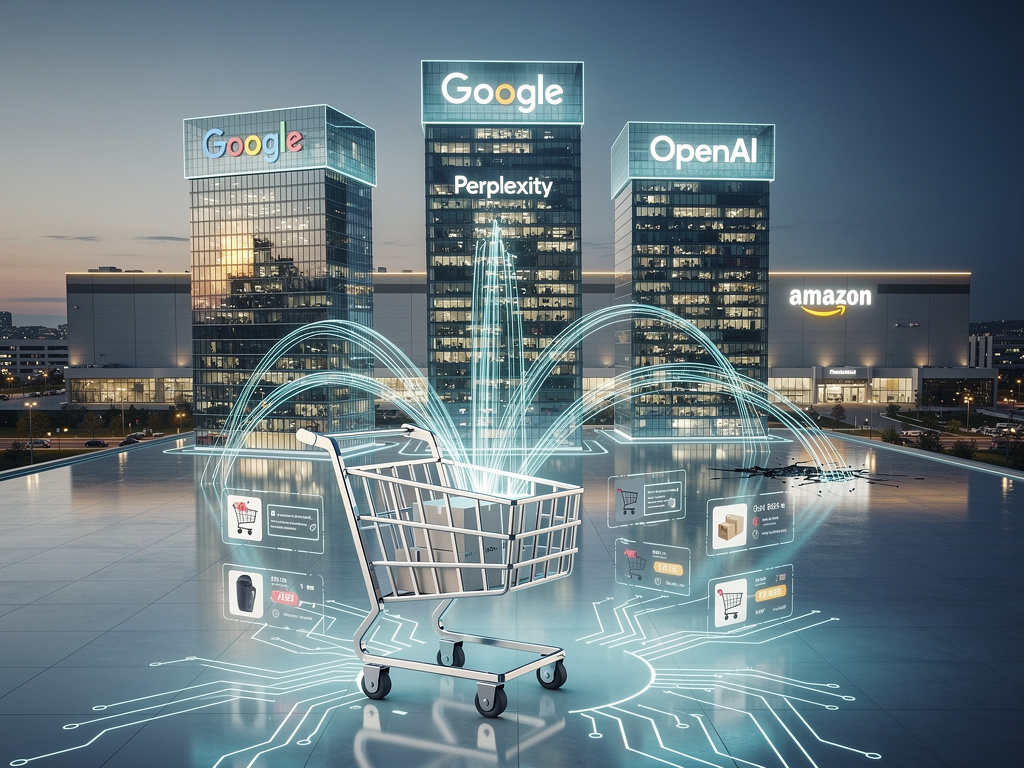
Amazon has dominated online retail for nearly three decades, but a new front in the e-commerce wars is emerging that could fundamentally alter the company’s stranglehold on digital shopping. As artificial intelligence reshapes how consumers discover and purchase products, a constellation of competitors—from established tech giants to nimble startups—are deploying AI-powered shopping assistants designed to circumvent Amazon’s marketplace entirely. The stakes are enormous: whoever controls the AI interface through which consumers shop will command the future of retail commerce worth trillions of dollars annually.
According to The Information, companies including Google, Perplexity, and OpenAI are racing to develop AI shopping tools that could redirect consumer purchases away from Amazon’s platform. These AI assistants promise to search across multiple retailers simultaneously, compare prices, and make personalized recommendations—potentially eliminating the need for consumers to visit Amazon at all. The technology represents a paradigm shift from traditional search-and-browse shopping to conversational commerce, where AI agents handle the entire purchasing journey on behalf of users.
The competitive dynamics are particularly intriguing because they unite unlikely allies against a common adversary. Google, which has struggled for years to build a meaningful e-commerce business despite multiple attempts, sees AI shopping as a potential path to finally monetize its search dominance in retail. Meanwhile, AI-native companies like Perplexity are leveraging their conversational interfaces to insert themselves between consumers and retailers, capturing valuable transaction data and potentially earning affiliate commissions or advertising revenue. Even OpenAI, primarily known for ChatGPT, has signaled interest in commerce applications that could transform its chatbot into a shopping concierge.
The Technology Powering the Assault on Amazon’s Moat
The technical architecture underlying these AI shopping assistants represents a significant departure from traditional e-commerce platforms. Rather than maintaining inventory or operating fulfillment centers like Amazon, these new entrants function as intelligent intermediaries that aggregate product information from across the internet. Large language models process natural language queries—”find me a durable backpack for hiking under $100″—and return curated recommendations drawn from multiple retailers, complete with price comparisons, reviews, and purchasing options.
This approach offers several advantages over Amazon’s walled garden. First, AI assistants can theoretically surface products from any retailer with an online presence, including specialty shops and direct-to-consumer brands that may not have significant Amazon presence. Second, the conversational interface reduces friction in the shopping process, potentially decreasing the time from initial query to purchase. Third, these tools can learn individual preferences over time, offering increasingly personalized recommendations that reflect actual user needs rather than algorithmic attempts to maximize platform revenue.
However, the technology faces significant hurdles. Product data across the internet is fragmented, inconsistent, and often outdated. Unlike Amazon’s tightly controlled marketplace with standardized product listings, AI shopping assistants must parse information from thousands of different websites with varying formats and reliability. Additionally, completing transactions requires integration with multiple payment systems and checkout processes, creating potential points of failure that could frustrate users. The companies developing these tools are investing heavily in web scraping technology, API partnerships with retailers, and natural language processing capabilities to overcome these obstacles.
Google’s Renewed E-Commerce Ambitions
For Google, AI-powered shopping represents perhaps its best opportunity yet to capture meaningful e-commerce revenue. The company has watched for years as product searches increasingly begin on Amazon rather than Google Search, eroding its ability to monetize shopping intent. Previous initiatives like Google Shopping and Google Express failed to gain significant traction against Amazon’s comprehensive selection and Prime membership benefits. But AI assistants integrated directly into Google’s search experience could change the calculus by meeting users where they already are.
The search giant has been testing various AI shopping features, including the ability to ask follow-up questions about products, receive personalized recommendations based on search history, and compare items across multiple dimensions simultaneously. By leveraging its vast data on user behavior and preferences, Google can potentially offer more relevant suggestions than generic product searches. The company is also exploring partnerships with retailers to ensure accurate, real-time inventory information and seamless checkout experiences that rival Amazon’s one-click purchasing.
Yet Google faces a delicate balancing act. Its core business remains advertising, and many retailers pay substantial sums for Google Shopping ads. An AI assistant that too effectively directs users to the lowest prices or best deals could cannibalize this lucrative advertising revenue. The company must design its shopping AI to generate value for users while preserving the business model that funds its operations—a challenge that has stymied previous Google commerce initiatives.
Startups Betting on Conversational Commerce
While tech giants bring scale and resources, startups like Perplexity are wagering that conversational AI represents a genuine discontinuity that favors new entrants. Perplexity has positioned itself as an “answer engine” rather than a traditional search engine, providing direct responses to queries rather than lists of links. Extending this approach to shopping feels natural: users ask for product recommendations and receive curated suggestions with explanations, rather than scrolling through pages of search results.
The startup advantage lies in focus and agility. Unlike Google or Microsoft, which must balance AI shopping against existing business lines, Perplexity can optimize purely for user experience without worrying about cannibalizing other revenue streams. The company is experimenting with various monetization approaches, including affiliate commissions from retailers and potential subscription tiers for premium shopping features. By building trust through helpful, unbiased recommendations, Perplexity hopes to establish itself as consumers’ preferred shopping advisor before larger competitors can respond effectively.
Other startups are pursuing adjacent opportunities in the AI shopping ecosystem. Some are developing specialized agents for specific product categories—fashion, electronics, groceries—where deep domain expertise can deliver superior recommendations. Others are building the infrastructure layer, providing APIs and tools that enable any company to add AI shopping capabilities to their products. This fragmentation suggests the AI shopping market may evolve into a complex ecosystem rather than a winner-take-all scenario, with different players capturing value at various points in the shopping journey.
Amazon’s Defensive Posture and Strategic Response
Amazon is hardly sitting idle while competitors develop AI tools to disintermediate its marketplace. The company has invested billions in AI research and development, including its Alexa voice assistant, which has offered shopping capabilities for years. However, Alexa’s shopping features have seen limited adoption, with most users employing the assistant for simple tasks like playing music or checking weather rather than making purchases. Amazon is now working to enhance Alexa with large language model capabilities that could make conversational shopping more natural and effective.
Beyond Alexa, Amazon is integrating AI throughout its e-commerce platform. The company has introduced AI-powered product review summaries, personalized shopping feeds, and enhanced search capabilities that understand natural language queries. Amazon’s substantial advantages include its vast product selection, unmatched fulfillment network, and Prime membership program that creates sticky customer relationships. Even if AI assistants from competitors direct users to better deals elsewhere, the convenience of Prime’s fast, free shipping may keep customers returning to Amazon for actual purchases.
The company is also leveraging its position as a retailer to potentially limit competitors’ access to its product data. While Amazon’s listings are publicly visible, the company could make it more difficult for AI assistants to scrape this information or could prioritize its own AI tools in search results for Amazon-related queries. This defensive strategy mirrors tactics Amazon has used against price comparison tools in the past, though it risks regulatory scrutiny if perceived as anticompetitive behavior.
The Retailer Perspective: Opportunity or Threat?
Traditional retailers view AI shopping assistants with mixed emotions. On one hand, these tools could drive traffic and sales to retailers that have struggled to compete with Amazon’s visibility and convenience. A Walmart or Target product recommended by an AI assistant reaches consumers who might never have visited those retailers’ websites directly. For smaller specialty retailers and direct-to-consumer brands, AI shopping tools offer potential access to customers at scale without the costs and compromises of selling through Amazon’s marketplace.
On the other hand, AI assistants that prioritize price above all else could intensify the race to the bottom on margins, making it even harder for retailers to maintain profitability. If consumers rely on AI to always find the absolute lowest price, retailers lose the ability to compete on factors like brand, experience, or customer service. There’s also concern about ceding the customer relationship to AI intermediaries—if shoppers interact primarily with an AI assistant rather than a retailer’s own website or app, the retailer loses valuable data on customer preferences and behavior.
Some retailers are hedging their bets by developing their own AI shopping assistants while also ensuring their products are discoverable through third-party AI tools. Walmart, for instance, has been testing AI-powered shopping features in its app while also working with companies like Google to ensure Walmart products appear in AI search results. This dual strategy allows retailers to maintain direct customer relationships while also capturing demand from users who prefer AI-mediated shopping experiences.
Regulatory Considerations and Market Structure Questions
The emergence of AI shopping assistants raises novel regulatory questions that existing e-commerce frameworks may not adequately address. If an AI assistant consistently recommends products from certain retailers—whether due to affiliate relationships, advertising payments, or algorithmic bias—should this be disclosed to users? Current regulations around native advertising and sponsored content may not translate cleanly to AI recommendations, where the line between organic suggestions and paid placements could be intentionally blurred.
Competition authorities are also monitoring how dominant players in AI and e-commerce leverage their positions in these emerging markets. Google’s integration of shopping features into its search engine, for example, has already attracted antitrust scrutiny in multiple jurisdictions. As AI shopping tools become more sophisticated and widely adopted, regulators may need to consider whether companies with market power in AI or search are using these advantages to unfairly compete in retail, or whether such integration benefits consumers through improved experiences.
Data privacy represents another regulatory frontier. AI shopping assistants require access to extensive personal information—purchase history, browsing behavior, stated preferences—to deliver personalized recommendations. The companies operating these assistants will accumulate rich profiles of consumer shopping behavior across multiple retailers, creating both privacy risks and competitive advantages. How this data can be collected, used, and shared will likely face increasing regulatory scrutiny, particularly in jurisdictions with strong privacy protections like the European Union.
The Path Forward: Scenarios for Market Evolution
The ultimate impact of AI shopping assistants on e-commerce market structure remains uncertain, with several plausible scenarios. In one future, AI tools successfully fragment Amazon’s dominance by making it easy for consumers to shop across multiple retailers, leading to a more competitive and diverse retail ecosystem. Consumers benefit from better prices and selection, while retailers gain alternative channels to reach customers beyond Amazon’s marketplace. The AI assistant providers capture value through affiliate commissions, advertising, or subscription fees, establishing themselves as essential infrastructure in digital commerce.
Alternatively, Amazon could successfully defend its position by leveraging its fulfillment capabilities, Prime membership, and own AI investments to maintain customer loyalty even as shopping discovery shifts to AI assistants. In this scenario, AI tools might change how consumers find products but not where they ultimately buy them, with Amazon’s convenience and trust prevailing over marginal price differences identified by AI. The shopping assistant market itself could consolidate around one or two dominant players—likely Google and OpenAI—creating new gatekeepers that replace Amazon’s marketplace power with their own algorithmic control over commerce.
A third possibility involves the emergence of a hybrid model where AI assistants and traditional e-commerce platforms coexist and interoperate. Consumers might use AI tools for research and discovery but complete purchases through familiar retailer websites and apps, with assistants earning referral fees for driving traffic. Retailers could develop their own AI agents that compete and cooperate with third-party assistants, creating a complex ecosystem where multiple AI entities negotiate on behalf of consumers and merchants to facilitate transactions. This fragmented future would lack a single dominant player but might prove more resilient and innovative than concentrated market structures.
Investment Implications and Strategic Imperatives
For investors and corporate strategists, the AI shopping wars present both opportunities and risks that demand careful navigation. Companies positioned at the intersection of AI capabilities and commerce relationships—Google, Microsoft, Meta—have natural advantages but must execute effectively against both nimble startups and Amazon’s defensive measures. Pure-play AI companies like OpenAI and Anthropic face questions about whether their technology advantages can translate into sustainable commerce businesses before larger competitors catch up.
Retailers must decide how aggressively to invest in their own AI shopping capabilities versus relying on third-party tools to drive discovery. Building proprietary AI assistants requires significant technical resources and may duplicate efforts across the industry, but cedes less control to potential competitors. Meanwhile, ensuring products are optimized for discovery by third-party AI assistants—through structured data, comprehensive product information, and competitive pricing—becomes a new imperative for digital merchandising teams.
The infrastructure and technology providers enabling AI shopping—companies offering product data APIs, payment processing, inventory management, and fulfillment services—may capture significant value regardless of which consumer-facing assistants succeed. As the market matures, strategic acquirers may target these enabling technologies to build comprehensive commerce stacks that compete with Amazon’s vertically integrated approach. The coming years will determine whether AI shopping assistants represent a genuine disruption to e-commerce’s established order or merely the latest in a long line of Amazon challengers that ultimately fell short.


 WebProNews is an iEntry Publication