
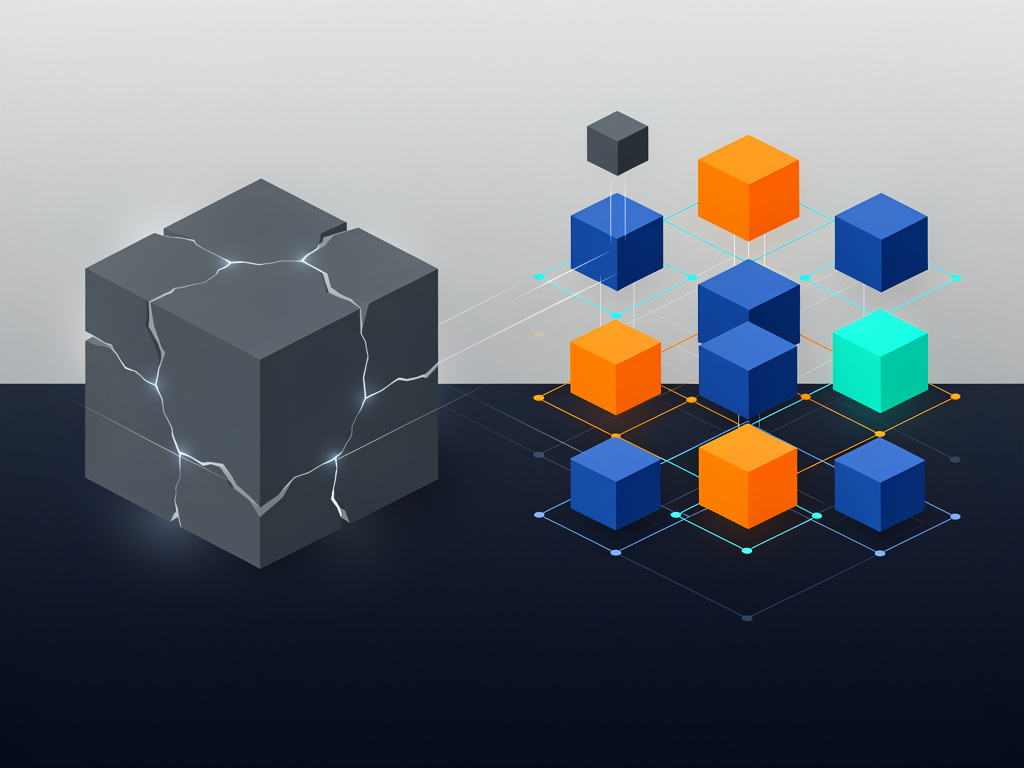
For two decades, the content management system was the center of gravity for the web. WordPress alone powers roughly 43% of all websites. Drupal runs government portals. Joomla still hums along in corners of the enterprise. But a growing chorus of developers, architects, and even CMS advocates themselves are making a startling admission: the traditional CMS — the monolithic, all-in-one platform that handles everything from content storage to front-end rendering — is losing its grip.
Not dying, exactly. Mutating.
Chris Reynolds, a veteran WordPress developer and engineer now working at Jetveo, published a provocative essay on his blog titled “The CMS Is Dead. Long Live the CMS,” and it’s resonating with a technical community that’s been quietly rethinking how content infrastructure should work. His thesis is blunt: the CMS as we’ve known it — a tightly coupled system where the editing interface, the database, the templating engine, and the front end all live under one roof — is an artifact of a web that no longer exists. The modern web demands something different. And the CMS must either adapt or become irrelevant.
“The CMS is no longer the website,” Reynolds writes. “It’s the place where content is managed. That’s it.”
That distinction sounds semantic. It isn’t.
The Decoupling That Changed Everything
The shift Reynolds describes has been building for years. The headless CMS movement — where the back-end content repository is separated from the front-end presentation layer — began gaining serious traction around 2018 and has since become a default architectural choice for many new projects. Companies like Contentful, Sanity, Strapi, and Storyblok have built entire businesses around the idea that content should be delivered via APIs, not rendered by the same system that stores it. Even WordPress, the most entrenched CMS on earth, has moved aggressively in this direction with its REST API and, more recently, its GraphQL integrations.
Reynolds, who spent years building WordPress sites and contributing to the platform’s open-source community, frames this not as a betrayal of CMS principles but as their logical fulfillment. The original promise of a CMS was to let non-technical users manage content without needing to write code. That promise still holds. What’s changed is that the CMS no longer needs to be responsible for how that content gets displayed. In fact, it probably shouldn’t be.
The reasons are practical. Modern front-end frameworks — React, Next.js, Astro, SvelteKit — offer performance, interactivity, and developer experience that no traditional CMS theme layer can match. Static site generators can pre-render pages at build time, delivering near-instant load speeds. Edge computing can personalize content at the CDN level. None of this requires a PHP-based theme engine sitting on a shared hosting server.
And the expectations of users have shifted. People expect web applications, not web pages. They expect content to appear on mobile apps, smartwatches, voice assistants, digital signage, and platforms that haven’t been invented yet. A CMS that renders HTML is a CMS that can only serve one channel. A CMS that serves structured content via an API can serve all of them.
Reynolds is clear-eyed about what this means for the WordPress community specifically. The platform’s greatest strength — its massive theme and plugin infrastructure — is also what makes it most vulnerable to this architectural shift. “WordPress themes are a liability,” he writes, a statement that would have been heretical five years ago. His argument: the theme layer couples content to presentation in ways that make it harder to reuse content across contexts, harder to optimize performance, and harder to maintain security. Every plugin that adds front-end functionality is another potential attack vector, another piece of code that can slow a page load, another dependency to manage.
This isn’t a fringe opinion anymore. Automattic, the company behind WordPress.com and a primary steward of the WordPress open-source project, has been investing heavily in headless use cases. The WordPress VIP platform, which serves enterprise clients including Time, Salesforce, and TechCrunch, actively promotes decoupled architectures. Matt Mullenweg, WordPress’s co-creator, has spoken repeatedly about the platform’s future as a content hub rather than a monolithic website builder.
But there’s tension. WordPress’s new block editor, Gutenberg, represents a massive investment in a tightly coupled editing experience — one where what you see in the editor is what you get on the front end. That vision is fundamentally at odds with a headless approach where the front end is built with entirely different tools. Reynolds acknowledges this contradiction without fully resolving it, and it’s one the WordPress community will have to wrestle with for years to come.
What Replaces the Monolith
So if the CMS isn’t the website anymore, what is the website? The answer, increasingly, is a composition of services. Content comes from a headless CMS. Authentication comes from an identity provider. Search comes from a dedicated search service like Algolia or Typesense. E-commerce comes from Shopify’s Storefront API or a similar platform. Media comes from a DAM (digital asset management) system. And the front end — the thing the user actually sees — is a custom application built with modern JavaScript frameworks, deployed to a CDN, and stitched together at build time or at the edge.
This architecture has a name: composable. It also has critics.
The composable approach trades the simplicity of a monolithic CMS for flexibility and performance, but it introduces complexity that many organizations aren’t equipped to handle. A small business owner who can spin up a WordPress site in an afternoon doesn’t have the engineering resources to wire together six different SaaS products with a custom Next.js front end. Agencies that built their practices around WordPress or Drupal face a skills gap. And the total cost of ownership for a composable stack can be significantly higher than a traditional CMS, especially when you factor in the ongoing maintenance of API integrations, the need for DevOps expertise, and the subscription costs of multiple SaaS platforms.
Reynolds doesn’t dismiss these concerns. He positions his argument as descriptive, not prescriptive. The CMS isn’t dead for everyone. WordPress will continue to power millions of sites that don’t need or want a decoupled architecture. The local restaurant, the personal blog, the small nonprofit — these use cases haven’t changed, and a traditional CMS still serves them well. But for organizations building at scale, serving content across multiple channels, or prioritizing performance and security, the old model is increasingly untenable.
Recent data supports this directional shift. The 2024 State of the CMS report from Storyblok found that 72% of companies using a headless CMS reported improved developer satisfaction, and 63% said it helped them deliver content faster across channels. W3Techs data shows that while WordPress’s market share remains dominant, its growth rate has plateaued — and in some segments, it’s declining. Meanwhile, headless and API-first CMS platforms are growing at double-digit rates year over year.
The JavaScript framework wars have also accelerated this transition. Next.js, backed by Vercel, has become a de facto standard for building modern web applications, and its architecture assumes content will come from external sources. Astro, a newer framework optimized for content-heavy sites, was designed from the ground up to pull content from any headless CMS. These tools don’t just support decoupled architectures — they expect them.
There’s also a generational factor. Developers entering the workforce today learned React, not PHP. They think in components, not templates. They deploy to Vercel or Netlify, not shared hosting. For them, a traditional CMS isn’t a starting point — it’s a legacy system. This cultural shift is as powerful as any technical argument, and it’s reshaping hiring patterns, agency business models, and platform adoption curves across the industry.
Reynolds makes another point that deserves attention: the role of AI. As large language models become integrated into content workflows — generating drafts, optimizing for SEO, personalizing at scale — the CMS increasingly needs to function as a structured content repository that AI systems can read from and write to. A monolithic CMS with content locked inside HTML blobs is poorly suited for this. A headless CMS with well-defined content models and clean API endpoints is a natural fit. The AI revolution in content isn’t coming. It’s here. And it’s another force pushing the CMS toward a decoupled, API-first architecture.
The Survival of the CMS — In a New Form
What’s striking about Reynolds’s essay is its tone. This isn’t a eulogy. It’s a call to evolution. The CMS isn’t going away — content still needs to be managed, and non-technical users still need interfaces to manage it. But the CMS is being unbundled, its responsibilities distributed across a wider set of tools and services. The content model becomes the product. The editing experience becomes the differentiator. And the rendering layer? That belongs to someone else now.
WordPress seems to understand this, at least partially. The Gutenberg project, for all its coupling to the front end, has also introduced a block-based content model that could, in theory, be serialized and delivered via API. The WordPress Playground project, which runs WordPress entirely in the browser via WebAssembly, hints at a future where the CMS is less a server application and more a portable content engine. And WordPress’s growing embrace of the Fediverse through its ActivityPub plugin suggests the platform is thinking about content distribution in fundamentally new ways.
Drupal, WordPress’s more enterprise-focused cousin, has arguably been ahead of this curve. Drupal’s “API-first” initiative, which began with Drupal 8, made JSON:API and GraphQL first-class citizens. Dries Buytaert, Drupal’s founder, has been writing about the “headless CMS” concept since at least 2016 and has consistently pushed the community toward decoupled architectures. For Drupal shops, the transition Reynolds describes is less a disruption and more a validation.
But the real winners of this shift may not be traditional CMS platforms at all. They may be the purpose-built headless CMS companies that designed their products for exactly this world. Contentful raised $175 million in its last funding round. Sanity has built a passionate developer community around its real-time, structured content platform. Hygraph (formerly GraphCMS) is growing fast in the enterprise segment. These companies don’t carry the baggage of a monolithic past. They were born headless.
And yet. There’s something lost in the transition that’s worth naming. The old CMS — the WordPress you could install in five minutes, customize with a theme, and hand off to a client — was democratizing in a way that composable architectures are not. It lowered the barrier to publishing on the web. It made website ownership accessible to people who couldn’t write a line of code. That accessibility was WordPress’s greatest achievement, and the headless future, for all its technical elegance, doesn’t yet have a compelling answer for the non-technical user who just wants to put something on the internet.
Reynolds acknowledges this implicitly. The CMS is dead, he says. But long live the CMS — meaning the function persists even as the form changes. Content management isn’t going anywhere. The web still needs tools that let humans organize, edit, and publish information. What’s dying is the assumption that one system should handle all of it.
For agencies, this means rethinking service offerings. For enterprises, it means rethinking procurement. For developers, it means learning to work across a distributed stack rather than within a single platform. And for the CMS vendors themselves — WordPress, Drupal, the headless upstarts — it means competing not on features, but on how well they fit into a world where they’re one piece of a much larger puzzle.
The CMS isn’t dead. But the CMS that tries to be everything? That one’s on life support.


 WebProNews is an iEntry Publication