
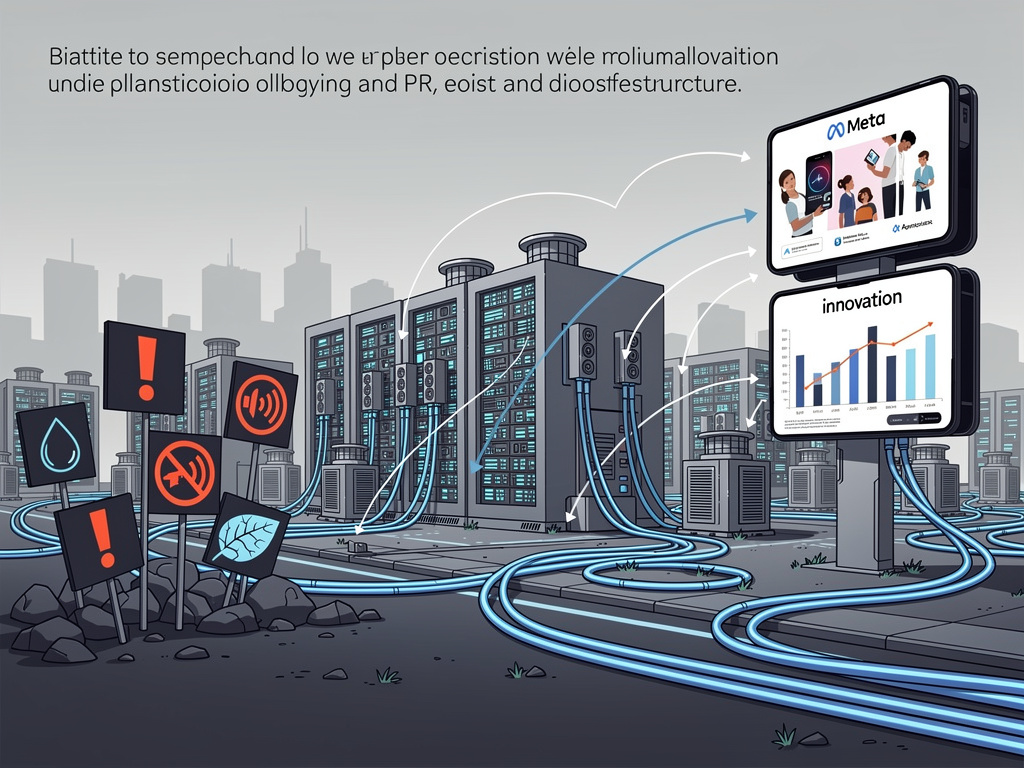
For years, the physical heart of the digital world operated in relative obscurity. Massive, windowless buildings housing servers for the likes of Meta, Google, and Amazon were quietly erected in rural and suburban communities, welcomed for their promised tax revenues with little public fanfare or scrutiny. That era of quiet expansion is decisively over. Today, the data center industry finds itself on the defensive, facing a populist backlash that is uniting strange political bedfellows and threatening to stall the very infrastructure needed to power the artificial intelligence boom.
In response, the tech industry is orchestrating a strategic pivot, moving from a posture of discreet development to a full-throated, multimillion-dollar public relations and lobbying offensive. Spearheaded by giants like Meta Platforms Inc., the campaign is an acknowledgment of a new reality: the future of the cloud will be decided not just in corporate boardrooms, but in contentious town hall meetings and on local ballots. The industry is now fighting a ground war to win the hearts and minds of the communities it seeks to call home, deploying sophisticated ad campaigns and lobbying muscle to reframe the narrative around its power-hungry facilities.
A New Era of Public Scrutiny and Political Realignment
The opposition is no longer a fringe movement. From Prince William County, Virginia—the world’s largest concentration of data centers—to small towns in Arizona and Oregon, residents are mobilizing against new projects. Their grievances are varied but potent: the deafening hum of cooling fans, the immense strain on local electricity grids, and the consumption of millions of gallons of water in often drought-prone regions. These concerns are creating unconventional alliances, with environmentalists worried about carbon footprints joining forces with conservatives concerned about property rights and the industrialization of pastoral communities. This dynamic is “scrambling political lines,” noted a recent report from NPR, as the debate transcends typical partisan divides.
The economic promises that once smoothed the way for these projects are also coming under fire. While data centers contribute significantly to local tax bases, they create relatively few permanent jobs once construction is complete. Critics argue that generous tax abatements often given to lure the facilities mean communities are subsidizing some of the world’s wealthiest companies without a proportional return in local employment or economic vitality. This growing skepticism has forced the industry to confront what Grist describes as a serious “image problem,” prompting a dramatic shift in its public engagement strategy.
Meta’s Campaign to Make Data Centers ‘Cool’
At the vanguard of this new charm offensive is Meta. The parent company of Facebook and Instagram has launched a sweeping ad campaign to redefine the public’s perception of its data centers. As detailed by The Verge, Meta is spending millions on ads that portray its facilities not as hulking industrial boxes, but as the vibrant, essential hubs of modern life. One ad, titled “Life in the Age of AI,” features a montage of small businesses, artists, and families using Meta’s services, implicitly linking these positive experiences to the unseen infrastructure in the background.
The campaign aims to make the abstract benefits of data centers tangible to the average person. Another initiative, “Data Centers for a Digital World,” features slick videos of smiling employees and highlights community investments, such as water restoration projects and grants for local schools. The goal, according to The New York Times, is a deliberate effort to “change public opinion” by directly connecting the server farms to the digital services people use daily. It’s a classic consumer-facing marketing strategy applied to an industrial asset, a move from business-to-business discretion to direct-to-public persuasion.
Lobbying Muscle and a Unified Industry Voice
Beyond glossy advertisements, the industry is significantly ramping up its political machinery. Trade groups like the Data Center Coalition and TechNet are increasing their lobbying expenditures at both the state and federal levels. Their primary objective is to create a more predictable and favorable regulatory environment, which often means advocating for state-level legislation that can streamline permitting processes and, in some cases, override the authority of local zoning boards that have become epicenters of opposition.
This coordinated effort reflects the industry’s recognition that it can no longer afford to fight these battles on a town-by-town basis. By unifying its voice and professionalizing its lobbying operations, the sector hopes to establish data centers as a ‘critical infrastructure’ category, akin to utilities or transportation hubs, thereby insulating them from localized political headwinds. The strategy is to elevate the debate from a local nuisance issue to a matter of state and national economic competitiveness, especially in the global race for AI supremacy.
The AI Imperative: Fueling an Insatiable Demand
The urgency behind this strategic shift is driven by one overarching factor: the explosive growth of artificial intelligence. Training and running advanced AI models like those behind ChatGPT and Meta’s Llama requires computational power on a scale that dwarfs previous technological eras. This translates into a voracious appetite for more, larger, and more powerful data centers. Industry insiders understand that any significant delay or moratorium on data center construction represents a direct threat to their AI roadmaps and a potential bottleneck for the next wave of technological innovation.
Companies are now in a high-stakes race to secure land, power, and water for the next generation of AI-focused facilities. The public backlash, therefore, is not merely a public relations nuisance; it is a fundamental business risk. If communities continue to reject new projects, the tech giants could face a physical limit to their growth ambitions. This reality has turned sleepy county board meetings into crucial battlegrounds for the future of a multitrillion-dollar industry.
The Future of Digital Infrastructure
The effectiveness of this multifaceted campaign remains to be seen. While polished ads may soften the image of data centers, they are unlikely to sway residents living with the constant noise or those concerned about the strain on their region’s power grid. The industry’s efforts to sponsor local STEM fairs and community events may build some goodwill, but they risk being perceived as cynical attempts to buy social license by opponents who feel their core concerns about environmental impact and quality of life are being ignored.
Ultimately, the conflict over data centers is a tangible manifestation of the broader tensions between the digital economy and the physical world it depends on. The tech industry, long accustomed to operating in a virtual realm with few physical constraints, is now being forced to negotiate its existence in real communities with real-world limits. Its new campaign is an expensive and ambitious bet that it can persuade the public that the price of progress—more noise, more power lines, and more water consumption—is one worth paying for a future defined by AI.


 WebProNews is an iEntry Publication