
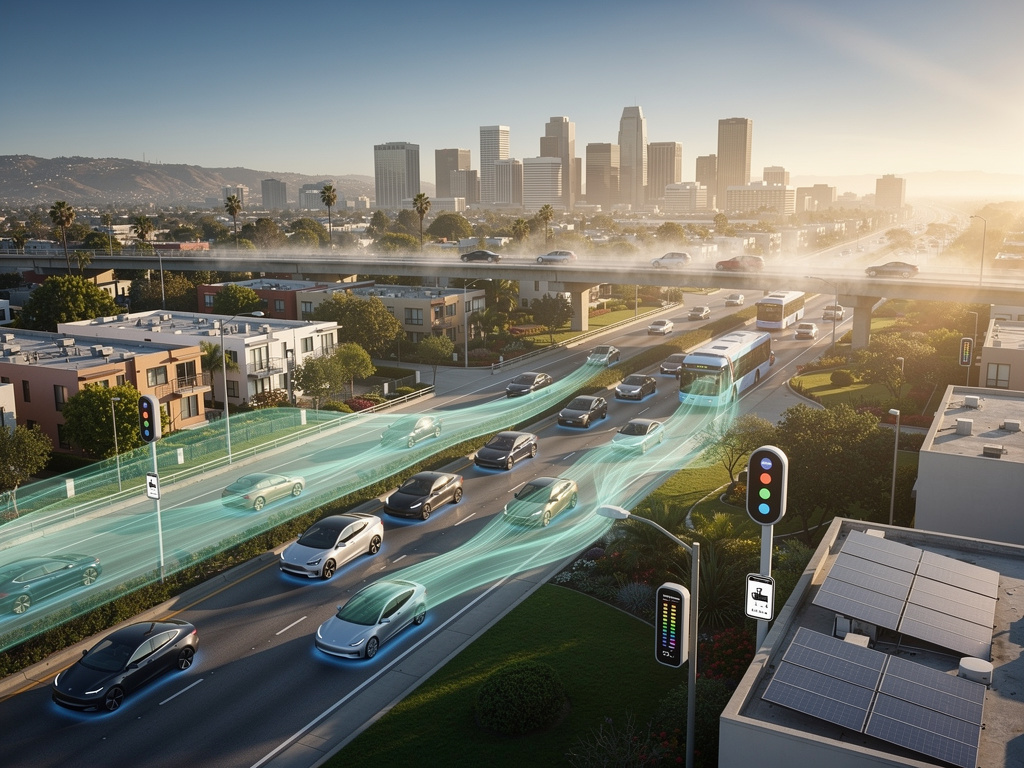
For more than a decade, the promise of cleaner urban air has been a primary justification for the trillions of dollars in public and private capital poured into the electric vehicle revolution. It was a compelling, if largely theoretical, argument based on lab models and emissions projections. Now, groundbreaking research from California is providing the first concrete, real-world evidence that the shift to EVs is paying a tangible “clean air dividend,” demonstrably improving public health in communities with higher adoption rates.
A detailed study led by researchers at the Keck School of Medicine of USC has successfully linked the density of zero-emission vehicles (ZEVs) at the zip code level to quantifiable reductions in harmful air pollution and associated respiratory illnesses. The findings, published in the journal Science of the Total Environment, move the conversation beyond forecasts and into the realm of observed reality, offering critical data for policymakers, urban planners, and automotive executives navigating the costly and complex transition away from the internal combustion engine.
A Direct Link Between EVs, Cleaner Air, and Fewer ER Visits
The USC researchers meticulously analyzed a vast dataset spanning from 2013 to 2019, a period of significant growth in EV ownership across California. They cross-referenced zip code-level ZEV registration data with readings from the state’s extensive network of air quality monitoring stations and records of asthma-related emergency room visits. According to the Keck School of Medicine of USC, the results were statistically significant: for every additional 20 ZEVs per 1,000 people in a given zip code, researchers observed a 3.2% drop in the rate of asthma-related emergency room visits.
This health improvement correlated directly with a measurable, albeit small, decrease in local levels of nitrogen dioxide (NO2), a toxic gas predominantly produced by burning fossil fuels in vehicles. NO2 is a known respiratory irritant that can trigger and worsen asthma, bronchitis, and other lung conditions. “This is the first study to use real-world data to link the growing ZEV adoption in California to actual air quality improvements and a resulting reduction in asthma-related health care utilization,” said Erika Garcia, PhD, MPH, an assistant professor of population and public health sciences at the Keck School of Medicine and the study’s lead author.
Quantifying the Broader Public Health Imperative
The USC study’s hyper-local findings are a microcosm of a much larger potential public health windfall. A nationwide analysis by the American Lung Association projects that a complete transition to zero-emission vehicles by 2035 would generate staggering benefits. Their “Driving to Clean Air” report estimates such a shift could result in over $1.2 trillion in public health savings by 2050, stemming from the prevention of 110,000 premature deaths and nearly 3 million asthma attacks.
This economic and health case provides powerful ammunition for proponents of accelerated electrification. While consumer incentives and emissions regulations often face scrutiny over their cost, this emerging body of evidence reframes the debate by quantifying the immense societal cost of inaction. The data suggests that investments in EV infrastructure and purchase subsidies are not just climate or energy policies, but are also direct investments in public health with a clear return.
The Uneven Distribution of Clean Air Gains
However, the USC research also highlights a critical challenge in the electric transition: equity. The study revealed that the air quality and health benefits were not evenly distributed. Instead, they were concentrated in zip codes with higher median incomes and educational attainment—the same communities that have, to date, seen the highest rates of EV adoption. This underscores a growing concern that the initial benefits of decarbonization may bypass the low-income communities and communities of color that are often located closer to major roadways and disproportionately suffer from traffic-related air pollution.
“The benefits of ZEVs may not be reaching the communities that need them most,” noted Sandrah Eckel, PhD, a co-senior author of the study and an associate professor at the Keck School of Medicine. This finding presents a direct challenge to policymakers and industry leaders to develop more targeted incentive programs, such as incentives for used EVs and investments in public charging infrastructure in underserved neighborhoods, to ensure a more equitable distribution of the clean air dividend.
Beyond the Tailpipe: A New Focus on Non-Exhaust Emissions
While the reduction in tailpipe emissions like NO2 is a clear victory, industry insiders are increasingly focused on the challenge of non-exhaust emissions. As vehicles become heavier due to large battery packs, particulate matter from brake and tire wear is emerging as a significant source of pollution. A report from Emissions Analytics, an independent testing firm, highlighted that particle pollution from tires can be substantially worse than that from modern internal combustion engine exhausts, which are equipped with highly effective particulate filters.
This form of pollution, primarily PM2.5, consists of fine inhalable particles that can penetrate deep into the lungs and enter the bloodstream, causing serious health issues. Addressing this will require a new wave of innovation in tire composition, braking systems (such as more aggressive regenerative braking that reduces friction brake use), and potentially new regulatory frameworks that look beyond what comes out of the tailpipe. For the automotive industry, it represents the next frontier in designing truly clean vehicles.
Policy and Market Momentum Accelerate
The tangible evidence of EV benefits is arriving as policy and market forces are aligning to accelerate the transition globally. The International Energy Agency reported that global electric car sales were on track to reach 17 million in 2024, accounting for more than one in five cars sold worldwide. This rapid growth is being driven by ambitious regulations in key markets.
In the United States, California’s Advanced Clean Cars II rule, administered by the California Air Resources Board, mandates that all new passenger cars, trucks, and SUVs sold in the state be zero-emission by 2035. At the federal level, the U.S. Environmental Protection Agency has finalized stringent new multi-pollutant emissions standards for light-duty vehicles that will significantly boost EV sales through the end of the decade. These regulations create market certainty and force automakers to accelerate their electrification strategies, a move now bolstered by clear evidence of public health returns.
The Path Forward in an Electrified World
The connection between EV adoption and improved public health is no longer a matter of speculation. The data from California provides a powerful validation of the core premise behind the electric transition. It proves that as more EVs silently navigate city streets, the air becomes cleaner and residents, particularly vulnerable ones with conditions like asthma, can literally breathe easier.
The road ahead requires a multi-faceted approach. It demands that industry tackle the next generation of challenges, such as non-exhaust emissions and battery lifecycle management. It also calls upon policymakers to ensure the benefits of this technological shift are shared by all communities, not just the most affluent. But for the first time, the debate can be grounded in the fact that the clean air dividend is real, it is measurable, and it is already being paid out on the streets of early-adopter communities.


 WebProNews is an iEntry Publication