
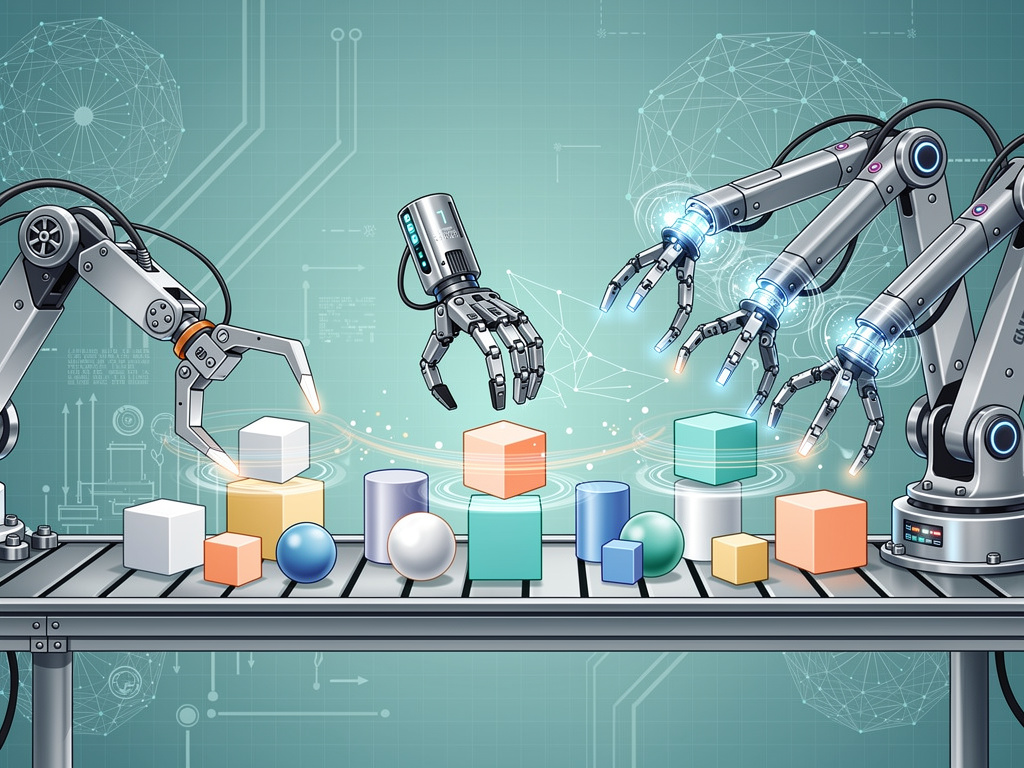
It started with a claw machine. Not the kind you’d find at an arcade, rigged to disappoint children and drain quarters, but a sophisticated robotic gripper powered by artificial intelligence — the kind that could, in theory, pick up almost anything. And from that deceptively simple premise, an entire competitive front has opened in the AI industry, one that’s drawing major players, significant capital, and a growing chorus of skeptics who wonder whether any of it will work at scale.
The story of how AI-powered robotic manipulation went from a niche research curiosity to a full-blown corporate arms race is, at its core, a story about the physical world — and the staggering difficulty of teaching machines to interact with it.
From ClawdBot to OpenClaw: The Accelerating Timeline
As CNET recently detailed, the progression from early prototypes like ClawdBot to more advanced systems such as MoltBot and eventually the open-source initiative OpenClaw has been remarkably swift. ClawdBot, an early demonstration project, showed that large language models could be paired with robotic arms to interpret natural-language commands and translate them into physical actions. Tell it to pick up a red ball. It picks up a red ball. Simple enough in a demo. Brutally hard in an unstructured environment.
MoltBot represented the next iteration — a system that could adapt its grip strength, approach angle, and manipulation strategy based on the object’s shape, weight, and material properties. The jump from ClawdBot to MoltBot wasn’t incremental. It was categorical. Where ClawdBot relied on pre-programmed object libraries and relatively constrained environments, MoltBot introduced real-time sensory feedback loops that allowed the robot to adjust mid-grasp. Drop rates fell. Versatility climbed.
Then came OpenClaw.
OpenClaw is the open-source framework that emerged from this lineage, designed to let researchers, startups, and even hobbyists build their own AI-powered manipulation systems without starting from scratch. According to CNET’s reporting, the project has already attracted contributions from dozens of independent developers and several university robotics labs. The pitch is straightforward: democratize access to robotic grasping intelligence the same way open-source LLMs democratized access to language models.
But the comparison only goes so far. Language models operate in the domain of text — infinitely reproducible, easily distributed, and fundamentally digital. Robotic manipulation operates in the physical world, where a millimeter of miscalculation means a shattered glass or a dropped surgical instrument. The gap between a compelling demo and a deployable product remains enormous.
The timing of OpenClaw’s emergence isn’t accidental. It arrives amid a broader push across the tech industry to move AI out of the cloud and into the physical world. Google DeepMind has been publishing research on robotic transformer models. Tesla continues to develop its Optimus humanoid robot. Startups like Covariant (recently acquired by Amazon) and Physical Intelligence have raised hundreds of millions of dollars on the promise that AI can finally make robots useful outside of highly controlled factory settings.
Amazon’s acquisition of Covariant, announced by the company in 2024, was particularly telling. Covariant had built AI systems specifically for warehouse picking — teaching robots to identify, grasp, and sort the chaotic jumble of products that flow through fulfillment centers. Amazon didn’t just want the technology. It wanted the team, the data, and the years of real-world trial and error that produced it.
Physical Intelligence, meanwhile, raised $400 million at a $2.4 billion valuation, as Reuters reported. The company’s thesis: a single foundation model for robotic control, capable of generalizing across tasks the way GPT-4 generalizes across text. Bold. Possibly premature. But backed by enough money to find out.
Why Grasping Is the Hard Problem Nobody Talks About
For all the attention paid to chatbots, image generators, and AI agents that can book flights, the manipulation problem remains one of the most consequential unsolved challenges in artificial intelligence. Consider the logistics industry alone. Warehouses still rely heavily on human workers to pick and pack items because robots can’t reliably handle the sheer variety of objects — different sizes, shapes, weights, textures, levels of fragility. A human worker intuitively adjusts their grip when picking up an egg versus a textbook. Teaching a robot to do the same requires solving problems in computer vision, tactile sensing, force control, motion planning, and real-time decision-making simultaneously.
And that’s just warehouses.
In manufacturing, agriculture, food service, healthcare, elder care, and construction, the same fundamental challenge appears in different forms. How do you build a machine that can handle novel objects in unstructured environments without breaking things, hurting people, or simply failing? The OpenClaw project and its predecessors represent one approach: build a shared foundation of grasping intelligence that can be adapted to specific use cases, rather than forcing every company to solve the problem from zero.
The open-source angle is strategically interesting. By releasing the framework publicly, the developers behind OpenClaw are betting that community contributions will accelerate progress faster than any single corporate lab could manage alone. It’s the Linux model applied to robotic hands. Whether it works depends on whether enough contributors show up — and whether the resulting code is reliable enough for commercial deployment.
So far, the signs are mixed. Open-source robotics projects have historically struggled to gain the kind of momentum that open-source software enjoys. Hardware is expensive. Testing requires physical setups. Bugs can cause real damage. The feedback loop between writing code and seeing results is orders of magnitude slower than in pure software development.
But the AI layer changes the calculus somewhat. Because much of the intelligence in systems like OpenClaw lives in software — neural network weights, control algorithms, simulation environments — contributors can work on the brains of the robot without necessarily having the body. Simulation platforms like NVIDIA’s Isaac Sim and Google’s robotic simulation tools allow developers to train and test grasping policies in virtual environments before deploying them on physical hardware. This lowers the barrier to entry considerably.
The commercial implications are significant. If OpenClaw or a similar project succeeds in creating a broadly capable, open-source grasping framework, it could compress the timeline for startups entering the physical AI space. Instead of spending two years and $10 million building basic manipulation capabilities, a company could start with a functional foundation and focus its resources on domain-specific refinement. That’s the theory, anyway.
Not everyone is convinced. Critics point out that robotic manipulation in the real world is dominated by edge cases — the weird shapes, the unexpected materials, the objects that are wet or dusty or tangled together. A foundation model that handles 90% of objects is impressive in a lab. In a commercial setting, it’s the remaining 10% that determines whether the system is viable. And that last 10% is where most of the difficulty lives.
The Stakes Beyond the Warehouse
The race to solve robotic grasping isn’t just a technical competition. It’s an economic one. McKinsey has estimated that automation could add trillions of dollars to global GDP over the coming decades, but much of that value is locked behind the manipulation problem. Self-driving cars get the headlines. Robotic arms that can fold laundry could have a bigger economic impact.
Japan, facing acute labor shortages driven by demographic decline, has invested heavily in service robots that can assist elderly citizens. South Korea is doing the same. China’s manufacturing sector, long powered by cheap labor, is rapidly automating as wages rise and the working-age population shrinks. In each case, the bottleneck isn’t computing power or AI algorithms. It’s the physical interface — the gripper, the hand, the mechanism that actually touches the world.
The progression from ClawdBot to MoltBot to OpenClaw mirrors a pattern familiar from other areas of AI development. First, a proof of concept. Then, a more capable but still proprietary system. Then, an open-source release that broadens access and accelerates iteration. It happened with language models (GPT to LLaMA). It happened with image generation (DALL-E to Stable Diffusion). Now it’s happening with robotic manipulation.
Whether the pattern holds through to commercial maturity is the open question. Language models and image generators operate in purely digital domains where scaling is relatively straightforward. Robotic manipulation must contend with physics, hardware variability, safety regulations, and the irreducible messiness of the real world. The gap between a viral demo and a product that works reliably on a factory floor, day after day, is vast.
And yet the money keeps flowing. The talent keeps moving. The papers keep publishing. For an industry that spent the last two years fixated on chatbots, the pivot toward physical AI feels both overdue and inevitable. The claw machines are getting smarter. The question is whether they’re getting smart enough, fast enough, to matter.


 WebProNews is an iEntry Publication