
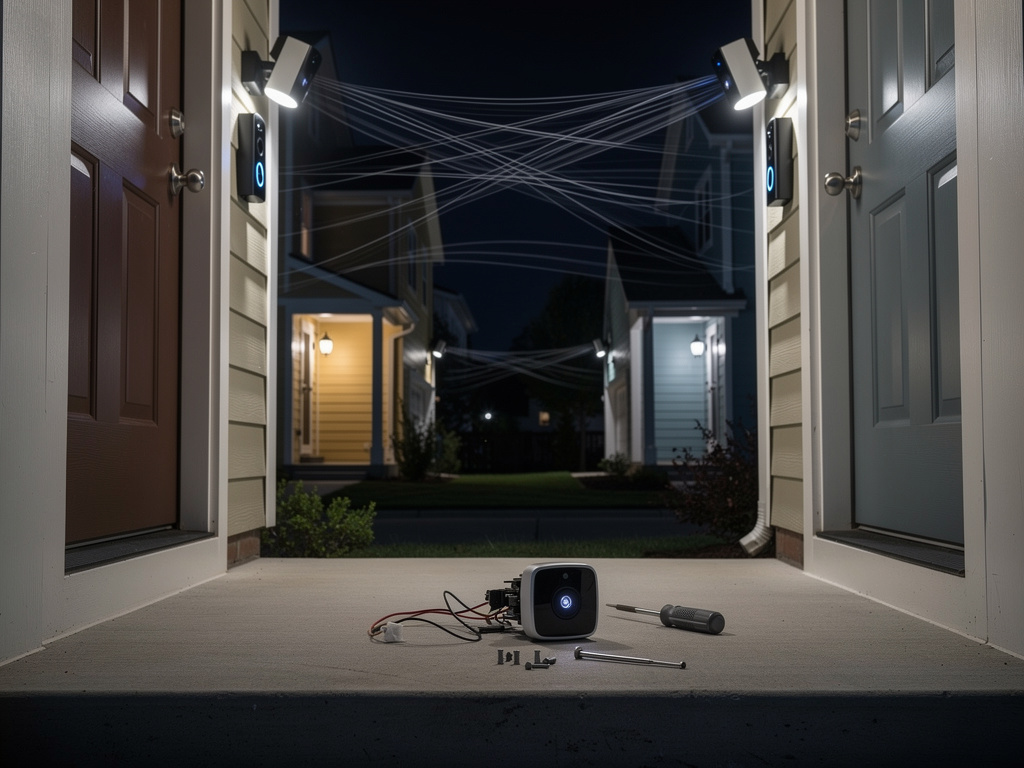
Hamilton Nolan doesn’t think you need a Ring camera. He thinks you need a claw hammer.
In a recent essay on his Substack publication, the veteran labor journalist and author made a case that is equal parts polemic and provocation: that Amazon’s Ring doorbell cameras — those small, glowing sentinels now mounted on tens of millions of American homes — represent something far more corrosive than a simple consumer electronics product. They are, in his framing, instruments of a surveillance infrastructure that has been sold to the public under the guise of neighborhood safety but functions primarily to normalize constant monitoring, erode community trust, and feed data to one of the most powerful corporations on earth.
“Remove your Ring camera with a claw hammer,” Nolan wrote on his Substack, dispensing with any pretense of measured techno-skepticism. The essay is blunt, deliberately provocative, and aimed squarely at a liberal professional class that he believes has sleepwalked into a bargain it doesn’t fully understand.
The argument isn’t new. But the cultural moment might finally be catching up to it.
The Quiet Sprawl of Amazon’s Surveillance Network
Ring, which Amazon acquired in 2018 for approximately $1 billion, has become the dominant player in the consumer home security camera market. The company has sold more than 20 million devices in the United States alone, according to estimates from multiple industry analysts. Its cameras are mounted above front doors in suburbs, on apartment building hallways in cities, and increasingly on small businesses in rural towns. The Neighbors app, Ring’s companion social platform, functions as a kind of perpetual neighborhood watch feed — a scrolling stream of package thieves, wandering strangers, and suspicious cars that users can post and comment on.
Amazon has aggressively marketed Ring as a tool for community safety. The company has partnered with more than 2,000 police departments and fire departments across the country, giving law enforcement the ability to request footage from Ring users through the Neighbors app portal. For years, these partnerships operated with minimal public scrutiny. That changed in 2022, when Amazon confirmed to Senator Edward Markey that Ring had provided footage to law enforcement without user consent or a warrant in at least 11 cases that year, as reported by Politico.
The backlash was swift. Civil liberties organizations, including the Electronic Frontier Foundation and the American Civil Liberties Union, condemned the practice. Amazon subsequently announced policy changes, stating that it would require law enforcement to obtain a warrant or demonstrate an emergency to access footage without user permission. But the damage to public trust was real, and it underscored a point that critics like Nolan have been making for years: the infrastructure was built first, the rules written later, and the public was the last to know.
Nolan’s essay situates Ring within a broader critique of what he calls the privatization of public space. The cameras don’t just watch your porch. They watch the sidewalk. They watch the street. They watch anyone who walks past your house, whether they’re a delivery driver, a canvasser, a teenager, or a person experiencing homelessness. And all of that footage flows back to Amazon’s servers, where it can be stored, analyzed, requested by police, or — as privacy researchers have warned — potentially used to train machine learning models.
This is not hypothetical. In 2023, the Federal Trade Commission fined Ring $5.8 million for failing to adequately protect customer video footage from unauthorized access by employees and contractors, and for deploying cameras in ways that violated children’s privacy protections. The FTC’s complaint alleged that Ring employees had accessed private customer videos without authorization, and that the company had failed to implement basic security measures for years after being alerted to the problem, as the FTC detailed in its press release.
Five point eight million dollars. For a subsidiary of a company worth more than $1.8 trillion. The fine was a rounding error.
Nolan’s frustration with this dynamic is palpable in his writing. He argues that the transaction at the heart of Ring — trade your privacy and your neighbors’ privacy for a feeling of security — is a bad deal on its own terms. The research on whether surveillance cameras actually reduce crime is, at best, mixed. A comprehensive meta-analysis published in the Journal of Quantitative Criminology found that CCTV cameras had a modest effect on property crime in parking lots but showed little to no statistically significant impact on violent crime or crime in residential areas. The feeling of safety, in other words, may be just that — a feeling.
But Nolan goes further. He contends that the cameras actively make communities worse. They replace human relationships — knowing your neighbors, trusting the people on your block — with technological intermediaries. They encourage a paranoid, suspicious orientation toward the outside world. And they disproportionately target people of color, the unhoused, and anyone whose presence in a given neighborhood is deemed “suspicious” by the overwhelmingly white, homeowning demographic that dominates Ring’s user base.
This last point has been extensively documented. Researchers at MIT and other institutions have studied the Neighbors app and found patterns of racial profiling baked into its usage. Posts flagging Black and brown individuals as suspicious, often for doing nothing more than walking down a street or approaching a door, are common. The app’s design — with its emphasis on alerts, its proximity to police partnerships, and its framing of neighborhood life as a series of potential threats — actively encourages this kind of behavior.
A Political Argument Disguised as a Consumer Choice
What makes Nolan’s essay distinctive isn’t the privacy critique alone. That ground has been well-trodden by the EFF, the ACLU, academic researchers, and investigative journalists at outlets like Politico and The Markup. What sets his piece apart is the class analysis underneath it.
Nolan — whose book The Hammer chronicles the resurgence of American labor organizing — frames Ring as a product of, and for, a particular kind of American homeowner: someone affluent enough to own property, anxious enough to surveil it, and disconnected enough from their community to prefer a camera over a conversation. He sees the Ring doorbell as a physical manifestation of a broader social withdrawal — the retreat of the professional class behind walls of technology, away from the friction and reciprocity of actual civic life.
It’s a pointed critique. And it lands differently in 2025 than it might have five years ago.
The political valence of surveillance technology has shifted. Under the previous administration, concerns about government and corporate surveillance were largely associated with the political left and civil libertarians. But the current political environment has scrambled those alignments. Conservatives alarmed by government overreach — particularly in the wake of January 6 prosecutions that relied heavily on private surveillance footage, social media data, and cell phone location tracking — have found unexpected common ground with privacy advocates on the left. The idea that a vast network of privately owned cameras, feeding data to both a trillion-dollar corporation and local police departments, might not be an unalloyed good has become more bipartisan than it once was.
Amazon, for its part, has continued to invest heavily in Ring and its associated technologies. The company integrated Ring into its broader smart home strategy alongside Alexa, its voice assistant, and has expanded into drone-based home security with the Ring Always Home Cam — a small autonomous drone that flies through your house to check on things. The product, announced in 2020 and shipped in limited release, was met with a mixture of fascination and horror. A surveillance drone. Inside your home. Made by Amazon.
And yet the devices keep selling. Ring’s market share in the video doorbell category remains dominant, and the broader home security camera market is projected to reach $14 billion globally by 2027, according to industry research from Mordor Intelligence. Consumer demand for these products shows no sign of abating, even as awareness of their privacy implications has grown.
This is the tension at the core of Nolan’s argument. He isn’t making a case that will win on the merits of consumer preference. People like their Ring cameras. They like seeing who’s at the door. They like the clips of porch pirates and the alerts when someone approaches. The product works, in the narrow sense that it does what it promises. Nolan’s argument is that what it promises isn’t worth what it costs — not in dollars, but in the kind of society it builds.
That’s a harder sell. It requires people to think beyond their own front porch, to consider the aggregate effect of millions of cameras pointed at public space, to weigh the comfort of watching a screen against the discomfort of being watched by one. It requires, in Nolan’s framing, a kind of civic imagination that consumer technology is specifically designed to short-circuit.
Recent developments have only sharpened these concerns. Reports have surfaced in 2025 about law enforcement agencies in multiple states expanding their use of real-time crime centers — centralized surveillance hubs that aggregate feeds from public and private cameras, license plate readers, gunshot detection systems, and social media monitoring tools. Ring footage is increasingly part of this patchwork. The line between a private consumer product and a public surveillance apparatus has become vanishingly thin.
Meanwhile, Amazon’s relationship with law enforcement continues to evolve. While the company formally ended its practice of allowing police to directly request footage through the Neighbors app in 2024, critics point out that police can still obtain Ring footage through subpoenas, warrants, and voluntary user cooperation — and that the sheer density of Ring cameras in many neighborhoods means that law enforcement effectively has access to a distributed surveillance network whether Amazon formally facilitates it or not.
The Hammer, Literal and Otherwise
Nolan’s prescription — take a claw hammer to your Ring camera — is obviously rhetorical. Mostly. He’s not actually organizing demolition squads. But the image is deliberate, and it connects to his broader body of work about the physical, material nature of power. In The Hammer, he argues that labor’s strength comes not from clever messaging or political endorsements but from the raw economic power of workers withholding their labor. The claw hammer is the same idea applied to surveillance: the most effective form of resistance is the most direct one. Don’t lobby Amazon. Don’t write to your senator. Just remove the camera.
It’s a satisfying fantasy. Whether it’s a viable politics is another question.
The reality is that the surveillance infrastructure Nolan describes is not going to be dismantled by individual consumer choices, any more than climate change will be solved by individual recycling habits. The problem is structural. Amazon built Ring into a network that is valuable precisely because of its scale — millions of cameras, millions of data points, thousands of police partnerships. Removing one camera from one house doesn’t change the network. It just means your porch isn’t part of it.
But Nolan would likely argue that this framing — the idea that individual action is futile in the face of structural power — is itself part of the problem. It’s the logic that keeps people buying the cameras, keeps them plugged into the network, keeps them scrolling the Neighbors app at 11 p.m. looking for threats that may or may not exist. The claw hammer is a rejection of that logic. It’s a refusal to participate.
And there is something to be said for refusal. The history of consumer resistance movements — from boycotts to divestment campaigns to the slow food movement — suggests that individual choices, when they become collective, can shift markets and norms. If enough people decided that surveilling their neighbors wasn’t worth the trade-off, Ring’s value proposition would collapse. Not because of regulation. Not because of lawsuits. Because the product would stop making sense.
That’s a big if. But Nolan has never been in the business of small arguments.
The essay ends without a neat resolution, which is appropriate. The questions it raises — about privacy, about community, about the kind of society that builds itself around suspicion rather than trust — don’t have neat resolutions. They have choices. And Nolan’s point, stripped of its rhetorical flourish, is simple: you are making a choice every day that camera stays on your wall. You just might not have thought about what you’re choosing.
So think about it. Then decide what to do with the hammer.


 WebProNews is an iEntry Publication