
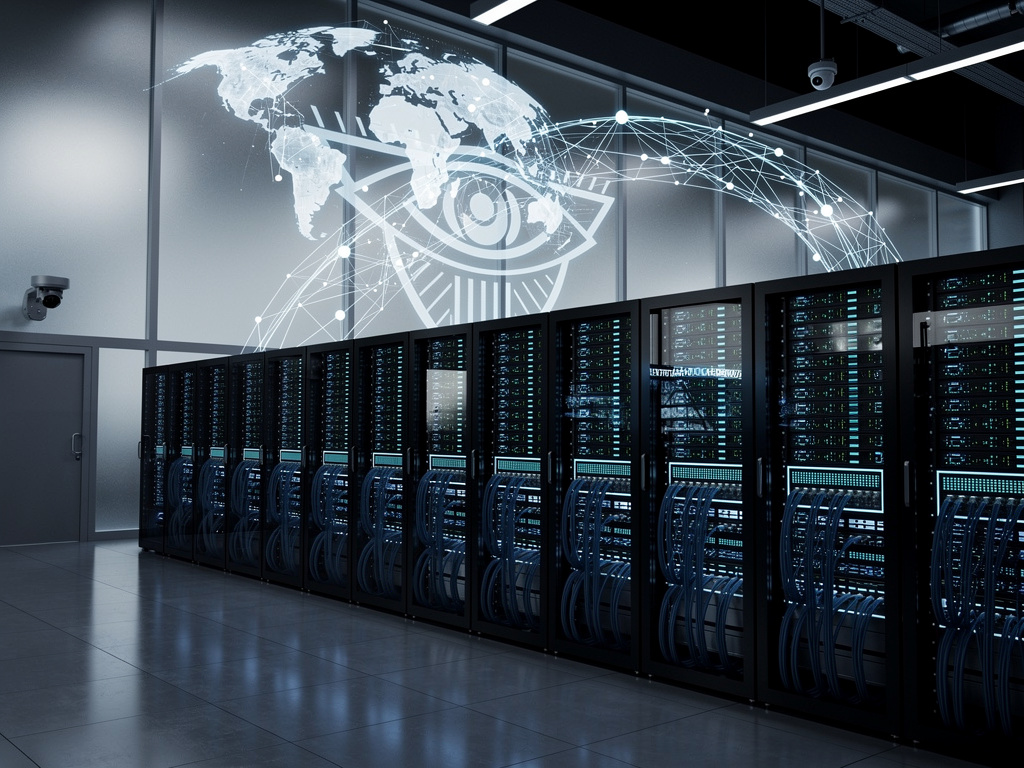
In-Q-Tel, the nonprofit venture capital arm of the Central Intelligence Agency, has invested in Prometheus Hyperscale, a data center development company — a move that signals just how deeply the U.S. intelligence community is now entangled with the physical infrastructure powering artificial intelligence. The investment, first reported by The Information, marks a striking departure from the kind of bets In-Q-Tel typically makes. This isn’t a cybersecurity startup or a satellite imaging firm. It’s a company that builds the actual buildings where AI models train and run.
That distinction matters.
For decades, intelligence agencies have poured money into software, sensors, and signals intelligence tools. The hardware was someone else’s problem — usually a hyperscaler like Amazon Web Services or Microsoft Azure, both of which hold massive cloud contracts with the federal government. But the explosion in AI compute demand has rewritten the calculus. The U.S. government now recognizes that access to physical data center capacity is itself a strategic asset, one that could be constrained by everything from power grid limitations to geopolitical competition with China. In-Q-Tel’s investment in Prometheus Hyperscale is an acknowledgment that the intelligence community can’t afford to sit on the sidelines while private-sector players scramble for megawatts and server racks.
Prometheus Hyperscale, based in the United States, has been developing large-scale data center campuses designed specifically for the power-hungry workloads that AI training demands. Details about the company remain relatively scarce — it doesn’t maintain a high public profile — but its pitch centers on building facilities that can deliver the kind of sustained, high-density power that GPU clusters require. That’s a nontrivial engineering challenge. Modern AI training runs consume electricity at rates that would have seemed absurd even five years ago, and the bottleneck for many organizations isn’t chips or capital. It’s power.
In-Q-Tel doesn’t invest for financial returns. It invests to give U.S. intelligence agencies early access to technologies and capabilities they might otherwise miss. The firm was established in 1999 with backing from the CIA, and its portfolio over the years has included companies working on everything from language translation to geospatial analytics. An investment in a data center developer, though, represents a different kind of thesis — one rooted not in novel algorithms but in the concrete, steel, and electrical substations that make those algorithms possible.
The timing isn’t accidental. Washington has spent the past 18 months in an escalating push to secure AI dominance, with the Biden administration issuing executive orders on AI safety and export controls on advanced chips, and the Trump administration continuing to emphasize AI infrastructure as a national priority. In January 2025, President Trump announced the Stargate Project, a joint venture involving OpenAI, SoftBank, and Oracle that aims to invest up to $500 billion in AI infrastructure across the United States. That announcement electrified the data center industry and underscored a bipartisan consensus: whoever controls the physical infrastructure of AI holds enormous power.
And the competition for that infrastructure is ferocious. According to recent reporting from Reuters, data center construction in the U.S. has surged to record levels, with developers racing to secure power purchase agreements and land in regions with available grid capacity. Northern Virginia remains the world’s largest data center market, but capacity constraints there have pushed developers into new geographies — Texas, the Midwest, even rural areas with access to cheap hydroelectric or natural gas power. Prometheus Hyperscale appears to be positioning itself in this land grab, though the specific locations of its projects haven’t been widely disclosed.
The intelligence community’s interest in dedicated data center capacity reflects a broader anxiety about supply chain resilience. The U.S. government already relies heavily on commercial cloud providers — the NSA and CIA both use AWS infrastructure under classified contracts, and the Department of Defense awarded its Joint Warfighting Cloud Capability contract to AWS, Google, Microsoft, and Oracle in late 2022. But those arrangements come with limitations. Shared infrastructure means shared risk. And as AI workloads grow more sensitive — think real-time battlefield analysis, signals intelligence processing, or large language models trained on classified data — the case for purpose-built, government-aligned facilities gets stronger.
There’s a geopolitical dimension too. China has been building data centers at a rapid clip, and its tech giants — including Alibaba, Tencent, and ByteDance — have invested heavily in AI training infrastructure both domestically and in Southeast Asia. The Chinese government views AI as a core element of national power, and its industrial policy reflects that. The U.S. response has included not just chip export controls but a growing emphasis on ensuring that domestic compute capacity keeps pace with demand. In-Q-Tel’s bet on Prometheus Hyperscale fits squarely within that framework.
So what does Prometheus actually do differently? The company’s focus appears to be on what the industry calls “AI-ready” facilities — data centers engineered from the ground up for high-performance computing rather than retrofitted from traditional enterprise hosting designs. That means higher power densities per rack, advanced liquid cooling systems, and electrical infrastructure capable of handling the sustained loads that GPU clusters impose. Traditional data centers might deliver 10 to 15 kilowatts per rack. AI training facilities increasingly need 40, 60, or even 100 kilowatts per rack. The gap between those numbers is where companies like Prometheus see their opportunity.
The financial mechanics of In-Q-Tel investments are worth understanding. The firm receives funding from the CIA and other intelligence agencies, and it typically takes minority stakes in companies whose technologies align with intelligence community needs. It doesn’t seek board seats or control. What it does seek is a relationship — a pipeline through which agencies can evaluate, test, and eventually procure new capabilities. For a company like Prometheus, an In-Q-Tel investment brings credibility, government connections, and a potential anchor tenant. For the intelligence community, it brings visibility into a sector that’s moving fast and where early positioning matters.
Private capital has been flooding into data center development. Blackstone, KKR, and Brookfield have all made multibillion-dollar commitments to the sector. Digital Realty and Equinix, the two largest publicly traded data center REITs, have seen their valuations surge. And a new class of AI-focused developers — including Crusoe Energy, Applied Digital, and CoreWeave — has emerged to serve the specific needs of AI training customers. Prometheus Hyperscale is entering a crowded field, but the In-Q-Tel backing gives it a differentiated customer base that most competitors can’t easily access.
Not everyone is convinced the current pace of data center construction is sustainable. Some analysts have warned of a potential overbuild, drawing parallels to the fiber-optic boom of the late 1990s. But the counterargument is straightforward: AI model sizes continue to grow exponentially, inference workloads are scaling even faster than training, and enterprise adoption of AI is still in its early stages. If anything, the constraint isn’t demand — it’s supply. Power, specifically. Utilities across the country are struggling to keep up with interconnection requests from data center developers, and permitting timelines for new generation capacity can stretch years.
That power crunch has become a national security concern in its own right. The Department of Energy has begun studying the grid impacts of large-scale data center deployment, and several states have started imposing moratoriums or additional review requirements on new data center projects. In Georgia, regulators have pushed back on utility plans to add generation capacity for data centers, citing cost concerns for residential ratepayers. In Virginia, Dominion Energy has warned that the pace of data center growth could strain the regional grid. These aren’t abstract policy debates. They directly affect the intelligence community’s ability to access the compute it needs.
In-Q-Tel’s investment in Prometheus Hyperscale should be read in this context. It’s not just a bet on a company. It’s a bet on a thesis: that the U.S. government needs its own pipeline of AI-ready data center capacity, separate from and complementary to its existing cloud contracts, and that securing that capacity requires getting involved at the development stage rather than waiting for facilities to come online and hoping there’s room.
The broader pattern is unmistakable. Government-adjacent capital is flowing into AI infrastructure at every layer of the stack — from chip fabrication (the CHIPS Act has directed tens of billions toward domestic semiconductor manufacturing) to model development (the National Science Foundation has funded AI research initiatives) to now the physical plants where it all runs. In-Q-Tel’s move is one piece of a much larger mobilization.
Whether Prometheus Hyperscale becomes a major player in the data center industry remains to be seen. The company is still relatively early-stage compared to giants like Digital Realty or even fast-growing upstarts like CoreWeave, which recently went public at a valuation exceeding $20 billion. But the In-Q-Tel imprimatur carries weight. It signals to other investors, to utilities, and to local governments that this company has the backing — implicit or explicit — of the U.S. intelligence apparatus. In a sector where permitting, power access, and political relationships can make or break a project, that signal is worth more than the dollar amount of the investment itself.
The CIA’s venture arm investing in a company that pours concrete and pulls electrical cable. A few years ago, that would have seemed bizarre. Now it looks like foresight.


 WebProNews is an iEntry Publication