
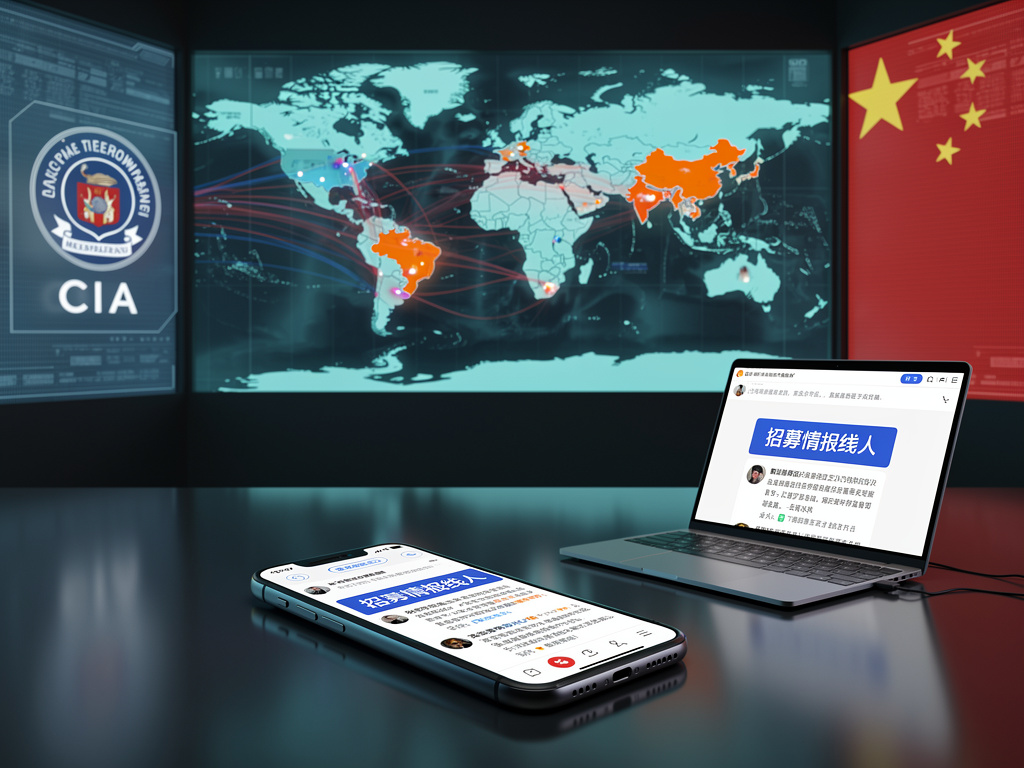
In a move that underscores the intensifying intelligence rivalry between Washington and Beijing, the Central Intelligence Agency has launched an aggressive new campaign to recruit informants from within China’s military and intelligence apparatus. The effort, which leverages Mandarin-language social media videos and encrypted communication channels, represents one of the most public overtures by a Western spy agency toward the personnel of a rival superpower in modern history.
The campaign, first reported widely in mid-February 2025, involves the CIA posting slickly produced recruitment videos on YouTube and other platforms, directly appealing to members of the People’s Liberation Army (PLA), China’s Ministry of State Security (MSS), and other government officials who may harbor disillusionment with the Chinese Communist Party. The videos, narrated in Mandarin, instruct potential recruits on how to securely contact the agency, emphasizing operational security and the promise of confidentiality.
A Public Recruitment Drive With Deep Strategic Roots
According to Slashdot, which aggregated coverage of the initiative, the CIA’s push is not entirely without precedent. The agency conducted a similar, though smaller-scale, recruitment effort targeting Chinese nationals in 2023, posting its first Mandarin-language video on social media platforms. That earlier campaign was widely viewed as a signal of intent — a public declaration that the United States was willing to go on the offensive in the espionage domain against China. The latest iteration, however, is far more ambitious in scope and sophistication.
The recruitment videos are carefully crafted to appeal to a specific psychological profile: individuals within the Chinese state apparatus who have become disillusioned with corruption, political repression, or the direction of Xi Jinping’s leadership. The messaging emphasizes themes of personal integrity, the protection of one’s family, and the idea that cooperating with the CIA is an act of conscience rather than betrayal. Intelligence analysts note that this framing is deliberate, designed to lower the psychological barriers that might prevent a potential asset from making initial contact.
Encrypted Channels and the Digital Frontline of Espionage
One of the most notable aspects of the campaign is its reliance on digital infrastructure. The CIA has directed potential informants to reach out via encrypted platforms, including guidance on using virtual private networks (VPNs) and the Tor browser to circumvent China’s Great Firewall. The agency has also provided instructions for contacting it through its official website, which includes a dedicated portal for tips and intelligence submissions. This digital-first approach reflects a broader transformation in how intelligence agencies conduct human intelligence (HUMINT) operations in the 21st century.
The move is not without risk. China’s domestic surveillance capabilities are among the most advanced in the world, and the MSS has invested heavily in monitoring digital communications, tracking VPN usage, and identifying individuals who access blocked foreign websites. For any Chinese military officer or intelligence operative considering reaching out to the CIA, the operational risks are enormous. Beijing has historically dealt harshly with those convicted of espionage on behalf of foreign powers, with penalties ranging from lengthy prison sentences to execution.
Beijing’s Fierce Counterintelligence Response
China’s reaction to the CIA’s recruitment drive has been swift and pointed. State media outlets have condemned the effort as a brazen act of interference, and the MSS has used its own social media presence — including its verified accounts on WeChat and Weibo — to warn Chinese citizens against engaging with foreign intelligence services. In recent months, Beijing has publicized several cases of individuals allegedly caught spying for the United States, a move widely interpreted as both a deterrent and a propaganda tool.
The MSS has also stepped up its own counterintelligence operations. In 2023 and 2024, Chinese authorities announced a series of arrests of individuals accused of working as CIA assets, some of whom were reportedly identified through digital surveillance. These cases sent a chilling message to anyone within the Chinese system who might be contemplating cooperation with American intelligence. The tit-for-tat dynamic has created what former intelligence officials describe as one of the most intense espionage confrontations since the Cold War.
Why the CIA Is Going Public Now
The decision to make the recruitment campaign so visible is itself a strategic choice. Traditionally, intelligence agencies have preferred to operate in the shadows, cultivating assets through personal relationships, diplomatic cover, and clandestine meetings. The CIA’s willingness to broadcast its intentions on YouTube and social media represents a significant departure from that tradition — one driven by both necessity and opportunity.
On the necessity side, the United States has acknowledged significant intelligence gaps when it comes to China. Former CIA Director William Burns, who served under President Biden, publicly identified China as the agency’s top priority and allocated substantial resources to the mission. The challenge, however, is that China’s internal security environment makes traditional recruitment methods — approaching potential assets at diplomatic functions or during overseas travel — increasingly difficult. The digital campaign is, in part, an acknowledgment that the agency needs to find new ways to reach potential informants who may never leave China.
The Broader Intelligence War Between Washington and Beijing
The recruitment drive exists within a much larger context of escalating intelligence competition between the two superpowers. The United States and China are engaged in a multifaceted contest that spans cyber espionage, technology theft, influence operations, and traditional spycraft. The FBI has repeatedly warned that China operates the largest state-sponsored espionage program in the world, targeting American corporations, universities, and government agencies. Beijing, for its part, accuses Washington of hypocrisy, pointing to revelations by Edward Snowden and others about the extent of American surveillance operations.
The CIA’s focus on recruiting from within the PLA is particularly significant given the current geopolitical tensions surrounding Taiwan, the South China Sea, and China’s rapid military modernization. Access to high-level military intelligence — including details about China’s nuclear posture, missile capabilities, and war planning — would be of extraordinary value to American policymakers and military planners. The stakes of this intelligence contest are not abstract; they bear directly on questions of war and peace in the Indo-Pacific region.
Historical Parallels and the Lessons of Cold War Espionage
Veterans of the intelligence community have drawn parallels between the current campaign and Cold War-era efforts to recruit Soviet military and intelligence officers. Programs like the CIA’s cultivation of Colonel Oleg Penkovsky, a Soviet military intelligence officer who provided critical information during the Cuban Missile Crisis, demonstrated the extraordinary strategic value of a single well-placed asset. The agency is clearly hoping to replicate that kind of success with China.
However, the differences between the Soviet Union and modern China are significant. China’s surveillance state is far more technologically advanced than anything the KGB ever deployed, and the Chinese Communist Party has studied the Soviet collapse with an eye toward preventing similar vulnerabilities. The ideological disillusionment that drove many Soviet defectors may exist within China’s system, but it manifests differently in a society where economic prosperity has provided the party with a powerful source of legitimacy.
What Comes Next in the Shadow War
The CIA’s public recruitment campaign is likely just the visible tip of a much larger covert effort. Intelligence professionals note that the videos and social media outreach serve multiple purposes beyond direct recruitment. They sow distrust within the Chinese security establishment, forcing the MSS to expend resources investigating potential leaks and monitoring its own personnel. They signal to Beijing that the United States is willing to play offense, not just defense, in the intelligence arena. And they may encourage walk-in defectors — individuals who might not have considered contacting the CIA but are prompted to do so by the visibility of the campaign.
For China, the challenge is equally complex. Every public case of an arrested spy serves as a deterrent, but it also raises uncomfortable questions about the extent of foreign penetration. The MSS must balance the need for vigilance against the risk of paralyzing its own institutions with suspicion and paranoia — a dynamic that plagued Soviet intelligence during the Cold War and contributed to its ultimate dysfunction.
As the intelligence war between Washington and Beijing intensifies, the CIA’s recruitment drive stands as a stark reminder that beneath the diplomatic handshakes and trade negotiations, a shadow conflict of enormous consequence is playing out. The officers and officials being targeted by these Mandarin-language videos hold secrets that could shape the future of great power competition — and both sides know it.


 WebProNews is an iEntry Publication