
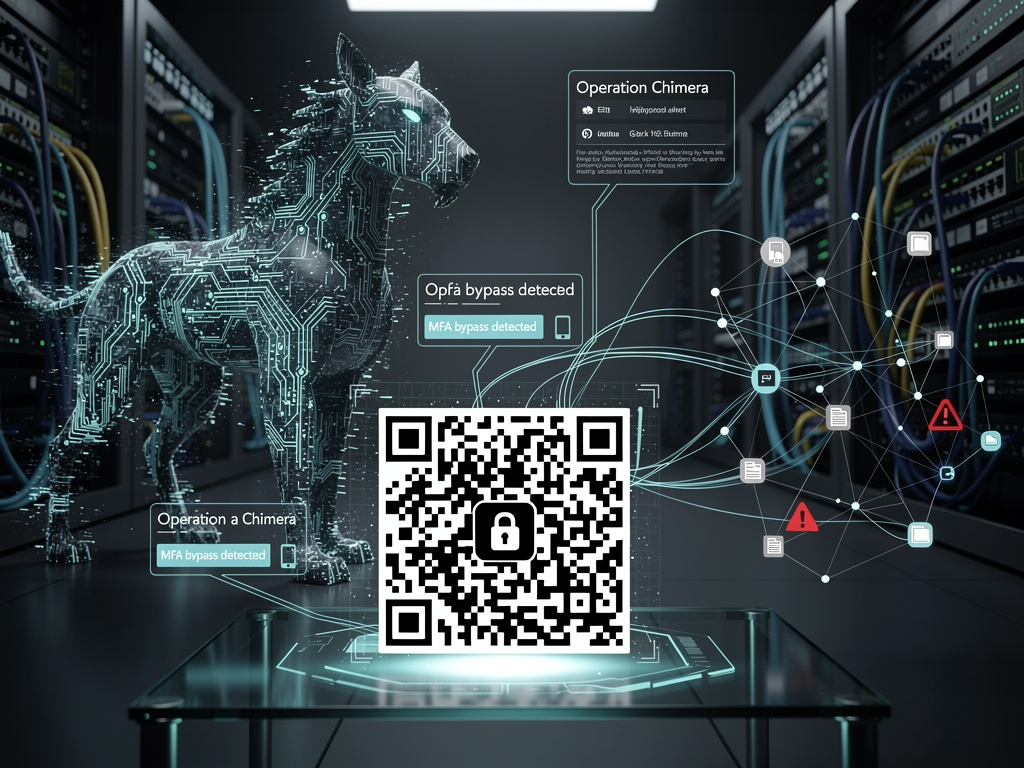
NEW YORK—A new and dangerously sophisticated strain of cyberattack is quietly bypassing the multi-million dollar security systems of major corporations, targeting not just low-level employees but seasoned executives and their financial teams. Security analysts are tracking the rise of multi-stage phishing campaigns, a class of threat so evasive and meticulously designed that it renders many traditional defenses, including some forms of multi-factor authentication (MFA), effectively obsolete.
Dubbed “Operation Chimera” by researchers at the cybersecurity firm Aperture Cyber, these campaigns represent a significant evolution in threat actor methodology. Unlike the clumsy, typo-laden phishing emails of the past, these are patient, multi-step operations that leverage a chain of seemingly innocuous actions to achieve a full network compromise. The initial point of entry is often an email or text message that contains no malicious payload itself, but rather a QR code or a benign-looking link to a legitimate cloud service, designed to lull the target into a false sense of security before the true attack begins.
A Labyrinth of Deceit: Deconstructing the Attack Chain
The first stage of these attacks is engineered to evade automated email security gateways. Instead of embedding a suspicious URL directly in an email, which scanners can easily flag, attackers are increasingly using QR codes in a technique known as “quishing.” An employee scanning a code on their phone with an urgent prompt like “Action Required for Payroll Verification” is immediately taken outside the protected corporate network environment. This simple pivot to a personal device often bypasses enterprise-level URL filtering and analysis, as detailed in a report by BleepingComputer, which notes a significant uptick in these attacks for credential theft.
Once the user clicks, they don’t land directly on a fake login page. Instead, they are funneled through a series of redirects, often using legitimate but compromised websites or abused open-redirect functions on trusted domains. Some advanced threat actors are now using decentralized hosting technologies like the InterPlanetary File System (IPFS) to host their phishing kits. According to analysis from security researchers at Trustwave, IPFS makes malicious sites incredibly resilient to takedowns, as the content isn’t stored on a single, easily blocked server but is distributed across a peer-to-peer network. This labyrinthine path makes it nearly impossible for security tools to trace the connection back to a malicious origin and block it in time.
The Man in the Browser: Weaponizing Trust with Advanced Techniques
The final destination in the attack chain is the most critical: a credential harvesting page. Here, attackers deploy Adversary-in-the-Middle (AiTM) phishing kits. These kits function as a transparent proxy, sitting between the victim and the actual service they are trying to log into, such as Microsoft 365 or Google Workspace. As the user enters their username, password, and even the one-time code from their MFA app, the AiTM kit intercepts this information in real-time and passes it to the legitimate service. As detailed in extensive research by Microsoft, the kit then steals the resulting session cookie.
This session cookie is the master key. With it, the attacker can log into the victim’s account from their own machine without needing the password or MFA, completely hijacking the authenticated session. The commoditization of this technology has lowered the barrier to entry for high-level attacks. AiTM phishing kits like EvilProxy are now sold as a service, allowing less-skilled cybercriminals to launch sophisticated campaigns that can defeat non-phishing-resistant MFA. This Phishing-as-a-Service (PhaaS) model, as described by researchers at Menlo Security, has democratized the tools previously reserved for elite state-sponsored groups.
Beyond the Breach: The Strategic Goals of Modern Phishing Actors
For the architects of Operation Chimera, stealing a login is not the end goal; it is the beginning. Once they have control of a legitimate corporate account, particularly one in the finance or executive department, they establish persistence. The stolen session cookie is used to add a new authenticator device or exploit OAuth permissions to grant a malicious third-party application access to the account. From this foothold, they can conduct internal reconnaissance, moving laterally through the network to identify high-value data, financial systems, and other privileged accounts.
The ultimate objective varies depending on the threat actor. Financially motivated groups, such as the prolific Scattered Spider syndicate, often use this initial access to deploy ransomware or engage in devastating Business Email Compromise (BEC) fraud. According to a Mandiant report on one such group, their tactics often involve sophisticated social engineering to manipulate IT help desks after the initial compromise. For state-sponsored actors, the goal may be corporate espionage: the quiet exfiltration of intellectual property, trade secrets, or sensitive negotiation documents over a period of months.
The High Cost of a Single Click: Quantifying the Business Impact
The financial consequences of a successful multi-stage phishing attack are staggering. The Federal Bureau of Investigation’s Internet Crime Complaint Center (IC3) reported that BEC scams alone resulted in over $2.7 billion in adjusted losses in a single year, highlighting the immense risk posed by compromised email accounts. This figure, found in the FBI’s 2022 Internet Crime Report and cited by ic3.gov, represents only the reported direct financial transfers and does not account for the cascading costs that follow a breach.
Beyond the immediate theft, companies face a long tail of expenses. Incident response and forensic analysis can cost hundreds of thousands of dollars. System remediation, regulatory fines under frameworks like GDPR or CCPA, and litigation from affected customers can escalate the total financial damage into the millions. Perhaps most damaging is the erosion of trust. A public breach can inflict lasting reputational harm, impacting stock prices, customer loyalty, and business partnerships for years to come.
Fortifying the Human Firewall in an Era of Evasive Threats
The rise of AiTM attacks confirms what many security experts have long feared: not all MFA is created equal. Methods like SMS one-time codes and even mobile push-button approvals, while better than a password alone, are proving vulnerable to interception by a determined attacker. These methods can be phished because they do not verify that the user is logging in from the same device that is authenticating. This critical vulnerability is the reason why organizations are being pushed to adopt a higher standard of security.
The solution lies in phishing-resistant MFA. This standard is met by technologies built on the FIDO2/WebAuthn protocol, such as hardware security keys (e.g., YubiKeys) or platform authenticators like Windows Hello and Apple’s Face ID. These methods create a cryptographic bond between the user’s device and the service they are accessing. As the U.S. Cybersecurity and Infrastructure Security Agency (CISA) explains in its guidance, a user can’t be tricked into authenticating on a phishing site because the authenticator recognizes the domain mismatch and refuses to function. This approach effectively makes credentials and session cookies un-phishable, as detailed by CISA.
Building a Resilient Defense-in-Depth Strategy
While phishing-resistant MFA is a powerful defense, it is not a silver bullet. A truly resilient security posture requires a multi-layered, defense-in-depth approach. This begins with advanced email security solutions capable of identifying precursor threats like QR codes and using computer vision to detect brand impersonation on landing pages. It must be paired with robust Endpoint Detection and Response (EDR) and Extended Detection and Response (XDR) platforms that can identify suspicious post-compromise behavior, such as an unusual login location or the registration of a new MFA device.
Ultimately, the emergence of threats like Operation Chimera demands a fundamental shift in corporate security philosophy—from a focus on breach prevention to one of assumed compromise and rapid response. Continuous, adaptive security training that simulates these advanced, multi-stage attacks is crucial for preparing employees. For business leaders, the message is clear: the threat has evolved beyond simple email filters and basic authentication. The time to invest in a modern, resilient security architecture is not after a breach, but before the next sophisticated deception lands in an inbox.


 WebProNews is an iEntry Publication