
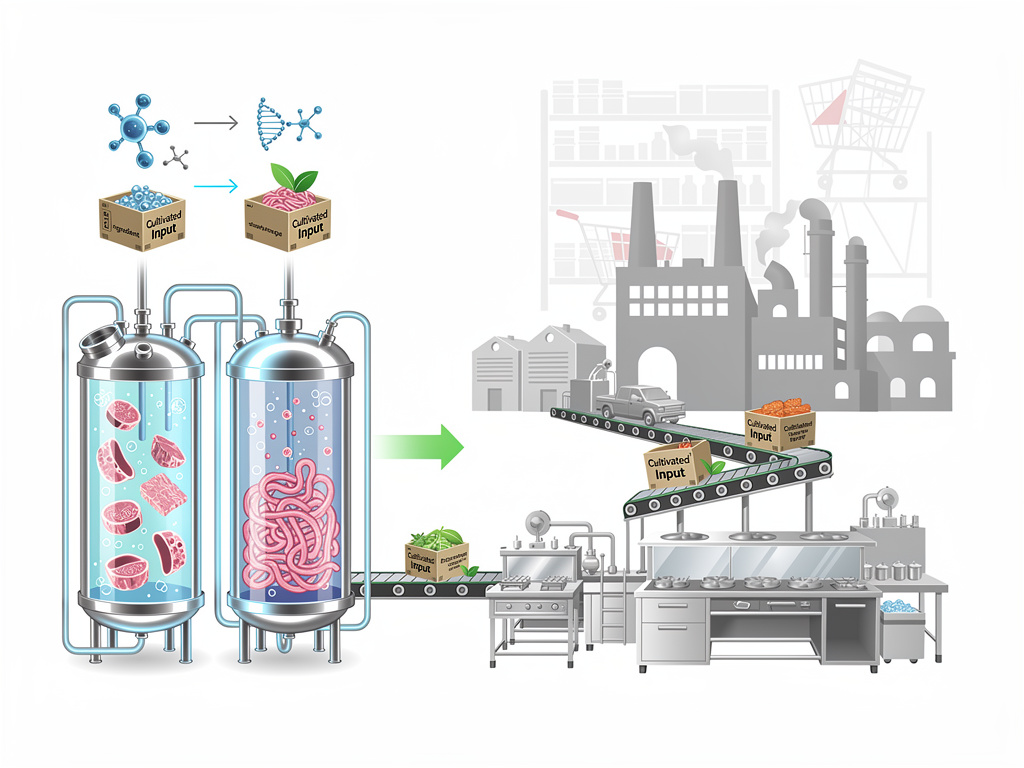
The cultivated meat industry, once heralded as the inevitable future of protein production, is undergoing a dramatic transformation as companies abandon consumer-facing strategies and retreat to business-to-business models. What was supposed to be a revolution on dinner plates has instead become a cautionary tale about the gap between technological promise and market reality, forcing industry leaders to fundamentally reassess their approach to commercialization.
According to Futurism, the sector that attracted billions in venture capital funding is now grappling with a harsh truth: consumers aren’t ready to embrace meat grown in bioreactors, and the economics of production remain stubbornly prohibitive. The shift represents more than just a tactical adjustment—it signals a complete reimagining of how cellular agriculture might actually integrate into the global food system, if at all.
The Great Pivot: From Fork to Factory
The most telling indicator of the industry’s struggles is the wholesale abandonment of direct-to-consumer strategies. Companies that once envisioned their products in grocery stores and restaurants are now focusing on selling cell lines, technology platforms, and manufacturing expertise to established food corporations. This pivot acknowledges what many industry observers have long suspected: the path to profitability doesn’t run through convincing individual consumers to choose lab-grown over conventional meat.
Upside Foods, which made headlines as one of the first companies to receive regulatory approval in the United States, has scaled back its ambitious retail plans. The company’s Singapore facility, once touted as a showcase for commercial viability, has faced significant operational challenges. Similarly, Eat Just’s Good Meat brand, despite achieving the historic distinction of being the first cultivated meat approved for sale anywhere in the world, has struggled to move beyond limited restaurant partnerships to achieve meaningful market penetration.
The Economics That Don’t Add Up
The fundamental problem plaguing cultivated meat isn’t technological—it’s economic. Production costs remain astronomically high compared to conventional meat, with estimates suggesting that even at scale, cultivated products would cost multiples of their traditional counterparts. The cell culture media required to grow meat cells, the specialized bioreactors needed for production, and the energy-intensive processes involved all contribute to a cost structure that defies the basic economics of commodity food production.
Industry insiders have begun speaking more candidly about these challenges. The growth media alone—the nutrient-rich solution that feeds cells as they multiply—can account for up to 90% of production costs in some estimates. While companies have made progress in developing more affordable media formulations, the improvements haven’t been dramatic enough to fundamentally alter the economic equation. The capital expenditure required to build production facilities at meaningful scale runs into hundreds of millions of dollars, creating a chicken-and-egg problem: companies need scale to reduce costs, but can’t justify the investment without proven demand.
Regulatory Hurdles and Consumer Skepticism
Beyond economics, the industry faces a two-front battle with regulators and consumers. In the United States, the regulatory framework requires coordination between the FDA and USDA, creating a complex approval process that has proven slower and more cumbersome than many companies anticipated. Each new product formulation requires separate approval, limiting companies’ ability to iterate and improve their offerings quickly.
Consumer acceptance has proven even more challenging than regulatory approval. Despite marketing efforts emphasizing environmental benefits and animal welfare, surveys consistently show that substantial portions of consumers express discomfort with the concept of lab-grown meat. The “ick factor” persists, particularly among older demographics, while even environmentally conscious consumers often prefer plant-based alternatives that feel more “natural.” Focus groups have revealed that the term “cultivated meat” itself, adopted by the industry to sound more appealing than “lab-grown,” still carries connotations that many find off-putting.
The Political Backlash Intensifies
The industry’s challenges have been compounded by an increasingly hostile political environment, particularly in agricultural states. Florida and Alabama have passed outright bans on the sale of cultivated meat, with legislators framing the technology as a threat to traditional farming communities. These bans, while potentially vulnerable to legal challenges, reflect the political power of conventional agriculture lobbies and the cultural resonance of arguments about “real” food versus laboratory products.
The political opposition has proven sophisticated and well-funded. Cattle ranchers’ associations have launched public relations campaigns questioning the safety and environmental claims of cultivated meat, while state legislators have introduced bills requiring prominent labeling that many in the industry view as deliberately stigmatizing. This political headwind makes the path to market acceptance even steeper, as companies must now fight battles in statehouses in addition to boardrooms and laboratories.
The Investor Exodus and Funding Crisis
The funding environment for cultivated meat has deteriorated dramatically from the heady days of 2020 and 2021, when venture capital flowed freely into the sector. Investment in cellular agriculture companies has declined by more than 75% from its peak, according to industry tracking data. High-profile investors who once championed the technology have quietly reduced their exposure or exited positions entirely, while new funding rounds have become increasingly difficult to close.
This capital drought has forced companies to make difficult choices. Staff reductions have become common across the sector, with some companies laying off more than half their workforce. Research and development budgets have been slashed, delaying the technological improvements that might eventually make production economically viable. Several startups have shut down entirely, unable to secure the additional funding needed to continue operations. The survivors are those who can demonstrate a credible path to revenue, even if that path looks nothing like their original business plans.
The B2B Pivot: Selling Picks and Shovels
Faced with these challenges, many companies are adopting what might be called the “gold rush strategy”—rather than mining for gold themselves, they’re selling equipment and expertise to others. This business-to-business approach involves licensing cell lines, selling bioreactor technology, and providing consulting services to food companies that want to experiment with cellular agriculture without building capabilities from scratch.
This pivot has some strategic logic. Established food corporations have deeper pockets, longer time horizons, and existing distribution networks that startups lack. By partnering with these companies rather than competing with them, cultivated meat firms can generate revenue while the technology matures. However, this approach also represents a significant scaling back of ambitions. Instead of revolutionizing the food system, these companies are positioning themselves as specialized suppliers within the existing structure.
The Technical Challenges That Remain
Even as business models evolve, fundamental technical challenges persist. Creating structured meat products—like whole cuts of steak rather than ground meat—remains extraordinarily difficult. The scaffolding required to give cells three-dimensional structure, the vascularization needed to deliver nutrients throughout a thick piece of tissue, and the complexity of replicating the marbling and texture of conventional meat all pose problems that haven’t been solved at commercial scale.
The contamination risks in cell culture also present ongoing challenges. Unlike conventional meat production, which can tolerate some level of bacterial presence, cell culture requires near-sterile conditions. A single contamination event can destroy an entire production batch, creating quality control demands that are difficult and expensive to maintain in industrial settings. These technical realities mean that even if the economics improved dramatically, the operational challenges of running cultivated meat facilities at food-industry scale would remain formidable.
What the Future Actually Holds
The current state of the cultivated meat industry offers important lessons about the difference between technological possibility and market viability. The science behind growing meat cells in bioreactors is sound, and continued research will likely yield improvements in efficiency and cost. However, the path from laboratory proof-of-concept to supermarket shelf is far longer and more complex than early enthusiasts anticipated.
The most realistic near-term future for cellular agriculture may involve niche applications rather than wholesale replacement of conventional meat. Cultivated fat for use in plant-based products, specialty ingredients for premium foods, or meat production in contexts where conventional agriculture is impossible—such as space exploration—represent more achievable goals than displacing the global meat industry. Some companies are already pursuing these narrower applications, recognizing that incremental adoption may be the only viable path forward.
The industry’s struggles also highlight broader questions about how food innovation actually happens. Despite the appeal of technological solutions to environmental and ethical problems, food systems prove remarkably resistant to rapid transformation. Consumer preferences, regulatory structures, economic realities, and cultural attachments to traditional foods all constrain the pace of change. The cultivated meat industry’s current predicament suggests that even the most promising technologies must navigate these constraints, and that doing so takes far more time and capital than Silicon Valley-style disruption models assume.
The Road Ahead for Cellular Agriculture
For the companies that survive this shakeout, the focus has shifted from growth to sustainability—not environmental sustainability, but the basic business sustainability of staying operational long enough for market conditions to potentially improve. This means modest revenue targets, conservative spending, and realistic timelines measured in decades rather than years. It means acknowledging that cultivated meat may be a component of future food systems rather than their foundation.
The industry’s challenges don’t necessarily mean cellular agriculture has no future. Technologies often require multiple cycles of hype and disappointment before finding their appropriate niche. Personal computers, electric vehicles, and countless other innovations followed similarly turbulent paths to eventual adoption. The question isn’t whether cultivated meat is possible—it demonstrably is—but whether it can become economically and culturally viable at meaningful scale. The answer to that question remains uncertain, and the current industry upheaval suggests it will take far longer to resolve than anyone initially imagined.


 WebProNews is an iEntry Publication