
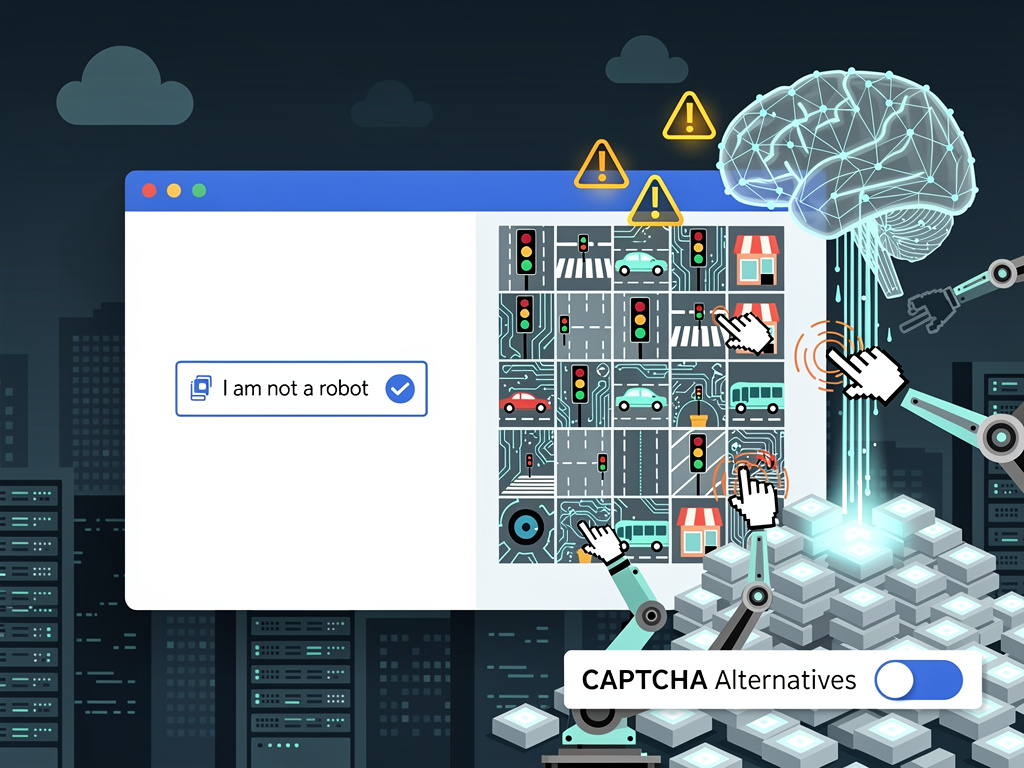
For years, the small checkbox labeled “I’m not a robot” served as a minor speed bump on the way to logging into a website or submitting a form. But what was once a quick click has morphed into an increasingly frustrating gauntlet of image puzzles, traffic light identifications, and bicycle-spotting exercises that can consume minutes of a user’s time — all while generating enormous value for Google. The backlash is growing, and industry observers are beginning to ask whether the world’s most ubiquitous bot-detection tool has become more of a burden than a benefit.
As reported by MakeUseOf, Google’s reCAPTCHA system has escalated in difficulty and frequency to the point where many users find it borderline unusable. What began as a clever system to digitize books has become an expansive data-labeling operation that trains Google’s artificial intelligence models — particularly those related to autonomous driving and image recognition — using the unpaid cognitive labor of billions of internet users.
From Digitizing Books to Training Self-Driving Cars
The original CAPTCHA — “Completely Automated Public Turing test to tell Computers and Humans Apart” — was developed at Carnegie Mellon University in the early 2000s. It asked users to decipher distorted text, a task that was easy for humans but difficult for bots. When Google acquired reCAPTCHA in 2009, it repurposed the system to help digitize the text of books and newspapers scanned by Google Books. Users were essentially performing free labor for Google’s digitization project, but the trade-off felt reasonable: you proved you were human, and in return, you helped preserve literary history.
The system evolved. By 2014, Google introduced reCAPTCHA v2, which replaced distorted text with image-based challenges. Users were asked to identify objects in photographs — storefronts, crosswalks, traffic lights, buses, and bicycles. These categories were not chosen at random. They correspond directly to the kinds of objects that autonomous vehicles need to recognize. As MakeUseOf noted, every time you click on a square containing a fire hydrant, you are effectively performing unpaid annotation work for Google’s machine learning datasets, including those that feed into Waymo, Google’s self-driving car subsidiary.
The Escalating Difficulty Problem
The frustration users feel is not imagined. The challenges have become demonstrably harder. Where once a single click on “I’m not a robot” sufficed — thanks to reCAPTCHA v3’s invisible risk analysis running in the background — failed or ambiguous scores now trigger image challenges that can cycle through multiple rounds. Users report being asked to identify motorcycles across six or more panels, only to be served another round of crosswalks, then another of stairs. The process can take 30 seconds, a minute, or longer, particularly on mobile devices where tapping small image tiles is imprecise.
Part of the issue is that reCAPTCHA’s difficulty scales based on behavioral signals. If you’re using a VPN, a privacy-focused browser like Tor or Brave, or have cookies disabled, the system is more likely to flag you as suspicious. This creates a perverse incentive structure: users who take steps to protect their online privacy are punished with harder and more frequent CAPTCHA challenges. The irony is not lost on privacy advocates, who point out that Google’s system effectively penalizes anyone who doesn’t fully submit to Google’s tracking infrastructure.
A Hidden Cost for Website Operators
The burden doesn’t fall solely on users. Website operators who implement reCAPTCHA are increasingly caught in a difficult position. Google offers reCAPTCHA for free — up to a threshold of one million assessments per month — but the cost is measured in user friction and abandonment rates. Studies in the e-commerce space have consistently shown that every additional step in a checkout or login process increases the likelihood that a customer will leave. A CAPTCHA challenge that takes 30 seconds to complete can be the difference between a completed sale and an abandoned cart.
Moreover, website operators who rely on reCAPTCHA are effectively outsourcing their security decisions to Google while simultaneously feeding Google’s data machine. When a user completes a reCAPTCHA challenge, Google collects behavioral data — mouse movements, browsing patterns, cookies, device information — that helps it build ever more detailed profiles. For websites that claim to respect user privacy, embedding reCAPTCHA creates a contradiction that is becoming harder to ignore. The European Union’s General Data Protection Regulation (GDPR) has already prompted legal scrutiny of reCAPTCHA’s data collection practices, with some data protection authorities questioning whether the tool’s data harvesting is proportionate to its stated security purpose.
The Rise of Alternatives
Dissatisfaction with reCAPTCHA has fueled a growing market for alternatives. Cloudflare’s Turnstile, launched in 2022, offers a free, privacy-focused alternative that runs challenges in the background without requiring user interaction. Apple has introduced Private Access Tokens, which allow websites to verify that a visitor is using a legitimate device without presenting any challenge at all. hCaptcha, which positions itself as a privacy-respecting alternative, has gained traction among websites that want bot protection without Google’s data collection apparatus.
These alternatives reflect a broader industry recognition that the CAPTCHA model — asking humans to prove they are human by performing tasks — is fundamentally flawed in an era when AI systems can increasingly solve the same challenges. Bots powered by modern machine learning can now pass many image-based CAPTCHAs with higher accuracy than humans. A 2023 study by researchers at the University of California, Irvine found that bots solved reCAPTCHA v2 image challenges with near-perfect accuracy, while human users struggled with ambiguous images and fading tiles. The arms race between CAPTCHA designers and bot developers has, in many cases, made the challenges harder for humans than for the machines they were designed to stop.
The AI Training Pipeline Nobody Opted Into
Perhaps the most significant criticism of reCAPTCHA is the one that receives the least attention: the question of consent. When users solve image challenges, they are contributing to commercial AI training datasets. Google does not compensate users for this work, nor does it provide a clear opt-out mechanism. The terms of service for reCAPTCHA are buried in Google’s broader privacy policy, and most users have no idea that their puzzle-solving efforts are feeding machine learning models worth billions of dollars.
This dynamic has drawn comparisons to other forms of uncompensated digital labor, from the content moderation performed by social media users who flag posts to the data generated by users of free apps that is then sold to advertisers. But reCAPTCHA is unique in that it is not optional in any meaningful sense. Users cannot choose to skip the challenge; it is a prerequisite for accessing a website. The “choice” is binary: solve the puzzle or leave. For essential services — government portals, banking sites, healthcare platforms — leaving is not a realistic option.
What Comes After the Checkbox
Google has signaled that it is aware of the friction problem. reCAPTCHA v3, introduced in 2018, was designed to operate invisibly, assigning risk scores to users based on their behavior without requiring any interaction. But v3 has its own issues: it requires website operators to decide what score threshold triggers a challenge, and it still falls back on image puzzles when it cannot determine whether a visitor is human. The result is a system that works well for users who behave in ways Google considers “normal” — logged into a Google account, using Chrome, with cookies enabled — and poorly for everyone else.
The industry is moving toward a post-CAPTCHA future, but the transition is slow. Passkeys, biometric verification, and device attestation are all emerging as potential replacements, but they require infrastructure changes that many websites are not yet prepared to make. In the meantime, reCAPTCHA remains the default choice for millions of websites, largely because it is free and easy to implement — a combination that is hard to compete with, even when the product’s externalities are significant.
For now, the internet’s billions of users will continue clicking on traffic lights and crosswalks, performing micro-tasks that generate macro-value for one of the world’s largest corporations. The question is not whether this arrangement is sustainable — it clearly is, given Google’s market position — but whether it is fair. As AI systems grow more capable and the challenges grow harder, the gap between the value users create and the compensation they receive will only widen. The humble CAPTCHA, once a minor inconvenience, has become a symbol of a much larger tension in the digital economy: who benefits from the work that ordinary people do online, and who gets to decide?


 WebProNews is an iEntry Publication