
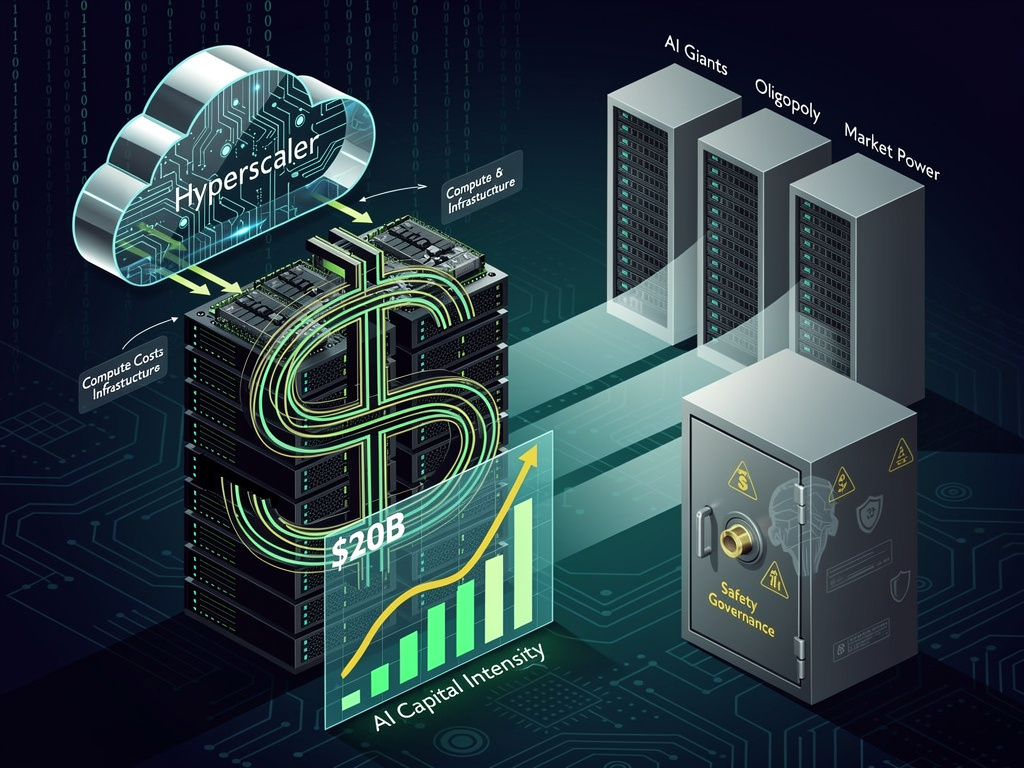
The era of venture capital as we once understood it—characterized by methodical rounds of funding scaling from seed to IPO—has effectively dissolved within the artificial intelligence sector. In its place, a new financial paradigm has emerged, defined by capital injections that rival the GDP of small nations. The latest signal of this seismic shift comes from reports that Anthropic has dramatically increased its capital requirements, targeting a staggering $20 billion raise. According to TechCrunch, the AI safety startup co-founded by the Amodei siblings is seeking to secure this war chest to fuel the development of its next-generation frontier models, Claude 4 and beyond. This figure does not merely represent a vote of confidence; it represents the sheer, terrifying admission of the costs required to stay relevant in the current computational arms race.
For industry insiders, the headline number is less shocking than the timeline. While massive rounds were anticipated, the acceleration toward double-digit billion-dollar tranches suggests that the scaling laws governing Large Language Models (LLMs) remain unbroken, yet increasingly expensive. The capital intensity of training frontier models is compounding at a rate that excludes traditional venture firms from participating as primary leads. Instead, we are witnessing the consolidation of the industry around a few sovereign-scale entities backed by hyperscalers. The roadmap laid out by Anthropic CEO Dario Amodei—predicting models that cost $1 billion, then $10 billion, and eventually $100 billion to train—is no longer a theoretical projection; it is the current operating budget.
The Hyperscaler Dependency and Round-Tripping Revenue
The mechanics of this raise cannot be decoupled from Anthropic’s strategic entanglements with Amazon and Google. Unlike traditional software startups where capital is spent on headcount and marketing, the vast majority of these funds are earmarked for immediate repatriation to the cloud providers who invest them. When Amazon committed an additional $4 billion to Anthropic in late 2024, as reported by The Wall Street Journal, the deal structure necessitated the use of Amazon Web Services (AWS) and its proprietary Trainium chips. This creates a circular economy where investment dollars are effectively cloud credits, bolstering the top-line revenue of the investor while securing the compute necessary for the startup.
This dynamic raises critical questions about the true valuation of these entities. If a significant percentage of a $20 billion raise is contractually obligated to flow back to AWS or Google Cloud Platform (GCP) as compute spend, the effective liquidity of the company is far lower than the headline number suggests. This structure mirrors the vendor-financing models of the telecom boom, though with a distinct technological imperative. For Anthropic, the choice is binary: accept the hyperscaler tax to access the tens of thousands of H100s (and future Blackwell clusters) required to train Claude’s successors, or cease to compete at the frontier.
Semiconductor Scarcity as the Primary constraint
The driving force behind this ballooning capital requirement is not merely the size of the models, but the scarcity and pricing power of the hardware required to build them. Nvidia’s stranglehold on the GPU market has dictated the burn rates of every major AI lab in San Francisco. As noted by Bloomberg, demand for the latest architecture is “insane,” creating a bidding war where capital availability is the only ticket to the queue. Anthropic’s move to raise $20 billion is a direct response to the need to secure long-term supply agreements for hardware that may not even be manufactured yet.
Furthermore, the infrastructure costs extend beyond silicon to energy and data center capacity. Training runs for models exceeding one trillion parameters require gigawatt-scale power availability, forcing companies to engage in complex real estate and energy deals. The capital raised is partly a hedge against future energy insecurity, allowing Anthropic to pre-pay for capacity in a grid-constrained market. This transforms the company from a software lab into a heavy industrial concern, managing a supply chain that rivals automotive manufacturers in complexity and capital expenditure.
Valuation Divergence and the OpenAI Comparison
Anthropic’s aggressive fundraising posture is inevitably measured against its primary rival, OpenAI. Following OpenAI’s historic $6.6 billion raise at a $157 billion valuation, the market established a benchmark for what investors are willing to pay for perceived dominance. However, Anthropic’s pitch has always differed fundamentally on the axis of safety and steerability. The challenge, highlighted by The New York Times, is maintaining that differentiation while matching the raw scale of a competitor that is aggressively commercializing its research. A $20 billion raise suggests Anthropic refuses to cede the “scale” argument to OpenAI, aiming to prove that safety does not require a compromise on capability.
The valuation implications of a raise this size are complex. To justify a $20 billion injection without completely wiping out existing equity holders (including the founders and early employees), Anthropic’s valuation must be pushing into the rarefied air of $60 billion to $80 billion, or perhaps higher. This creates a high-stakes environment where the company must demonstrate a clear path to hundreds of billions in revenue—a feat no SaaS company has achieved in such a compressed timeframe. The bet is that AI is not software, but a replacement for cognitively expensive labor, unlocking a Total Addressable Market (TAM) significantly larger than traditional enterprise IT.
The Burn Rate Reality Check
Underneath the massive fundraising figures lies a stark reality regarding profitability. Reports on the financial health of AI labs indicate that for every dollar of revenue generated, a disproportionate amount is spent on inference and training. Leaked financial documents discussed by The Information have previously suggested that while revenue growth is robust, the margins are currently suppressed by the immense cost of serving these models. A $20 billion war chest provides a runway, but it also signals that the timeline to being cash-flow positive is stretching further into the future.
This “profitless prosperity” is acceptable to investors only as long as the technological advancements continue to be exponential. If the curve of model performance begins to flatten—if we hit a plateau in scaling laws—the economics of a $20 billion raise collapse. Anthropic is betting that the next order of magnitude in compute will yield a commensurate leap in reasoning capability, opening up lucrative enterprise applications in coding, legal analysis, and scientific research that justify the burn. The capital is essentially an option premium paid on the hypothesis that AGI (Artificial General Intelligence) is achievable through scale.
Governance and the Public Benefit Structure
A unique friction in Anthropic’s fundraising is its corporate structure. As a Public Benefit Corporation (PBC), it is legally mandated to prioritize safety and public welfare alongside profit. This structure was designed to prevent the very kind of reckless acceleration that a $20 billion raise might imply. However, Wired has detailed how the immense pressure to raise capital can strain these governance guardrails. When sovereign wealth funds and hyperscalers write checks of this magnitude, their influence—explicit or implicit—becomes a gravitational force.
The tension lies in whether Anthropic can maintain its “safety-first” branding while engaging in the most aggressive capital accumulation in startup history. The $20 billion influx will inevitably come with expectations of rapid product deployment and market capture. Maintaining the Long-Term Benefit Trust’s authority over a company effectively owned by external capital giants will be the ultimate test of the PBC model. If the board is forced to choose between a slow, safe release and a competitive, revenue-generating launch to service its valuation, the capital structure will dictate the outcome.
The End of the Open Field Era
Finally, this raise signals the closing of the frontier to new entrants. The barrier to entry for training a foundational model is now effectively set at tens of billions of dollars. This cements an oligopoly consisting of OpenAI, Google DeepMind, Anthropic, and perhaps Meta. As noted in broader market analysis by the Financial Times, the consolidation of talent and compute resources makes it nearly impossible for a “garage startup” to compete on base model capabilities. Innovation for smaller players is being pushed to the application layer, or “wrappers,” while the foundational layer becomes the domain of quasi-state entities.
Anthropic’s move to secure $20 billion is a defensive moat as much as it is an offensive play. By locking up capital, they are also locking up the limited supply of GPUs and energy contracts available globally. In this zero-sum game of physical infrastructure, money is the only mechanism to deny resources to competitors. We are moving away from a period of scientific discovery into a period of industrial entrenchment, where the size of the balance sheet is the primary determinant of survival.


 WebProNews is an iEntry Publication