
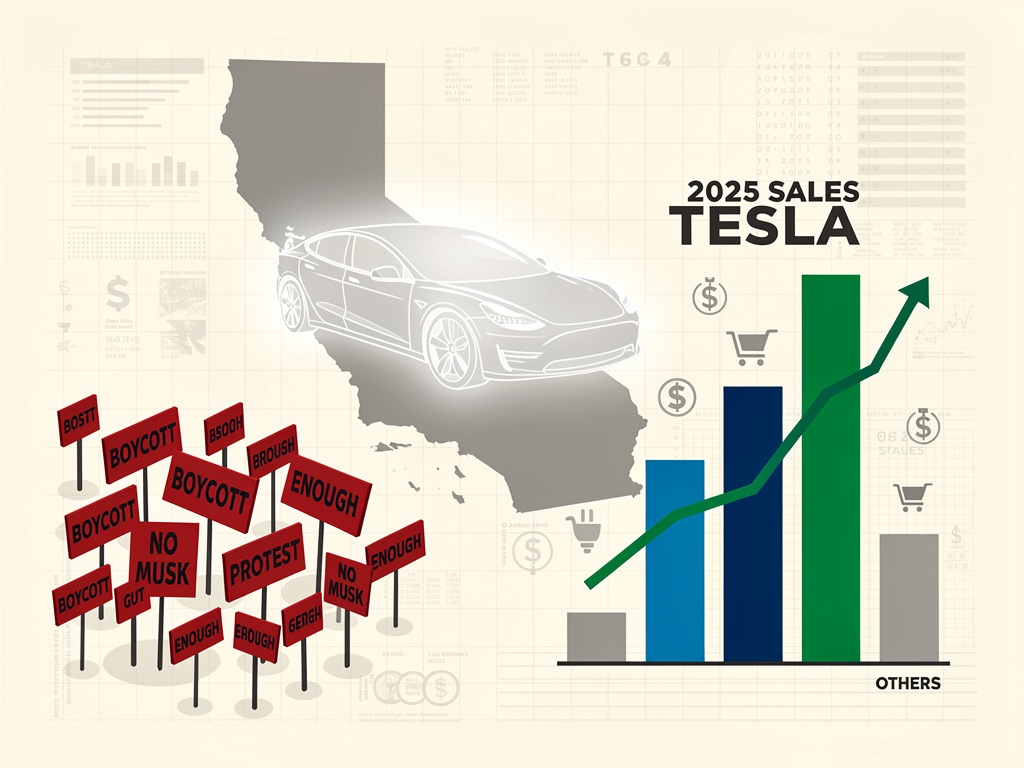
In a state where protests against Elon Musk have become as commonplace as farmers’ markets and freeway traffic, Tesla has done something that defies the prevailing political narrative: it has maintained its commanding lead as the best-selling car brand in California for 2025, and by a margin that isn’t even close.
The juxtaposition is striking. Throughout the first half of 2025, demonstrators have gathered at Tesla showrooms, supercharger stations, and even outside the company’s Fremont factory to voice their displeasure with Musk’s political activities, his role leading the Department of Government Efficiency (DOGE) under President Donald Trump, and what many progressives view as an alarming consolidation of power by the world’s richest man. Yet when Californians walk into dealerships — or, more accurately, open their laptops to place orders — Tesla remains the overwhelming choice.
Numbers That Speak Louder Than Placards
According to data reported by KRON4, Tesla’s dominance in California’s auto market has persisted despite months of organized backlash. The Model Y and Model 3 continue to be the top-selling vehicles in the state, outpacing competitors from both legacy automakers and fellow EV startups. California, which accounts for roughly 12% of all U.S. vehicle sales and has long been the nation’s largest electric vehicle market, remains Tesla’s most important domestic stronghold.
The data underscores a fundamental tension in consumer behavior: political sentiment and purchasing decisions do not always move in lockstep. While surveys earlier this year suggested that a meaningful share of prospective EV buyers were reconsidering Tesla due to Musk’s polarizing public persona, the actual sales figures tell a more complicated story. Brand loyalty, charging infrastructure, vehicle range, and the simple reality that Tesla offers some of the most competitively priced EVs on the market have proven to be powerful counterweights to political boycott movements.
The Boycott Movement: Loud, Visible, but Limited in Impact
The anti-Musk protest movement gained significant momentum in early 2025, fueled by Musk’s deepening involvement in the Trump administration’s cost-cutting agenda through DOGE. Protesters have targeted Tesla dealerships in San Francisco, Los Angeles, San Diego, and Sacramento, sometimes drawing hundreds of participants. Social media campaigns urging consumers to “dump Tesla” have generated millions of impressions on X and other platforms. Some Tesla owners have even publicly sold or traded in their vehicles, posting videos of themselves switching to Rivian, BMW, or Hyundai alternatives.
Yet the movement’s reach appears to have a ceiling. Industry analysts note that boycotts historically have a poor track record of materially denting sales for dominant consumer brands, particularly when those brands offer products that are difficult to replicate at the same price point. Tesla’s Supercharger network — the most extensive fast-charging system in North America — gives it a structural advantage that no competitor has yet matched. For many California buyers, especially those in suburban and exurban areas where home charging is feasible and long-distance travel is common, Tesla remains the pragmatic choice regardless of how they feel about its CEO.
California’s EV Market Is Growing — and Tesla Is Growing With It
California’s overall EV adoption rate continues to climb. The state has set aggressive targets to phase out the sale of new gasoline-powered vehicles by 2035 under its Advanced Clean Cars II regulation, and generous state and federal incentives continue to make electric vehicles financially attractive. In this expanding market, Tesla has managed to hold its share even as competition intensifies from companies like Hyundai, Kia, Ford, Chevrolet, and a growing roster of Chinese-designed models seeking entry into the U.S. market.
The refreshed Model Y, which began deliveries earlier this year, has been a critical factor in sustaining Tesla’s momentum. The updated crossover SUV features a redesigned interior, improved ride quality, and enhanced technology — changes that have been well-received by reviewers and consumers alike. The Model 3, which received its own significant refresh in late 2023, continues to be one of the most affordable long-range EVs available in the United States, with a starting price that, after federal tax credits, can dip below $30,000 for qualifying buyers.
Political Identity vs. Consumer Rationality
The Tesla-California dynamic has become a case study in the limits of political consumerism. California is arguably the most liberal large state in the nation, a place where Musk’s alignment with Trump-era politics is deeply unpopular among a significant portion of the electorate. Polls have shown that Musk’s favorability ratings in the state have cratered over the past year, with some surveys placing his unfavorable rating among California adults above 60%.
And yet, the car keeps selling. Part of the explanation lies in the demographics of EV buyers themselves. While the early adopter cohort skewed heavily toward environmentally motivated progressives, the current wave of EV purchasers is broader and more diverse in its motivations. Many buyers are drawn to EVs for economic reasons — lower fuel costs, reduced maintenance expenses, and attractive lease terms. For these consumers, the political affiliations of a company’s CEO are secondary to the monthly payment and the cost per mile.
Competitors Are Closing In, but Not Fast Enough
To be sure, Tesla’s rivals are making inroads. Hyundai and Kia’s combined EV sales in California have surged, driven by well-reviewed models like the Ioniq 5, Ioniq 6, and EV6. Ford’s Mustang Mach-E continues to find buyers, and Chevrolet’s Equinox EV, priced aggressively to compete directly with the Model Y, has shown early promise. Rivian, headquartered in Irvine, California, has cultivated a loyal following among affluent buyers who want an American-made EV without the Musk association.
But none of these competitors have come close to matching Tesla’s volume in the state. The gap between Tesla and its nearest rival in California remains measured in tens of thousands of units. Tesla’s vertically integrated manufacturing model, its direct-to-consumer sales approach that bypasses traditional dealerships, and its software-driven ownership experience continue to set it apart in ways that are difficult for legacy automakers to replicate quickly.
The Musk Factor: Liability and Asset Simultaneously
Musk himself remains the most unpredictable variable in Tesla’s future. His public statements, his management of X (formerly Twitter), and his political activities generate a constant stream of headlines that alternately energize and alienate potential customers. In California, where his political activities are most likely to generate backlash, the risk is real that sustained negative sentiment could eventually erode Tesla’s brand equity — particularly among younger buyers who tend to weigh corporate values more heavily in purchasing decisions.
Yet Musk also brings an undeniable charisma and a cult of personality that continues to attract buyers who see Tesla as more than a car company. The brand’s association with technological innovation, space exploration (through Musk’s SpaceX), and a vision of a sustainable energy future still resonates with a substantial segment of the market. For every buyer who refuses to purchase a Tesla because of Musk, there may be another who is drawn to the brand precisely because of his boundary-pushing persona.
What the California Numbers Mean for the National Picture
California has historically been a leading indicator for national automotive trends, particularly in the EV segment. If Tesla can maintain its dominance in the state most hostile to its CEO’s politics, it suggests that the brand’s competitive moat — built on product quality, infrastructure, and pricing — is deeper than many critics have assumed. The protest movement, while culturally significant and genuinely reflective of widespread frustration with Musk, has not yet translated into the kind of sustained commercial pressure that would force a strategic reckoning at Tesla’s headquarters in Austin, Texas.
For the broader auto industry, the lesson is sobering. Building a better product is necessary but not sufficient to dethrone Tesla in its most important market. Competitors need to match not just the vehicle, but the ecosystem — the charging network, the software experience, the brand identity, and the pricing structure. Until that happens, Tesla’s California paradox is likely to persist: a company led by one of the state’s least popular public figures, selling more cars there than anyone else, and doing so by a margin that makes the competition look like a rounding error.


 WebProNews is an iEntry Publication