
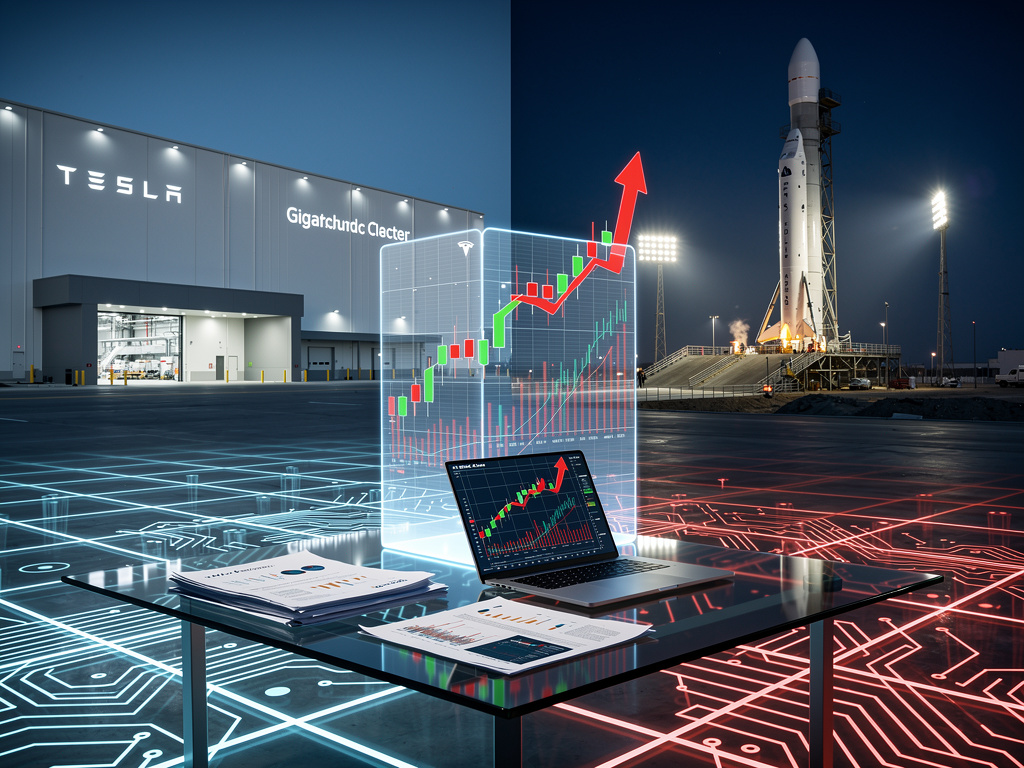
In the pantheon of modern business leadership, few executives have staked their reputation—and fortunes—on high-wire acts quite like Elon Musk. His approach to risk-taking at Tesla, SpaceX, and now X (formerly Twitter) has become a case study in corporate audacity, prompting boardrooms across America to reconsider the traditional calculus of calculated business decisions. As companies navigate an increasingly volatile economic environment, Musk’s willingness to bet the company on unproven technologies and controversial strategies offers both a template and a cautionary tale for the next generation of corporate leaders.
According to CNN Business, Musk’s risk-taking philosophy extends beyond mere bravado—it represents a fundamental reimagining of how corporations can pursue transformative innovation. The Tesla CEO has repeatedly pushed his companies to the brink of bankruptcy, most notably during the Model 3 production crisis of 2018, when the electric vehicle maker was burning through approximately $6,500 per minute. Yet these near-death experiences have consistently preceded periods of explosive growth, challenging conventional wisdom about sustainable business practices.
The financial markets have rewarded this approach with remarkable consistency. Tesla’s market capitalization has fluctuated between $500 billion and over $1 trillion in recent years, making it more valuable than the next ten largest automakers combined at its peak. This valuation reflects investor confidence not just in Tesla’s current operations, but in Musk’s track record of delivering on seemingly impossible promises—from making electric vehicles mainstream to developing reusable rockets that have revolutionized space travel.
The Anatomy of Musk’s Risk Architecture
Musk’s approach to risk differs fundamentally from traditional corporate risk management frameworks. Where most Fortune 500 companies employ elaborate systems to minimize downside exposure, Musk operates under what industry observers have termed “asymmetric risk optimization”—accepting massive potential losses in exchange for theoretically unlimited upside. This philosophy manifests in decisions like Tesla’s $1.5 billion Bitcoin investment in 2021, or SpaceX’s commitment to developing Starship, a fully reusable rocket system that has already consumed billions in development costs.
The methodology behind these decisions reveals a sophisticated understanding of technological probability curves and market timing. Rather than pursuing incremental improvements, Musk targets inflection points where emerging technologies can disrupt entire industries. His bet on lithium-ion battery technology for vehicles, made when most automakers dismissed electric cars as impractical, exemplifies this approach. Today, virtually every major automaker has committed billions to electric vehicle development, validating Musk’s early gamble.
Cultural Transmission: Risk-Taking as Organizational DNA
Perhaps more significant than Musk’s individual decisions is his success in institutionalizing risk-taking within his organizations. Tesla’s corporate culture actively rewards employees who propose ambitious solutions to seemingly intractable problems. The company’s development of the Gigafactory concept—massive, vertically integrated production facilities that manufacture batteries at unprecedented scale—emerged from this environment of encouraged audacity.
Former Tesla executives describe a workplace where failure is not just tolerated but expected as part of the innovation process. This stands in stark contrast to the risk-averse cultures that dominate much of corporate America, where career advancement often depends on avoiding mistakes rather than achieving breakthroughs. The practical result: Tesla has achieved manufacturing innovations, such as the use of large casting machines that produce entire vehicle sections in single pieces, that traditional automakers initially dismissed as impossible.
The Financial Tightrope: Near-Bankruptcy as Strategy
Musk’s willingness to operate his companies at the edge of financial viability represents perhaps his most controversial strategic choice. During Tesla’s “production hell” period, the company came within weeks of running out of cash, forcing Musk to sleep on the factory floor and personally oversee production line improvements. Critics argued this represented reckless management; supporters countered it demonstrated the all-in commitment necessary to achieve breakthrough results.
The financial community remains divided on this approach. Traditional value investors view Musk’s leverage-heavy strategy as unnecessarily dangerous, pointing to the very real possibility that a single miscalculation could topple his entire corporate empire. Growth investors, conversely, argue that Musk’s willingness to risk everything enables the kind of rapid scaling that creates category-defining companies. Tesla’s ability to increase vehicle production from fewer than 100,000 units in 2017 to over 1.8 million in 2023 suggests the strategy, however nerve-wracking, can deliver extraordinary results.
Regulatory Roulette and Government Relations
Musk’s risk-taking extends into the regulatory arena, where his companies have repeatedly pushed against established rules and norms. Tesla’s Autopilot system, marketed with a name that critics argue overstates its capabilities, has drawn scrutiny from the National Highway Traffic Safety Administration. Rather than retreating, Musk has doubled down, arguing that the regulatory framework itself needs updating to accommodate rapidly evolving autonomous vehicle technology.
This confrontational approach to regulation carries significant risks. Federal investigations, potential fines, and mandatory recalls could materially impact Tesla’s financial performance and reputation. Yet Musk appears to calculate that the cost of regulatory compliance—both financial and in terms of innovation speed—exceeds the cost of occasional conflicts with authorities. SpaceX’s rapid iteration approach to rocket development, which involves numerous test failures, similarly challenges traditional aerospace regulatory paradigms that prioritize perfection over speed.
The Human Capital Equation
Musk’s demanding management style represents another dimension of his risk philosophy—one that generates intense debate about sustainable leadership practices. Reports of 80-hour work weeks, aggressive deadlines, and high employee turnover at Tesla and SpaceX raise questions about the human cost of Musk’s approach. Former employees describe an environment of relentless pressure, where job security depends on meeting seemingly impossible targets.
Yet this same intensity attracts a particular type of talent: engineers and executives who thrive on challenge and view the opportunity to work on transformative technologies as compensation in itself. Tesla and SpaceX consistently rank among the most desirable employers for engineering graduates, despite—or perhaps because of—their reputations for grueling work environments. This suggests Musk has successfully created a self-selecting workforce aligned with his risk-tolerant philosophy.
Market Manipulation or Visionary Communication?
Musk’s use of social media, particularly X (which he acquired for $44 billion in 2022), adds another layer to his risk profile. His tweets have moved markets, triggered SEC investigations, and occasionally undermined his own companies’ stock prices. The $20 million settlement with the SEC over his “funding secured” tweet regarding taking Tesla private demonstrated the potential costs of his unfiltered communication style.
Yet this same directness has built a devoted following of retail investors who view Musk as uniquely transparent compared to typical corporate executives. His willingness to engage directly with customers, critics, and investors on social media creates a personal connection rare among CEOs of major corporations. Whether this approach represents savvy stakeholder management or dangerous impulsiveness depends largely on one’s perspective—and tolerance for volatility.
Competitive Response and Industry Transformation
Traditional automakers’ responses to Tesla reveal how Musk’s risk-taking has reshaped competitive dynamics across entire industries. Companies like General Motors, Ford, and Volkswagen have committed over $500 billion collectively to electric vehicle development, fundamentally altering their century-old business models. This massive capital reallocation represents a defensive response to Tesla’s success—proof that Musk’s gambles have forced incumbent players to take risks they would have otherwise avoided.
The ripple effects extend beyond automotive. Musk’s success has emboldened a generation of entrepreneurs to pursue moonshot projects previously considered too risky for serious investment. The proliferation of electric vehicle startups, commercial space ventures, and brain-computer interface companies can be traced directly to Musk’s demonstration that audacious technical goals can attract capital and achieve commercial viability. Whether these followers can replicate his success remains an open question, but the shift in entrepreneurial ambition is undeniable.
The Sustainability Question
As Musk enters his sixth decade and his companies mature, questions arise about whether his risk-taking approach can sustain itself over the long term. Tesla’s transition from scrappy upstart to major automaker requires different operational disciplines than those that characterized its early years. The company’s inclusion in the S&P 500 brings new institutional shareholders with different expectations around governance and predictability.
Early signs suggest Musk may be adapting his approach without abandoning its core principles. Tesla’s recent focus on cost reduction and manufacturing efficiency, while less dramatic than developing new vehicle platforms, represents a more mature form of risk management. Similarly, SpaceX’s Starlink satellite internet service provides a revenue stream that could fund continued development of more speculative projects like Mars colonization. The question is whether Musk can maintain the innovative intensity that defined his companies’ early years while building the institutional stability required for long-term survival.
Implications for Corporate Governance
Musk’s career poses fundamental questions about corporate governance in an era of founder-led companies. His dual role as CEO and largest shareholder at Tesla gives him unusual autonomy compared to professional managers answerable to independent boards. This concentration of power enables rapid decision-making but also eliminates many of the checks and balances that prevent catastrophic errors.
The broader implications for corporate America are profound. As more companies remain private longer and founder-CEOs retain control through dual-class share structures, Musk’s example provides both inspiration and warning. His successes suggest that empowered leaders with long-term vision can achieve results impossible under traditional governance structures. His occasional missteps—from production delays to controversial public statements—illustrate the dangers of unchecked executive authority. Finding the optimal balance between entrepreneurial freedom and institutional oversight may be one of the defining corporate governance challenges of the coming decade.
The Musk phenomenon ultimately forces a reconsideration of how corporations should approach innovation in an era of rapid technological change. His willingness to risk everything on unproven technologies has delivered extraordinary results, creating hundreds of billions in shareholder value and accelerating the transition to sustainable transportation. Yet the sustainability of this approach—both for Musk’s companies and for those attempting to emulate his methods—remains uncertain. What is clear is that Musk has permanently altered the conversation about acceptable corporate risk-taking, pushing the boundaries of what ambitious leaders believe they can attempt. Whether this represents progress or peril may not be fully understood for years to come.


 WebProNews is an iEntry Publication