
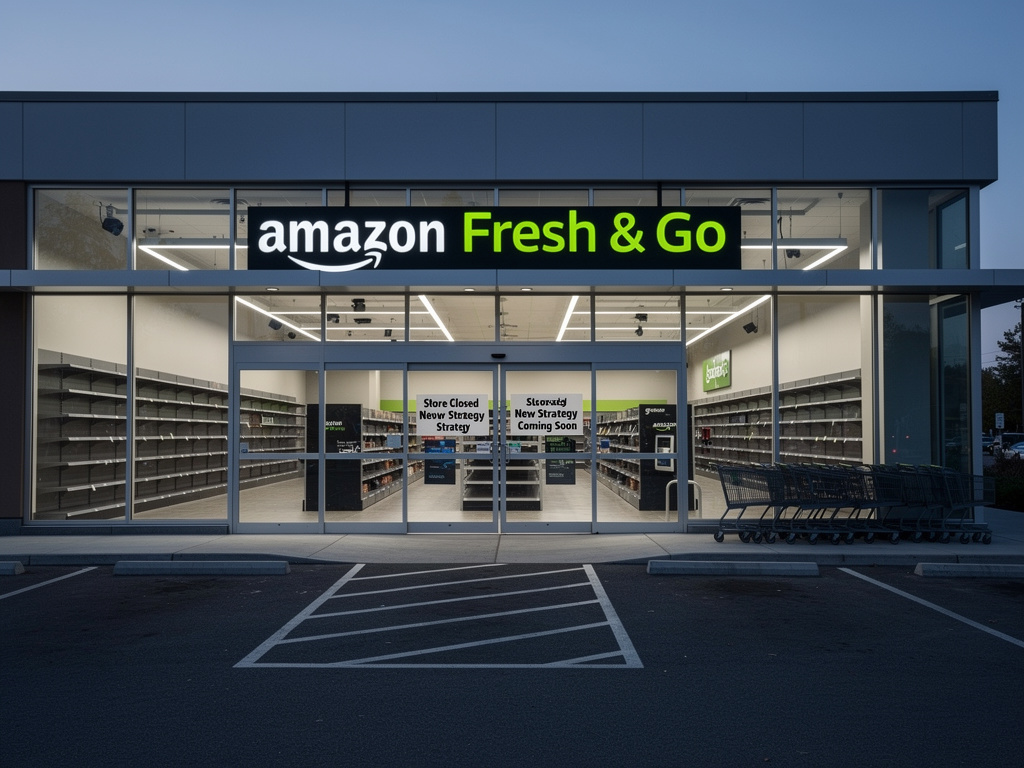
The fluorescent lights are still humming in some locations, but the ambitious vision of a cashier-less utopia has dimmed significantly. Amazon, a company that famously prioritized growth over profits for decades, has found itself colliding with the unforgiving economics of the physical grocery sector. The retail giant’s recent moves to shutter specific Amazon Fresh and Amazon Go locations mark a pivotal moment in its brick-and-mortar strategy, signaling not just a pause, but a fundamental rethinking of how the world’s largest e-commerce player interacts with the American shopper. This retrenchment is less about a failure of ambition and more about a collision with reality in a sector where margins are razor-thin and consumer habits are deeply entrenched.
For industry insiders, the writing has been on the wall—or rather, the empty shelves—for some time. The closure of these stores, including locations in Seattle, New York City, and San Francisco, represents a stark reversal from the aggressive expansion plans touted just a few years ago. According to CNN, the decision to pause the rollout and close underperforming locations underscores CEO Andy Jassy’s mandate to trim the fat from the company’s portfolio. The closures are not merely a real estate shuffle; they are an admission that the “Just Walk Out” technology, while a marvel of engineering, may not be the silver bullet for mass-market grocery adoption that Amazon had hoped for.
The Economics of the Empty Cart
The financial implications of this pivot are substantial. In recent earnings reports, Amazon revealed nearly $720 million in impairment charges related to its grocery division, a figure that startled analysts who had modeled the segment as a future growth engine. The cost of outfitting a store with the cameras and sensors required for cashier-less checkout is astronomical compared to the setup costs of a traditional grocer like Kroger or Albertsons. When foot traffic fails to meet the high threshold required to offset these capital expenditures, the model breaks down. CNBC notes that Jassy has been explicit about the need for a distinct mass-market format that is financially viable before the company commits to further large-scale expansion, suggesting the current iteration of Amazon Fresh simply burned too much cash for too little return.
Furthermore, the operational overhead extends beyond the hardware. While the premise of Amazon Go was automation, the backend reality was labor-intensive. Reports surfaced indicating that the “computer vision” often relied on human reviewers to verify transactions that the algorithms couldn’t process with high confidence. This hidden labor cost undermines the very efficiency narrative that Amazon sold to investors. The company is now pivoting toward “Dash Carts”—smart shopping carts that scan items as they are dropped in—as a more scalable middle ground. This shift acknowledges a critical user experience lesson: customers in large-format grocery stores are less concerned with skipping the checkout line entirely than they are with price, selection, and the overall store environment.
The Phenomenon of the ‘Zombie’ Store
Perhaps the most visible symbol of this strategic confusion is the proliferation of so-called “zombie stores”—locations where Amazon holds a lease, and has often completed construction, but refuses to open the doors. These phantom grocery stores have been spotted from Philadelphia to the suburbs of Chicago, sitting empty as the company re-evaluates its footprint. As reported by The Information, this hesitation has frustrated landlords and local municipalities alike, creating a drag on commercial real estate in key markets. Holding these leases without generating revenue speaks to the severity of the internal strategic review; Amazon determined it was cheaper to pay rent on an empty shell than to operate a store with a flawed business model.
This real estate limbo highlights the disconnect between Amazon’s data-driven approach and the tactile reality of neighborhood retail. A grocery store is not a fulfillment center; it requires a connection to the community and a consistent flow of perishable inventory. By leaving these stores unopened, Amazon risks damaging the brand equity of “Fresh” before customers even step inside. The pause allows Amazon to avoid sinking operational costs into these locations, but it also signals a retreat from the promise of omnipresence that terrified competitors when Amazon acquired Whole Foods Market in 2017.
Identity Crisis: Whole Foods vs. Amazon Fresh
The dual-brand strategy has also proven more difficult to manage than anticipated. Whole Foods Market continues to perform well, catering to an affluent demographic with a focus on organic and premium products. However, Amazon Fresh was intended to capture the middle-market shopper—the Walmart or Kroger customer. The problem, as highlighted by Bloomberg, is that Amazon Fresh stores often feel sterile and utilitarian, lacking the warmth and merchandising savvy of established grocers. The reliance on technology over atmosphere resulted in a shopping experience that felt efficient but joyless, a critical misstep in a sector where food presentation and store environment drive basket size.
Integrating the supply chains of Whole Foods and Amazon Fresh has also been a logistical quagmire. While the company has made strides in unifying the e-commerce cart, allowing Prime members to shop both banners more easily online, the physical separation remains. Industry analysts point out that running two distinct grocery supply chains—one for organic, high-margin goods and another for conventional CPG brands—denies Amazon the density efficiencies that make Walmart a grocery juggernaut. The closures of the Fresh and Go locations are, in part, an attempt to stop the bleeding while leadership figures out how to merge these distinct operational DNA strands into a cohesive offering.
Management Shakeups and Structural Flaws
The retreat is not just about buildings and software; it has precipitated a significant restructuring of human capital. Amazon recently eliminated hundreds of “Zone Lead” positions, a layer of middle management within the grocery division. This reduction in force was widely covered by tech outlets like GeekWire, which noted that the move was part of a broader effort to flatten the organization and speed up decision-making. TheZone Lead role was designed to manage multiple store locations, but in practice, it added bureaucratic weight to a division that needed to be agile. By removing this layer, Amazon is acknowledging that its grocery operations had become bloated relative to their revenue output.
This restructuring aligns with Jassy’s broader philosophy of operational efficiency, but it also drains the division of institutional knowledge during a critical transition period. Running a grocery store requires a different skillset than managing a fulfillment center; it involves managing spoilage, customer service, and local merchandising nuance. The exodus of talent, combined with the store closures, suggests that Amazon is stripping the division down to the studs to rebuild it, rather than simply tweaking the existing model. It is a tacit admission that the “Amazon Way”—heavy on algorithms, light on human intuition—hit its limits in the produce aisle.
The Omnichannel Future and Prime Integration
Despite the closures and the ominous headlines, it would be a mistake to assume Amazon is exiting the grocery business. The sector is simply too large—valued at over $800 billion in the U.S. alone—for the company to ignore. Instead, the strategy is shifting toward a tighter integration with the Prime ecosystem. The future likely lies not in standalone Amazon Go kiosks, but in a hybrid model where physical stores serve as both retail destinations and micro-fulfillment centers for delivery. The Wall Street Journal reports that Amazon is aggressively reworking its delivery fees and subscription models to make grocery delivery profitable, a challenge that has plagued the industry for years. The closures of underperforming physical assets free up capital to invest in the logistics network that supports this delivery-first ambition.
Ultimately, the closure of these Amazon Fresh and Go stores is a healthy, albeit painful, correction. It marks the end of the experimental phase where Amazon threw capital at the wall to see what stuck. The next phase will be defined by disciplined growth, where technology is deployed only where it adds clear value to the bottom line, rather than as a novelty. The “Just Walk Out” cameras may be turning off in some locations, but the data gathered during this expensive experiment will inform Amazon’s next, likely more formidable, attempt to digitize the American dinner table.


 WebProNews is an iEntry Publication