
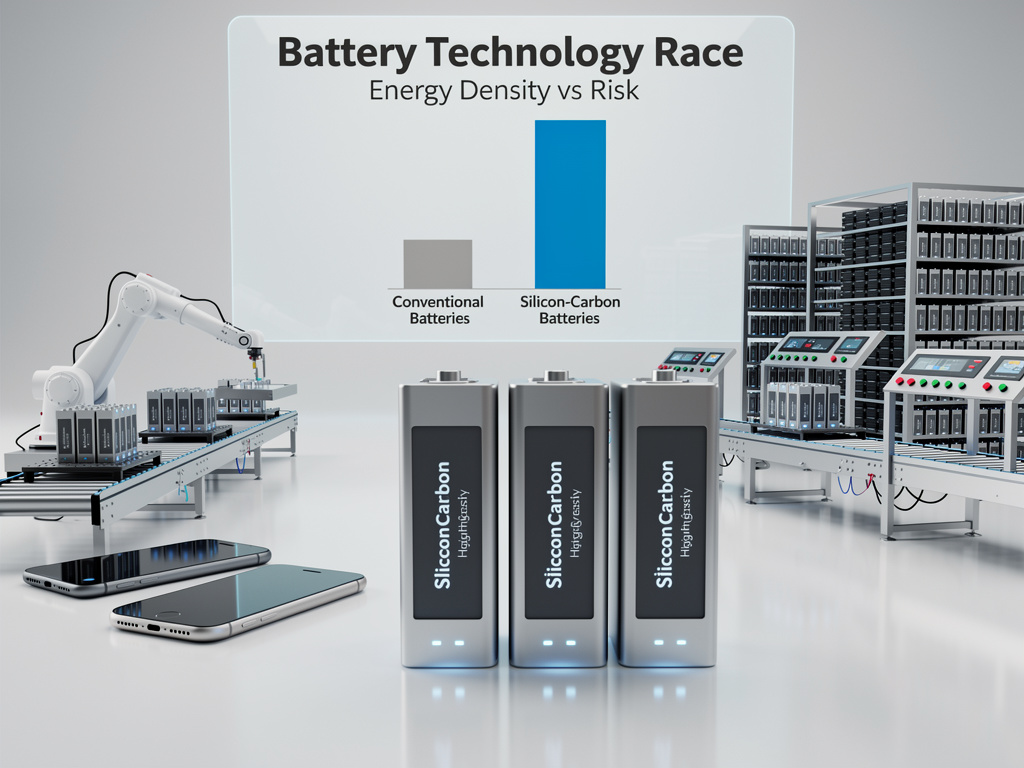
For years, the consumer electronics industry has been tantalized by the promise of silicon-carbon batteries — a next-generation power source that could dramatically extend the runtime of smartphones, laptops, and wearables while shrinking battery footprints. Yet despite the technology’s clear advantages and its growing adoption in electric vehicles, the world’s two largest smartphone makers, Apple and Samsung, have conspicuously refrained from making the switch. The reasons behind this reluctance reveal a complex web of manufacturing challenges, economic calculations, and strategic risk management that goes far deeper than simple technological readiness.
Silicon-carbon batteries replace the traditional graphite anode found in conventional lithium-ion cells with a silicon-carbon composite material. Silicon can theoretically store roughly ten times more lithium ions than graphite, which translates directly into higher energy density. In practical terms, this means a battery of the same physical size could hold significantly more charge, or a device could achieve the same battery life with a much smaller, lighter cell. Chinese smartphone manufacturers like Honor and OnePlus have already begun shipping devices with silicon-carbon batteries, demonstrating that the technology is not merely theoretical — it is commercially viable, at least in certain contexts.
A Technology That Works — But Not Without Trade-Offs
The core appeal of silicon-carbon batteries is straightforward: more energy in less space. As MakeUseOf detailed in its analysis, silicon’s ability to absorb lithium ions far exceeds that of graphite, making it an ideal candidate for next-generation anodes. The silicon-carbon composite approach blends silicon particles with a carbon matrix, which helps mitigate some of silicon’s well-documented physical limitations. The result is a battery chemistry that offers meaningfully higher energy density than what current lithium-ion cells can achieve, potentially in the range of 10% to 30% improvements depending on the specific formulation and engineering approach.
However, silicon’s advantages come packaged with a fundamental physical problem: expansion. When silicon absorbs lithium ions during charging, it swells by as much as 300% to 400% of its original volume. This dramatic expansion and subsequent contraction during discharge creates enormous mechanical stress within the battery cell. Over repeated charge cycles, this stress can crack the silicon particles, degrade the solid electrolyte interphase (SEI) layer that forms on the anode surface, and ultimately cause the battery to lose capacity far more rapidly than a conventional graphite-based cell. This degradation issue is the single largest technical barrier standing between silicon-carbon batteries and mainstream consumer electronics adoption.
Why Chinese Rivals Moved First — And What That Tells Us
The fact that Chinese manufacturers have already embraced silicon-carbon batteries while Apple and Samsung have not is not simply a matter of technological courage versus timidity. Companies like Honor, with its Magic 7 RSR, and OnePlus have deployed these batteries in flagship devices, marketing them as cutting-edge differentiators. These companies operate in an intensely competitive domestic market where specification-sheet advantages — a larger milliamp-hour number, a thinner profile — can translate directly into sales. The calculus for these brands favors early adoption even if it means accepting some compromises on long-term cycle life or manufacturing yield.
Apple and Samsung, by contrast, operate under a different set of constraints. Both companies ship hundreds of millions of devices annually and maintain brand reputations built substantially on reliability and longevity. A battery that degrades noticeably faster than its predecessor would represent a reputational risk that neither company is willing to accept lightly. As MakeUseOf noted, Apple in particular has a history of being cautious with battery technology transitions, preferring to wait until a new chemistry can meet its stringent internal standards for cycle life, safety, and consistency before committing to mass production. Samsung, still carrying institutional memory from the Galaxy Note 7 battery debacle of 2016, has every reason to be equally conservative.
The Manufacturing Equation: Scale, Cost, and Supply Chain Readiness
Beyond the technical challenges of silicon expansion, there are significant manufacturing and economic hurdles that make silicon-carbon batteries a difficult proposition at the scale Apple and Samsung require. Producing silicon-carbon anodes demands specialized manufacturing processes that differ substantially from the well-established graphite anode production lines that battery suppliers have optimized over decades. Retooling these facilities, qualifying new materials, and establishing reliable supply chains for high-purity silicon nanoparticles or silicon-carbon composite powders requires enormous capital investment and time.
The cost differential remains meaningful. Graphite is abundant, inexpensive, and its supply chain is mature. Silicon-carbon composite materials, while not exotic in a chemical sense, are considerably more expensive to produce at battery-grade quality. For companies like Apple and Samsung, which negotiate battery contracts covering hundreds of millions of units, even a modest per-cell cost increase can translate into billions of dollars in additional component spending. Unless the performance improvement is dramatic enough to justify a higher device price or to enable a compelling new product feature — such as a significantly thinner phone or a meaningfully longer battery life — the economic case for switching remains weak.
Cycle Life: The Silent Dealbreaker
Perhaps the most critical factor in Apple’s and Samsung’s hesitation is cycle life — the number of times a battery can be charged and discharged before its capacity drops below an acceptable threshold. Industry standards for smartphone batteries typically target at least 500 full charge cycles before capacity falls to 80% of its original rating, with Apple recently raising its own benchmark to 1,000 cycles for recent iPhone models. Current silicon-carbon batteries, while improving rapidly, often struggle to match the cycle life performance of well-engineered graphite-anode cells, particularly at the higher silicon content ratios that would deliver the most significant energy density gains.
This is not merely an engineering preference — it has direct consumer-facing implications. Smartphone users increasingly keep their devices for three, four, or even five years. A battery that degrades to 80% capacity after 300 or 400 cycles rather than 800 or 1,000 would generate a wave of customer complaints, warranty claims, and negative press coverage that could far outweigh any marketing benefit from advertising a higher milliamp-hour rating. For Apple, which has built an entire ecosystem around device longevity and environmental sustainability through programs like its trade-in and refurbishment initiatives, premature battery degradation would undermine a core brand narrative.
The Path Forward: Incremental Adoption and Hybrid Approaches
Industry observers widely expect that both Apple and Samsung will eventually adopt silicon-carbon battery technology — but the transition is likely to be gradual rather than abrupt. One probable pathway involves hybrid anodes that incorporate small percentages of silicon into a predominantly graphite matrix. This approach captures some of silicon’s energy density benefits while keeping the expansion problem manageable and preserving acceptable cycle life characteristics. Several major battery suppliers, including Samsung SDI and LG Energy Solution, have been developing exactly these kinds of blended anode formulations for both consumer electronics and electric vehicle applications.
Apple has been particularly active in battery research, with numerous patents filed in recent years related to silicon anode technologies, advanced electrolyte formulations, and novel cell architectures designed to accommodate silicon’s expansion behavior. These filings suggest that Apple is not ignoring silicon-carbon technology but rather working to solve its limitations on its own terms and timeline. Samsung, through its SDI battery division, has similarly invested heavily in next-generation anode research, with particular focus on silicon nanostructures and protective coating technologies that could extend cycle life while preserving energy density gains.
What the Electric Vehicle Sector Reveals About the Timeline
The electric vehicle industry offers instructive parallels. Companies like Tesla, CATL, and BYD have been integrating silicon into their battery anodes for several years, but typically at low percentages — often in the range of 3% to 10% silicon by weight. Even at these modest levels, the benefits in energy density are measurable, and the cycle life trade-offs are manageable within the context of EV battery packs that include sophisticated thermal management and charge management systems. The consumer electronics world lacks some of these mitigating factors; a smartphone battery operates in a far less controlled thermal environment and is subject to more erratic charging patterns than an EV battery managed by a dedicated battery management system.
The timeline for broader adoption in smartphones likely depends on continued advances in silicon particle engineering — particularly the development of porous silicon structures, silicon nanowires, and pre-lithiation techniques that can reduce first-cycle capacity loss and improve long-term stability. Several research institutions and startups are making meaningful progress on these fronts, and battery industry analysts generally expect commercially viable, high-silicon-content anodes suitable for consumer electronics to reach maturity within the next two to four years.
Strategic Patience as Competitive Advantage
For Apple and Samsung, the decision to wait is itself a strategic choice. Both companies have learned from past industry episodes — Samsung’s Note 7 crisis, Apple’s battery throttling controversy — that battery-related missteps carry outsized reputational and financial consequences. By allowing smaller, more risk-tolerant competitors to serve as early adopters and, in effect, as large-scale beta testers, Apple and Samsung can observe real-world performance data, identify failure modes, and refine their own implementations before committing to mass deployment.
This approach carries its own risks, of course. If a competitor like Honor or Xiaomi delivers a genuinely superior battery experience using silicon-carbon technology and captures meaningful market share as a result, the cost of Apple’s and Samsung’s caution could be measured in lost customers rather than avoided warranty claims. The balance between prudence and competitive urgency is one that both companies’ engineering and product leadership must navigate carefully. What is clear is that silicon-carbon batteries represent not a question of if but of when — and the companies that time their adoption correctly will reap significant rewards in a market where battery life remains one of the most important factors in consumer purchasing decisions.


 WebProNews is an iEntry Publication