
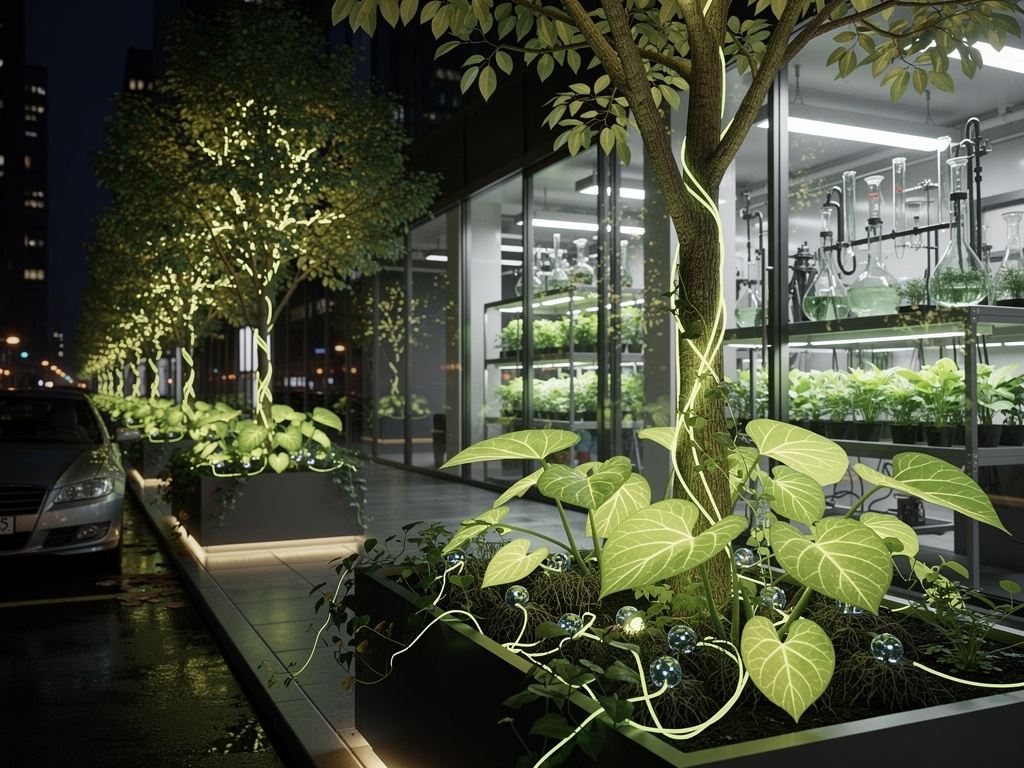
Imagine walking down a city boulevard at night, guided not by the amber glow of sodium vapor lamps but by the soft luminescence of engineered trees lining the sidewalk. No electricity. No wiring. No monthly utility bill. Just biology doing what it was designed to do — only better.
That vision, once relegated to science fiction, is now the subject of serious scientific investment. Researchers at multiple institutions are racing to bioengineer plants that emit enough light to serve practical purposes — from illuminating footpaths to, eventually, replacing streetlights entirely. The work sits at the intersection of synthetic biology, nanotechnology, and urban planning, and it’s advancing faster than most people realize.
From Fireflies to Foliage: The Science of Making Plants Shine
The foundational research traces back to MIT, where a team led by Michael Strano, a professor of chemical engineering, first demonstrated in 2017 that watercress plants could be made to glow for nearly four hours by embedding specialized nanoparticles into their leaves. The nanoparticles contained luciferase — the same enzyme that gives fireflies their characteristic flash — along with luciferin, the molecule luciferase acts upon, and coenzyme A, which removes a reaction byproduct that inhibits luciferase activity. The result was a dim but unmistakable greenish glow.
As Futurism reported, the MIT team has since made significant progress. By 2021, they had boosted the light output twentyfold compared to their initial experiments and extended the glow duration dramatically. They achieved this by using a different type of nanoparticle — light-capacitor particles made from strontium aluminate — that could absorb and re-emit light over time, functioning essentially as biological batteries for photons. Plants treated with these particles could be briefly “charged” with an LED and then glow for up to an hour, a cycle that could be repeated.
The numbers still sound modest. Early versions produced about one-thousandth the light needed to read by. But the trajectory matters. Each iteration has delivered order-of-magnitude improvements.
Strano’s group isn’t alone. A startup called Light Bio, spun out of research at the University of Idaho, has taken a fundamentally different approach. Rather than embedding nanoparticles, Light Bio’s scientists genetically modified plants to produce their own bioluminescence using genes borrowed from the fungus Neonothopanus nambi, a mushroom that glows in the dark. Their first commercial product — a glowing petunia called the “Firefly Petunia” — went on sale in the United States in 2024 after receiving USDA approval. The plants produce a faint, continuous glow visible in darkness, powered entirely by the plant’s own metabolic processes.
The Firefly Petunia is a novelty item. It doesn’t illuminate anything useful. But it represents a proof of concept that a living plant can be engineered to glow autonomously, without any external chemical application, for its entire lifespan. That distinction is significant.
The fungal bioluminescence pathway is particularly promising because it relies on caffeic acid, a molecule plants already produce in abundance. Researchers at the Russian Academy of Sciences first mapped this metabolic pathway in 2020, publishing their findings in Nature Biotechnology. They showed that by inserting just four genes from the bioluminescent fungus into tobacco plants, they could create specimens that glowed visibly throughout their life cycle — from seedling to mature plant. The glow was brightest in young, actively growing tissues, particularly flowers.
This metabolic compatibility is key. The plant doesn’t need to be fed exotic substrates or recharged. It simply grows and glows.
The Urban Promise — and the Engineering Gap
So can glowing trees actually replace streetlights? The honest answer right now: not yet. Not even close, in terms of raw lumen output.
A standard LED streetlight produces roughly 10,000 to 30,000 lumens. The brightest bioluminescent plants currently produce light measured in fractions of a lux at close range. The gap is enormous — several orders of magnitude. And bridging it requires not just brighter bioluminescence but fundamentally rethinking how biological light could be deployed in urban settings.
Proponents argue the comparison to streetlights is the wrong frame. Cities don’t need every pathway flooded with light. Many applications — park trails, residential sidewalks, bike lanes, decorative plazas — require far less illumination than a major roadway. A continuous border of softly glowing hedges along a walking path might provide sufficient wayfinding light while also reducing light pollution, which has documented harmful effects on human sleep cycles, migrating birds, and insect populations.
The energy argument is compelling on paper. According to the U.S. Department of Energy, outdoor lighting accounts for a substantial portion of municipal electricity budgets. Street and roadway lighting alone consumes an estimated 60 terawatt-hours annually in the United States. Plants that provide even supplemental lighting could meaningfully reduce that figure — and the associated carbon emissions — at essentially zero operating cost after planting.
There are also maintenance considerations that favor biology. Streetlights require regular bulb replacement, electrical infrastructure, and repair crews. Trees require pruning and occasional care, but they also sequester carbon, reduce urban heat island effects, manage stormwater, and improve air quality. A glowing tree would deliver all of those co-benefits while also providing light. The value proposition, if the technology matures, is multidimensional.
But the engineering challenges are formidable. Brightness is the obvious one. There’s also the question of controllability — can you dim a tree? Turn it off during the day? Direct its light downward where it’s needed rather than radiating in all directions? Strano’s nanoparticle approach offers some answers here, since the light-capacitor particles can theoretically be tuned and the charging cycle controlled. Genetic approaches are harder to modulate.
Durability matters too. A streetlight works in January in Minneapolis. Would a bioluminescent tree? Deciduous species lose their leaves. Evergreens grow slowly. Cold temperatures suppress metabolic activity, which would presumably reduce light output precisely when longer nights demand more of it.
And then there’s the regulatory dimension. The USDA approved Light Bio’s Firefly Petunia partly because petunias are not considered invasive and the inserted genes don’t confer any competitive advantage in the wild. Scaling bioluminescence to trees — long-lived organisms that reproduce, spread, and interact with complex forest and urban biomes — would face far more scrutiny. The environmental review process for genetically modified trees is rigorous, slow, and politically charged.
A Convergence of Investment and Ambition
Despite these hurdles, money is flowing. Light Bio has attracted venture capital funding and generated significant consumer demand — the Firefly Petunia reportedly accumulated a waitlist of tens of thousands before its commercial launch. The company has signaled ambitions well beyond ornamental houseplants.
MIT’s work continues to receive federal research funding, and Strano has been explicit about the long-term urban lighting goal. His lab is exploring ways to increase nanoparticle uptake efficiency, extend glow duration, and apply treatments to larger plant species including trees. The approach has the advantage of being applicable to existing, non-modified plants — you could theoretically treat a mature oak rather than waiting decades for a transgenic sapling to grow.
Other research groups are exploring hybrid approaches. Some are investigating whether CRISPR gene-editing tools could upregulate a plant’s natural production of fluorescent compounds. Others are looking at symbiotic relationships — could bioluminescent bacteria or fungi living on a tree’s surface provide the glow without modifying the tree’s own genome? Such approaches might face a lighter regulatory burden.
The commercial interest extends beyond lighting. Bioluminescent plants could serve as living environmental sensors — engineered to glow brighter in the presence of specific pollutants, or to change color when soil conditions shift. Strano’s MIT lab has already demonstrated plants that can detect explosives in groundwater and signal the finding through changes in their fluorescence. The military and security applications are obvious.
Urban designers are paying attention too. The concept aligns with broader movements toward biophilic city design, which emphasizes integrating natural systems into urban infrastructure rather than treating nature as mere decoration. Glowing gardens and luminescent tree canopies would represent perhaps the most dramatic expression of that philosophy — infrastructure that is literally alive.
There’s a philosophical dimension here that shouldn’t be dismissed. For centuries, human civilization has defined progress partly by its ability to push back the darkness with artificial light — fire, gas lamps, incandescent bulbs, LEDs. Each technology was brighter, more efficient, more controllable than the last. Bioluminescent plants would represent something different entirely. Not brighter. Not more controllable. But alive, self-sustaining, and carbon-negative. A fundamentally different relationship between human settlements and the natural world.
Whether that vision materializes in five years or fifty depends on whether researchers can close the brightness gap without sacrificing the biological elegance that makes the concept attractive in the first place. The science is real. The trajectory is encouraging. The distance still to travel is vast.
But on some lab bench right now, a small plant is glowing in the dark. And it’s getting brighter.


 WebProNews is an iEntry Publication