
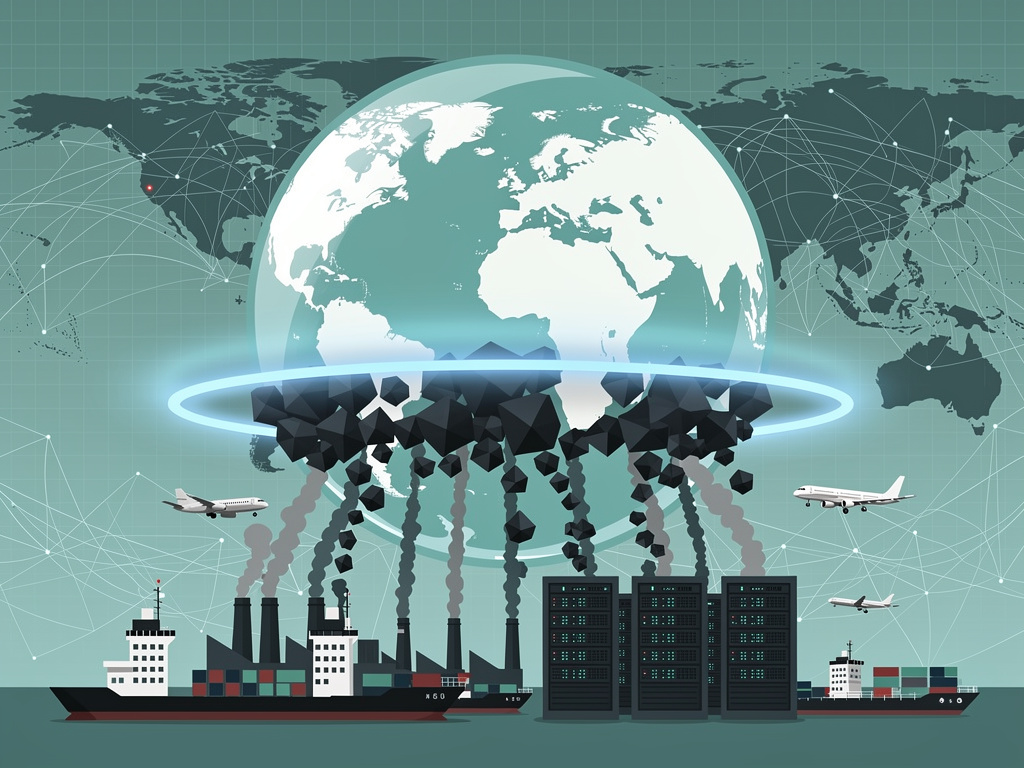
For most of human history, the atmosphere was invisible in more ways than one. We breathed it, flew through it, launched signals across it — and barely gave it a second thought. That era is over. The thin shell of gases wrapped around the planet has become the most contested shared resource on Earth, and how we govern it will determine the economic trajectory of every nation for decades to come.
A recent analysis published by Toni.org lays out the stakes with unusual clarity, framing the atmosphere not as an abstract environmental concern but as a commons — a finite, shared resource whose misuse imposes costs on everyone. The piece draws on centuries of economic thinking, from Garrett Hardin’s tragedy of the commons to Elinor Ostrom’s Nobel Prize-winning work on collective governance, and applies it directly to the carbon problem. The argument is straightforward: the atmosphere has a limited capacity to absorb greenhouse gases without destabilizing the climate. We’ve been treating that capacity as free. It isn’t.
This framing matters because it shifts the conversation away from morality and toward property rights, incentive structures, and institutional design — the language of markets and governance that actually moves policy.
The core tension is familiar to anyone who has studied common-pool resources. When a resource is open to all and owned by none, individuals and firms have every incentive to overuse it. Each ton of CO₂ emitted into the atmosphere delivers private benefit — cheap energy, industrial output, economic growth — while spreading the cost across all 8 billion people on the planet. The emitter captures the upside. Everyone else absorbs the downside. Classic externality.
What makes the atmosphere different from, say, an overfished lake or an overgrazed pasture is scale. There’s no local authority that can fence it off. No single government can enforce limits. And the lag between emissions and consequences stretches across decades, making it almost perfectly designed to resist political action. Voters don’t punish leaders for problems that won’t fully materialize until the next generation.
The Toni.org analysis argues that this isn’t a reason for despair — it’s a reason to get serious about institutional architecture. Ostrom showed that communities can manage shared resources without privatization or top-down regulation, provided they establish clear rules, monitoring systems, and graduated sanctions. The question is whether those principles can operate at a planetary scale.
So far, the evidence is mixed.
The Paris Agreement, signed in 2015, attempted something like an Ostrom-style framework: voluntary commitments, regular reporting, and peer pressure rather than enforceable mandates. It was a diplomatic achievement. But as the Toni.org piece notes, voluntary pledges without binding enforcement mechanisms tend to produce exactly the outcome theory predicts — underprovision of the public good. Countries set targets, miss them, reset them, and repeat. The atmosphere keeps accumulating carbon regardless of what’s written in communiqués.
Carbon pricing has been the economist’s preferred solution for decades. Tax the externality, let the market adjust. The European Union’s Emissions Trading System, the world’s largest carbon market, has shown that the mechanism can work — emissions in covered sectors have fallen significantly since the system launched in 2005. But the EU ETS covers only about 40% of European emissions, and Europe accounts for roughly 8% of global output. China launched its own carbon market in 2021, though prices remain low and coverage is limited to the power sector. The United States has no national carbon price and, under current political conditions, isn’t likely to get one soon.
The patchwork nature of these efforts creates its own problems. Carbon leakage — where emissions-intensive production simply migrates to jurisdictions with weaker rules — undermines the environmental benefit and creates competitive distortions. The EU’s Carbon Border Adjustment Mechanism, which began its transitional phase in 2023, is an attempt to address this by imposing carbon costs on imports. But it’s generated friction with trading partners who view it as protectionism dressed in green clothing.
The Real Question Isn’t Whether to Price Carbon — It’s Who Owns the Sky
This is where the commons framing becomes genuinely provocative. If the atmosphere’s absorptive capacity is a shared resource, then every person on Earth has an equal claim to it. That principle, taken seriously, has radical implications for how carbon budgets are allocated.
Right now, allocation is determined by history and power. Industrialized nations used the bulk of the atmosphere’s carbon budget during the 19th and 20th centuries to build their wealth. Developing nations, which contributed far less to cumulative emissions, are now being asked to constrain their growth to preserve what’s left. The inequity is glaring, and it poisons every international negotiation.
The Toni.org analysis points to per-capita allocation frameworks as one potential resolution — essentially dividing the remaining carbon budget equally among all people and allowing nations to trade their shares. It’s an elegant idea on paper. In practice, it would represent a massive transfer of wealth from high-emitting countries to low-emitting ones, which is precisely why it has gained little traction in capitals that would be writing the checks.
And yet the underlying logic is hard to dismiss. If the atmosphere is truly a commons, then those who have overused it owe something to those who haven’t. That’s not a moral argument. It’s an accounting one.
Recent developments have added urgency to these debates. The World Meteorological Organization confirmed that 2024 was the hottest year on record, with global average temperatures exceeding 1.5°C above pre-industrial levels for the first time over a full calendar year. That threshold — enshrined in the Paris Agreement as a target not to cross — was supposed to be a ceiling, not a floor. Its breach hasn’t triggered the kind of political mobilization that climate advocates hoped for, but it has sharpened the focus on adaptation costs and loss-and-damage financing for vulnerable nations.
Meanwhile, the technology picture has shifted faster than almost anyone predicted. Solar and wind power are now the cheapest sources of new electricity generation in most of the world. Battery costs have plummeted. Electric vehicle adoption is accelerating, particularly in China and Europe. These trends don’t solve the commons problem — they make the solution cheaper, which is different. The atmosphere doesn’t care whether emissions come from coal plants or from cement kilns or from deforestation. It absorbs all of it indiscriminately.
That indiscriminate absorption is both the problem and the clue to the solution. Because CO₂ mixes globally within about a year, a ton reduced anywhere benefits everyone everywhere. This means that the most cost-effective reductions — wherever they occur — deliver the same atmospheric benefit as the most expensive ones. It’s the strongest possible case for international cooperation and flexible mechanisms. And it’s the strongest possible case against the kind of go-it-alone industrial policy that has dominated climate discussions in Washington and Brussels.
The tension between national industrial strategy and global atmospheric management is likely to define climate politics for the next decade. The U.S. Inflation Reduction Act, passed in 2022, channeled hundreds of billions of dollars into clean energy subsidies — effective at driving domestic deployment, but structured as competitive advantage rather than global public goods provision. China’s dominance in solar manufacturing and battery production serves its own economic interests while also, incidentally, driving down costs for the rest of the world. These aren’t altruistic moves. They’re national strategies that happen to have positive atmospheric spillovers.
Whether that’s enough depends on your definition of enough.
The atmospheric science is unforgiving on this point. The remaining carbon budget consistent with limiting warming to 1.5°C is, by most estimates, already exhausted or nearly so. The budget for 2°C is larger but shrinking fast — roughly 1,150 gigatons of CO₂ from the start of 2020, according to the IPCC’s Sixth Assessment Report, against current annual emissions of approximately 40 gigatons. Simple arithmetic. At current rates, that budget runs out in less than three decades.
This is why the commons framing isn’t just an academic exercise. It forces a question that carbon pricing alone can’t answer: who gets to emit what’s left? And who decides?
Current governance structures aren’t equipped to answer those questions. The UN Framework Convention on Climate Change operates on consensus, which means any country can effectively block action. The G7 and G20 can set agendas but can’t enforce compliance. Bilateral deals between major emitters — the U.S.-China climate agreements of 2014 and 2021 — have been productive but fragile, subject to the vagaries of domestic politics and geopolitical rivalry.
Ostrom’s research suggested that successful commons governance requires, among other things, clearly defined boundaries, proportional equivalence between benefits and costs, collective-choice arrangements that include most affected parties, and effective monitoring. By those criteria, the current international climate architecture fails on nearly every count. Boundaries are fuzzy. Costs and benefits are wildly misaligned. Many of the most affected parties — small island states, future generations — have minimal influence. And monitoring, while improving through satellite technology and atmospheric measurement, still relies heavily on self-reporting by national governments with obvious incentives to shade the numbers.
None of this means the situation is hopeless. It means the institutional challenge is enormous and largely unsolved. The atmosphere will continue to accumulate greenhouse gases until the institutions catch up with the physics. Every year of delay narrows the options and raises the eventual cost.
The Toni.org analysis closes with a point that deserves wider attention: the atmosphere is the only commons that every human being depends on equally. Not approximately equally. Exactly equally. No one can opt out of breathing. No one can build a wall against a changing climate. That universality should, in theory, make cooperation easier than it is for any other shared resource. In practice, it hasn’t. But the logic remains, patient and indifferent to our politics, waiting for the institutions to catch up.
The sky belongs to everyone. The question is whether we’ll govern it that way before the bill comes due.


 WebProNews is an iEntry Publication