
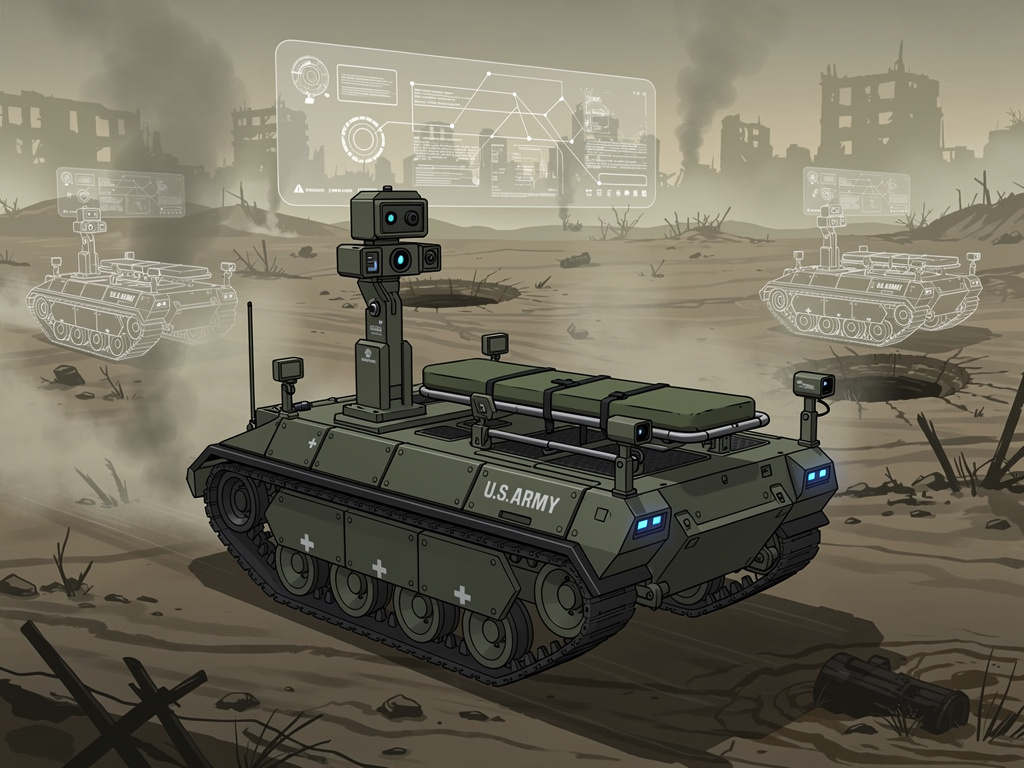
The U.S. Army is betting that in future conflicts, the first responder pulling a wounded soldier off the battlefield won’t be a medic. It’ll be a machine.
According to a Business Insider report, the Army is actively developing robotic systems capable of performing casualty evacuation — one of the most dangerous tasks in combat. The concept isn’t science fiction anymore. It’s a near-term military planning priority, with prototypes and testing already underway.
The core problem is straightforward and brutal. Battlefield casualty evacuation, or CASEVAC, has always been one of the deadliest jobs in war. Medics and fellow soldiers who rush to retrieve the wounded expose themselves to the same fire that caused the initial injuries. In peer-level conflicts — think potential engagements against adversaries like China or Russia — the Army expects contested environments where air superiority isn’t guaranteed and helicopter medevac may not be available. That changes everything about how you get hurt soldiers out.
So the Army is turning to unmanned ground vehicles.
The service has been experimenting with autonomous and semi-autonomous platforms that can drive into a danger zone, load a casualty, and transport them to a collection point where human medical teams can take over. The vision isn’t to replace combat medics entirely but to reduce the number of people who have to enter kill zones. Fewer humans exposed means fewer additional casualties during rescue operations.
One key effort centers on the Army’s Robotic Combat Vehicle (RCV) program, which has been developing various classes of unmanned ground platforms for years. While the RCV program is primarily focused on combat and reconnaissance roles, the Army sees clear crossover potential for logistics and medical evacuation variants. The thinking: if you already have a robotic chassis that can handle rough terrain under fire, strapping a litter system onto it isn’t a massive engineering leap.
But the technical challenges are real. Autonomy in an unstructured, chaotic battlefield environment is orders of magnitude harder than autonomy on a highway. The robot needs to avoid obstacles, identify safe routes, potentially respond to enemy fire indicators, and — critically — handle a wounded human being without causing further injury. That last part is non-trivial. Loading an unconscious or immobilized soldier onto a platform requires either sophisticated manipulation systems or a design that allows nearby soldiers to quickly load casualties with minimal exposure time.
The Army’s approach appears to favor teleoperation as a bridge to full autonomy. A soldier operating from a protected position could drive the robot to the casualty, while the longer-term goal remains increasing the vehicle’s ability to perform the mission with minimal human input. This mirrors the broader Pentagon strategy across unmanned systems: start with a human in the loop, gradually reduce the tether.
Timing matters here. The Army’s modernization push under its Transformation in Contact initiative has accelerated timelines for integrating robotic systems across multiple mission sets. According to Army leaders cited by Business Insider, the service wants these capabilities fielded not in decades but in years. Some experimental units are already testing concepts with existing platforms.
The broader context is the Pentagon’s Replicator initiative and the wider push toward autonomous systems across all service branches. The military’s appetite for unmanned platforms has surged since observing drone and robotic warfare in Ukraine, where both sides have used ground robots for logistics, reconnaissance, and even direct combat. Ukraine has essentially become a live proving ground for concepts the U.S. military has been theorizing about for years.
And the economics make sense. Unmanned ground vehicles don’t require the same training pipeline as combat medics. They don’t experience fear or fatigue. They can operate in contaminated environments — chemical, biological, radiological — where sending humans would be extraordinarily risky. For an Army worried about sustaining casualties in a large-scale conflict against a near-peer adversary, reducing the human cost of casualty recovery is a strategic priority, not just a humanitarian one.
There are legitimate concerns. Reliability in combat conditions remains unproven at scale. Electronic warfare — jamming, spoofing, cyberattacks — could render teleoperated systems useless at exactly the wrong moment. And there’s the question of trust: will soldiers actually rely on a robot to rescue their wounded, or will they default to doing it themselves regardless of the risk? Military culture around “never leave a fallen comrade” runs deep. A robot showing up instead of a buddy is a psychological shift the force hasn’t fully grappled with.
Still, the trajectory is clear. The Army isn’t asking whether robots will perform casualty evacuation. It’s asking how soon. Budget documents, modernization roadmaps, and experimental unit exercises all point in the same direction — unmanned CASEVAC is coming, and the service wants it operational before the next major conflict, not during one.
For defense tech companies, this represents a significant opportunity. Firms working on autonomous ground mobility, ruggedized medical transport systems, and human-machine teaming interfaces should be paying close attention to upcoming solicitations. The Army’s requirements will likely emphasize modularity — platforms that can switch between logistics, evacuation, and other roles — rather than purpose-built medical robots.
The bottom line: the future battlefield medic might be made of steel and silicon. Not a replacement for human care, but a way to get the wounded to that care without adding more names to the casualty list. That’s a trade the Army is increasingly ready to make.


 WebProNews is an iEntry Publication