
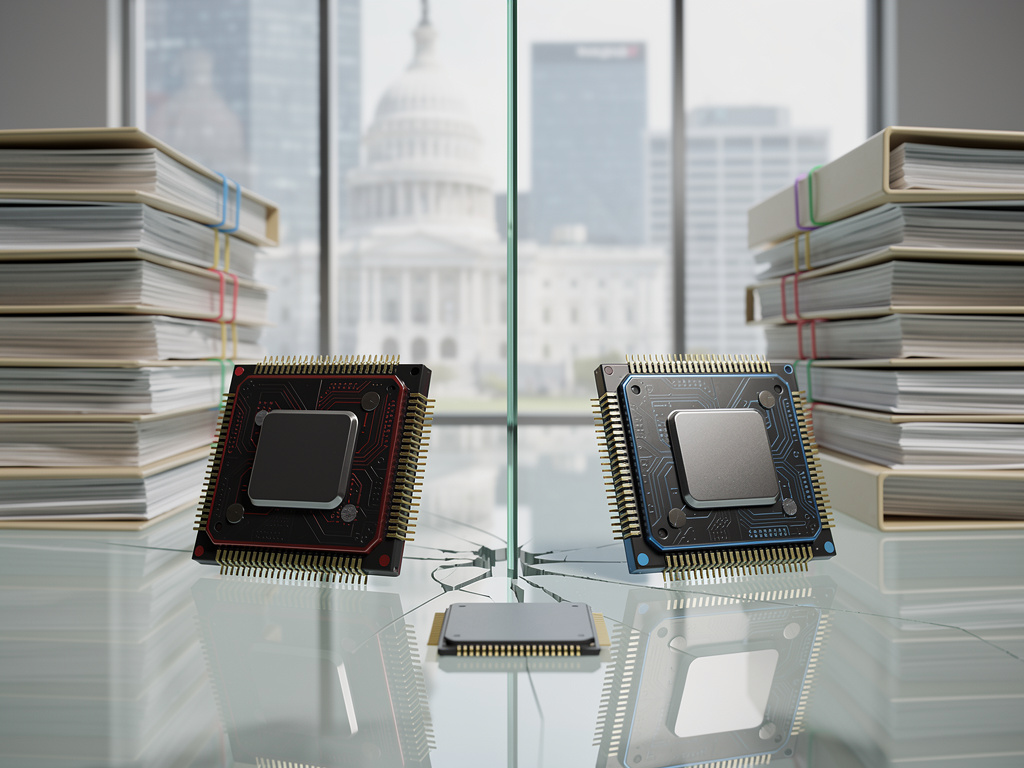
For a few breathless hours this week, the internet convinced itself that Advanced Micro Devices was about to acquire Intel Corporation — a deal that would have been the largest in semiconductor history, a regulatory nightmare of unprecedented scale, and a complete reshaping of the x86 processor market as we know it. None of it was true.
The rumor erupted after AMD filed an HSR (Hart-Scott-Rodino) Act notification with the Federal Trade Commission, a routine antitrust filing that companies must submit before completing certain transactions above a dollar threshold. The filing was real. The interpretation was not. Within minutes, social media platforms — X in particular — lit up with speculation that AMD CEO Lisa Su was orchestrating a hostile takeover of her company’s oldest and most storied rival. Stock traders took notice. Tech journalists scrambled. And the narrative took on a life entirely disconnected from the underlying facts.
As Gadget Review reported, the HSR filing that triggered the frenzy was almost certainly related to something far more mundane: AMD’s previously announced acquisition of ZT Systems, a deal valued at approximately $4.9 billion that AMD disclosed in August 2024. ZT Systems is a server and infrastructure company whose capabilities would bolster AMD’s data center ambitions. That transaction requires HSR clearance. The filing appeared. People connected the wrong dots.
It’s the kind of misunderstanding that reveals how jittery the market has become about Intel’s future — and how hungry observers are for a dramatic resolution to the chipmaker’s prolonged decline.
Intel’s troubles are no secret. The company has lost market share to AMD in both consumer and enterprise processors for years. Its ambitious foundry strategy under CEO Pat Gelsinger, who departed in December 2024, consumed tens of billions in capital expenditure while delivering uneven results. Intel’s stock price has cratered from its 2021 highs, and the company announced layoffs affecting more than 15,000 employees in 2024. The new leadership under interim arrangements has yet to articulate a clear path forward that satisfies Wall Street. So when any filing with even a tangential connection to Intel surfaces, speculation fills the vacuum.
But the idea that AMD would buy Intel doesn’t survive contact with basic arithmetic or antitrust law.
Start with the numbers. Intel’s market capitalization, even in its diminished state, hovers around $90 billion to $100 billion depending on the day. AMD’s own market cap sits in the range of $170 billion to $200 billion. An acquisition of Intel would require AMD to either take on staggering debt, dilute its shareholders massively through a stock-based deal, or both. Lisa Su has built AMD’s comeback on disciplined capital allocation and focused R&D spending. Swallowing a company half your size that is bleeding cash on a foundry buildout would be the opposite of disciplined.
Then there’s the antitrust question, which is even more disqualifying. AMD and Intel are the only two companies that design and sell x86 processors. They operate under a cross-licensing agreement that dates back decades — an agreement that, as Gadget Review noted, would almost certainly be voided or rendered meaningless by a merger. Combining the two companies would create a monopoly in x86 chips. No antitrust regulator on Earth — not the FTC, not the European Commission, not China’s State Administration for Market Regulation — would approve it. The review process alone would take years and almost certainly end in rejection.
There’s also the matter of CHIPS Act funding. Intel has been awarded billions in subsidies and loan guarantees under the U.S. CHIPS and Science Act to build domestic semiconductor fabrication capacity. Those awards come with strings attached, including restrictions on ownership changes and foreign influence. A merger with AMD would trigger extensive government review of whether those commitments could still be honored, adding yet another regulatory barrier to an already impossible transaction.
None of this stopped the rumor from spreading. On X, posts speculating about an AMD-Intel combination racked up millions of views before corrections gained traction. Some accounts framed the HSR filing as a confirmed precursor to a deal. Others speculated that the U.S. government itself might encourage the merger as a national security play to consolidate domestic chip capabilities against Chinese competition. That theory, while creative, ignores the fact that antitrust enforcement and industrial policy operate on separate tracks with different mandates.
The speed of the rumor’s spread — and the slowness of its debunking — illustrates a recurring pattern in financial media. HSR filings are public but often lack detail about the specific transaction they cover. That ambiguity creates space for speculation. And in an environment where Intel’s strategic direction is genuinely uncertain, speculation finds fertile ground.
What AMD is actually doing is interesting enough on its own merits without fabricating an Intel acquisition. The ZT Systems deal, once completed, would give AMD a vertically integrated capability in designing and deploying AI-optimized server infrastructure. That matters because the data center market is where the real money is right now. Nvidia dominates AI training workloads with its GPU platform, but AMD has been making inroads with its Instinct MI300 series accelerators. Adding ZT Systems’ rack-scale design and deployment expertise would let AMD offer more complete solutions to hyperscale cloud customers like Microsoft, Meta, and Amazon.
AMD reported its fourth-quarter 2024 earnings in late January, posting data center revenue of $3.9 billion — a 69% year-over-year increase. The company’s total revenue hit $7.7 billion for the quarter. These are strong numbers. Lisa Su doesn’t need to buy Intel to keep AMD’s growth trajectory intact. She needs to keep executing on AI infrastructure, which is exactly what the ZT Systems acquisition is designed to support.
Intel, meanwhile, is fighting its own battles. The company’s board is searching for a permanent CEO after Gelsinger’s exit. It’s weighing whether to spin off or restructure its foundry business, Intel Foundry Services, which has been a drag on profitability. There have been legitimate reports — from Bloomberg, Reuters, and others — about potential investors or partners for Intel’s manufacturing operations, including interest from Broadcom and TSMC in various configurations. Those discussions are real. An AMD acquisition is not among them.
The broader context here is an industry in the middle of a massive capital reallocation driven by artificial intelligence. Nvidia’s market cap has surpassed $3 trillion. TSMC is spending over $30 billion annually on capital expenditure. Samsung is pouring money into advanced packaging and high-bandwidth memory. Every major chip company is repositioning itself around AI workloads, and the winners and losers of this transition are being sorted in real time. Intel is trying not to become a loser. AMD is trying to become a bigger winner. Those are parallel stories, not converging ones.
So what should investors and industry watchers actually take away from this episode? A few things.
First, HSR filings are not acquisition announcements. They’re procedural. Companies file them for transactions of all kinds, including ones that have already been publicly disclosed. Reading an HSR notice as evidence of a secret mega-deal is like reading a building permit as evidence someone is constructing a skyscraper. Maybe. Or maybe they’re adding a deck.
Second, the AMD-Intel rumor persists because it appeals to a certain narrative logic: the scrappy underdog buys the fallen giant, the student becomes the master. It’s a compelling story. It’s just not a plausible one. The regulatory, financial, and strategic obstacles are each individually sufficient to kill the deal. Together, they make it a fantasy.
Third, Intel’s real strategic options — a foundry spinoff, a partnership with a major manufacturing player, a breakup into design and fabrication units — are complicated enough without adding fictional ones to the mix. The company’s next CEO will inherit one of the most difficult jobs in the technology industry. Whoever takes the role will need to decide what Intel actually wants to be: a fabless chip designer, an integrated manufacturer, or something in between. That decision will shape the semiconductor industry for a decade. It deserves serious analysis, not social media hysteria.
And AMD? AMD will keep doing what it’s been doing. Shipping competitive processors. Gaining share in data centers. Closing the ZT Systems acquisition. Building out its AI software stack to compete with Nvidia’s CUDA dominance. Lisa Su has been one of the most effective CEOs in tech over the past decade, and her playbook doesn’t include reckless empire-building.
The merger that wasn’t is already fading from the news cycle. But the conditions that made it go viral — Intel’s vulnerability, AMD’s ascendance, the market’s appetite for dramatic narratives — aren’t going anywhere. The next rumor is already forming somewhere. It’ll probably be just as wrong.


 WebProNews is an iEntry Publication