
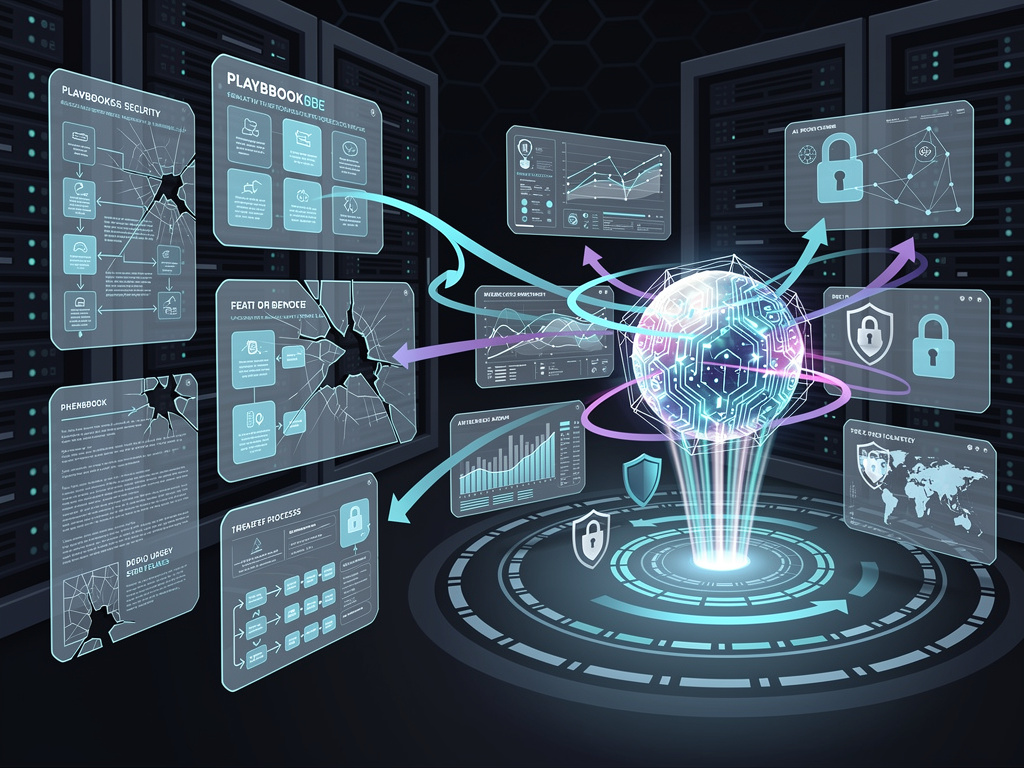
In the glowing command centers of corporate America, a familiar scene of frustration unfolds daily. A junior security analyst, faced with a tsunami of alerts, frantically flips through a thick binder—or its digital equivalent—searching for the right procedure. The pre-written playbook for a potential ransomware attack, drafted months ago, feels rigid and ill-suited for the novel, multi-pronged digital assault currently unfolding on their network. This reliance on static, one-size-fits-all instructions is a critical vulnerability for modern enterprises.
The sheer velocity and sophistication of today’s cyber threats have rendered this traditional approach dangerously obsolete. Attackers adapt their methods in real time, while defense teams are hamstrung by procedural checklists that cannot account for nuance or unforeseen variables. This operational friction is compounded by a severe talent shortage. A 2023 study by Fortinet revealed that 68% of organizations face additional cyber risks due to the ongoing cybersecurity skills gap, a reality that leaves many security operations centers (SOCs) understaffed and overwhelmed (Fortinet).
A Strategy Buckling Under Digital Pressure
The solution, according to a growing consensus among industry leaders and analysts, is not a better binder but a smarter brain. The focus is shifting toward AI-driven playbooks that function less like a static script and more like an elite coaching staff, generating custom strategies on the fly. This new paradigm treats cyber defense as a dynamic game where the ability to adapt is paramount. The goal is to empower security analysts to act like a star quarterback who can read a defense and call an audible at the line of scrimmage.
This marks a fundamental departure from the compliance-driven, checklist mentality that has long defined security operations. “As cyber threats accelerate, static SOC playbooks fall short,” analysts at International Data Corporation (IDC) wrote in a recent blog post, arguing for a system that creates “X’s and O’s on the fly” based on the unique circumstances of each threat (IDC). Instead of forcing an analyst to match an unfolding incident to a pre-existing playbook, the AI generates a bespoke playbook tailored to the specific attacker, the targeted assets, and the current state of the IT environment.
The Shift from Static Checklists to Dynamic Strategy
At the heart of this transformation is the fusion of Generative AI with established Security Orchestration, Automation, and Response (SOAR) platforms. Traditionally, SOAR tools automate repetitive tasks based on rigid, human-defined workflows. By infusing these systems with large language models (LLMs) and other AI, they gain the ability to reason, synthesize information, and generate novel response plans. The AI engine acts as a central nervous system, ingesting a torrent of data from security information and event management (SIEM) systems, threat intelligence feeds, network logs, and endpoint detection tools.
From this vast data pool, the AI can construct a narrative of the attack, identify the probable threat actor, and predict their likely next moves. It then generates a step-by-step response plan, complete with the precise commands needed to isolate an affected machine, block a malicious IP address, or revoke compromised credentials. This process, which could take a human team hours of research and deliberation, can be accomplished in seconds. As experts at IBM note, generative AI can rapidly “generate a natural-language summary of the security incident” and even “generate new threat hunting queries,” effectively doing the heavy lifting of investigation for the analyst (IBM Security).
Inside the AI-Powered Response Engine
Technology giants are racing to bring this capability to market, offering a glimpse into the future of the SOC. Microsoft, for instance, has integrated its generative AI into a product called Security Copilot, which it touts as an “AI-powered security analysis tool.” The system allows analysts to ask natural-language questions like, “What can you tell me about the Vanta Black threat actor?” or “Summarize all alerts related to this suspicious PowerShell script.” It then provides concise summaries and, crucially, a guided response interface that recommends and helps execute the next steps.
In a demonstration, Microsoft showed how Copilot can distill thousands of alerts into a few key incidents, create a visual timeline of an attack, and automatically generate a polished incident report for leadership (Microsoft Security). This is not just automation; it is cognitive augmentation, equipping analysts with an ever-present, all-knowing partner that can process information at machine speed while communicating with human-like clarity.
Tech Giants Field Their AI Defenders
The most profound impact of this technology may be its ability to democratize expertise and mitigate the chronic skills shortage. An AI-driven playbook acts as a force multiplier, embedding the knowledge of a seasoned, tier-3 security analyst into a tool that a tier-1 junior analyst can use effectively. When a novel threat emerges, the AI can generate a best-practice response plan that the junior analyst can validate and execute, effectively allowing them to perform at a much higher level. This on-the-job training and guidance system can dramatically reduce the time it takes for new hires to become productive defenders.
This capability directly addresses the core challenge of scaling security expertise. Instead of relying on a handful of senior experts who quickly become bottlenecks during a major incident, organizations can distribute response capabilities across their entire team. The AI provides the strategic guidance, ensuring that actions are consistent, effective, and aligned with industry best practices, freeing up senior staff to focus on more complex threat hunting and strategic initiatives.
Forging Expertise in Silicon to Bridge the Talent Gap
Beyond speed and efficiency, AI-generated playbooks introduce a new level of accountability and process integrity. Every step recommended by the AI and every action taken by the analyst is meticulously logged, creating a detailed, immutable audit trail. This solves a major pain point in traditional incident response, where manual logging can be inconsistent or incomplete, especially in the heat of a crisis. This automated record-keeping is invaluable for post-incident reviews, allowing teams to analyze their response and refine the AI’s future recommendations.
Furthermore, this detailed logging provides a robust foundation for compliance and regulatory reporting. When auditors or regulators ask for proof of a swift and appropriate response to a data breach, organizations can present a complete, timestamped record of the entire incident lifecycle. As IDC points out, this ensures that “processes are followed and are auditable,” a critical requirement in today’s stringent regulatory environment.
Navigating the Perils of Algorithmic Over-reliance
However, the transition to AI-driven security is not without its risks. A primary concern is the potential for AI “hallucinations,” where the model generates plausible but incorrect or nonsensical information. An AI that wrongly identifies a benign administrative action as malicious could trigger a disruptive and unnecessary response, such as shutting down a critical server. This makes a “human-in-the-loop” approach essential, where analysts are responsible for validating the AI’s findings and authorizing critical actions.
There is also the risk of automation bias, where analysts become overly reliant on the AI’s recommendations and lose their critical thinking skills. According to security analysts at TechTarget, maintaining this balance is crucial because while AI can accelerate analysis, “it’s not infallible and lacks the contextual understanding and intuition of a seasoned human analyst” (TechTarget Security). The most effective SOCs will be those that use AI not as a replacement for human intellect, but as a powerful tool to augment it.
A New Symbiosis for Cyber Defense
Looking ahead, the role of the human security analyst is set to evolve from a hands-on-keyboard first responder to that of a strategic overseer. Their primary function will be to manage, train, and refine the AI models, fine-tuning their behavior and ensuring their recommendations align with the organization’s risk tolerance and business objectives. The most valuable security professionals will be those who can effectively orchestrate this human-machine team, leveraging the AI’s speed and data-processing power while applying human intuition and strategic oversight.
The era of the static, paper-based playbook is drawing to a close. In its place is a new, dynamic paradigm of cyber defense, built on a symbiotic relationship between human and artificial intelligence. The playbook is no longer a document to be read but a living, intelligent entity that adapts in lockstep with the threat. For companies navigating an increasingly hostile digital world, the algorithmic quarterback is no longer a futuristic concept but a competitive necessity for survival.


 WebProNews is an iEntry Publication