
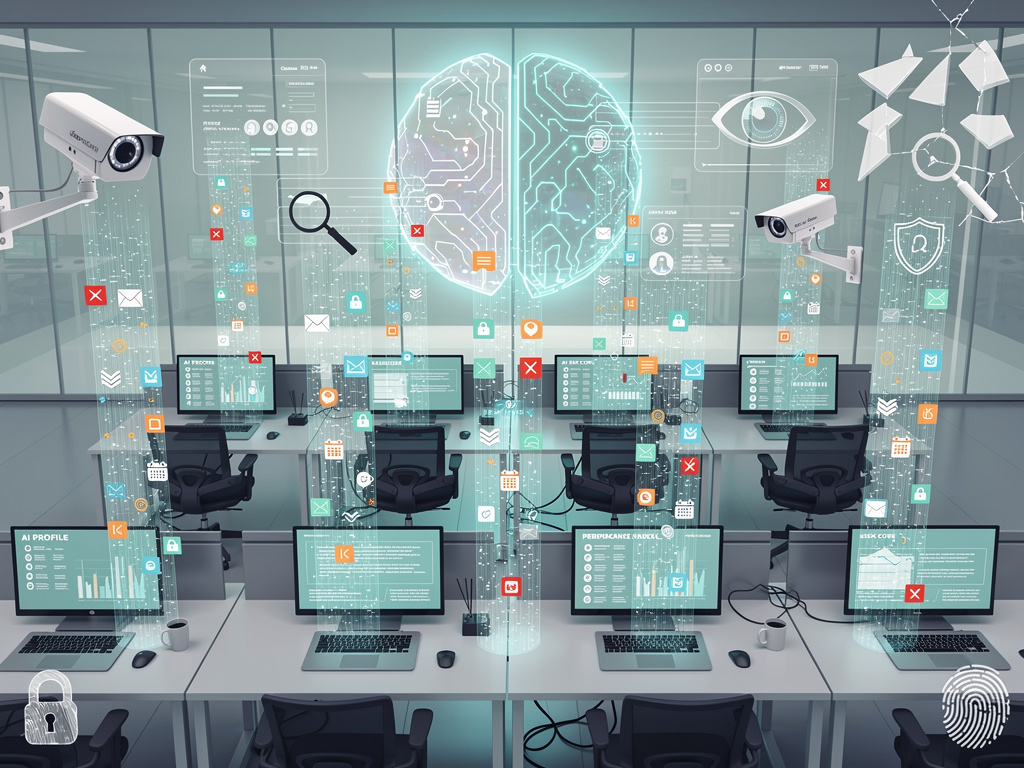
For many white-collar workers, the path to promotion has long been a mix of performance, networking, and a manager’s advocacy. But a new, unseen force is increasingly influencing who gets ahead, who gets reskilled, and even who might be a flight risk. This force is an advanced form of artificial intelligence, operating quietly in the background, analyzing a trove of data that constitutes an employee’s entire digital footprint within a company.
At the forefront of this shift are companies like Eightfold AI, whose “Talent Intelligence Platform” is being adopted by corporations globally. The system creates what is essentially a dynamic, deep-learning dossier on every employee. It ingests and analyzes a staggering amount of information—not just performance reviews and completed projects, but also internal communications on platforms like Slack and Microsoft Teams, emails, documents stored on company servers, and even code checked into repositories. This internal data is then often cross-referenced with public information from sources like LinkedIn, professional publications, and patent filings to build a comprehensive skills profile far beyond what a traditional resume could ever convey.
A New Operating System for Talent Management
From the C-suite’s perspective, these platforms offer a solution to some of the most persistent challenges in human resources: identifying skills gaps, facilitating internal mobility, and retaining top performers. Proponents argue this is not about surveillance, but about opportunity. “The whole point is to understand the capabilities of the people so you can give them the right opportunity,” Ashutosh Garg, CEO of Eightfold AI, stated in a report by Futurism. The promise is a meritocracy powered by data, where a quiet but brilliant software engineer in one division can be algorithmically identified as the perfect candidate for a high-priority project in another, an opportunity they might have otherwise been overlooked for.
This technology represents a move toward what the industry calls “algorithmic management,” where key workforce decisions are increasingly guided or even made by AI-driven insights. Companies see it as a way to unlock the hidden potential within their own ranks, proactively suggesting training for employees whose skills might become obsolete and creating career pathways that are personalized and dynamic. According to an analysis by the Society for Human Resource Management (SHRM), these platforms are designed to serve as a central intelligence layer, helping organizations make smarter, faster decisions about their most valuable asset: their people.
The Unseen Scrutiny of Digital Exhaust
While executives focus on efficiency and opportunity, the implications for employees are profound and complex. The constant, automated scanning of daily work product transforms everyday digital interactions into data points for career evaluation. A sarcastic comment on Slack, a collaborative document edited late at night, or the specific programming language used in a project—all of it becomes “digital exhaust” vacuumed up and analyzed by the algorithm. This introduces a new layer of pressure, where workers may feel compelled to curate their digital behavior for an unseen algorithmic audience, potentially stifling the informal communication and experimentation that often leads to innovation.
The core of the anxiety stems from a lack of transparency and control. Most employees are likely unaware that their daily communications are being systematically parsed to determine their future career trajectory. This raises significant privacy concerns, blurring the line between company oversight and intrusive monitoring. As detailed by The Wall Street Journal, the rise of sophisticated employee monitoring tools is a growing trend, but systems that not only watch but also actively judge and predict create an entirely new dynamic in the employer-employee relationship.
The Persistent Shadow of Algorithmic Bias
A primary defense for these AI systems is that they can reduce human bias in promotions and assignments. By focusing on a quantifiable inventory of skills, the argument goes, the algorithm can bypass the cronyism, favoritism, and unconscious biases of human managers. However, AI is not inherently objective. These systems learn from historical data, and if that data reflects existing societal or organizational biases, the AI can learn and even amplify them. If men have historically been promoted into leadership roles more frequently, the AI may identify patterns it associates with those promotions and favor male candidates for future opportunities.
This risk is not merely theoretical. The potential for discriminatory outcomes has prompted regulatory action, most notably New York City’s Local Law 144, which requires employers using “automated employment decision tools” to conduct independent bias audits and notify candidates that such systems are in use. As an investigation by MIT Technology Review highlights, when AI systems are trained on flawed data, they are prone to replicating and scaling those flaws with terrifying efficiency, whether in the justice system or the corporate world. Without rigorous, ongoing audits and transparency, these talent platforms could inadvertently create a high-tech veneer for old-fashioned discrimination.
A Trade-Off Between Efficiency and Autonomy
The push for AI-driven talent management is part of a larger corporate quest for optimization. For multinational corporations with hundreds of thousands of employees, manually tracking the skills and aspirations of each individual is an impossible task. AI offers a scalable way to manage human capital, aligning employee capabilities with strategic business goals in real-time. The vision sold by companies like Eightfold is one of a perfectly fluid internal talent marketplace where skills are matched to needs with unparalleled precision, boosting both corporate agility and employee engagement.
Yet, this data-driven approach fundamentally reframes the nature of a career. It shifts from a path navigated by human agency, relationships, and ambition to one heavily influenced by algorithmic recommendation. The risk is that employees become passive recipients of AI-suggested career moves rather than active architects of their own professional lives. This shift is explored in a Bloomberg analysis on how AI is reshaping not just jobs, but the very structure of management, potentially reducing the role of middle managers to simply overseeing the implementation of algorithmic directives.
Charting the Path Forward in the Algorithmic Workplace
The deployment of these powerful AI systems is unlikely to slow down. The competitive advantages they promise are too significant for large organizations to ignore. The central question, therefore, is not whether they will be used, but how they will be governed. For these tools to be a force for genuine opportunity rather than a mechanism for opaque surveillance and control, a new framework of digital rights in the workplace is required.
This framework must include, at a minimum, radical transparency. Employees should be informed that these systems are in use and have the right to access and understand their own AI-generated profiles. There must be clear, human-led processes for appealing or correcting algorithmic assessments. Furthermore, independent, third-party audits for bias and fairness should be standard practice, not a regulatory afterthought. Ultimately, the integration of AI into talent management is a test of corporate ethics: a choice between using technology to empower employees and using it to commodify them into a collection of data points on a dashboard.


 WebProNews is an iEntry Publication