
For years, the promise of the autonomous vehicle industry was predicated on a future tense: eventually, the technology would work; eventually, the regulators would acquiesce; and eventually, the economics would undercut human labor. That future is rapidly becoming the present in select American cities. In San Francisco, a critical threshold has been crossed, not with fanfare, but with the quiet hum of electric Jaguars navigating complex urban grids. New analysis suggests that the long-awaited inflection point—where robotaxis compete directly with gig-workers on both price and speed—has arrived, fundamentally altering the operational calculus for investors and incumbents alike.
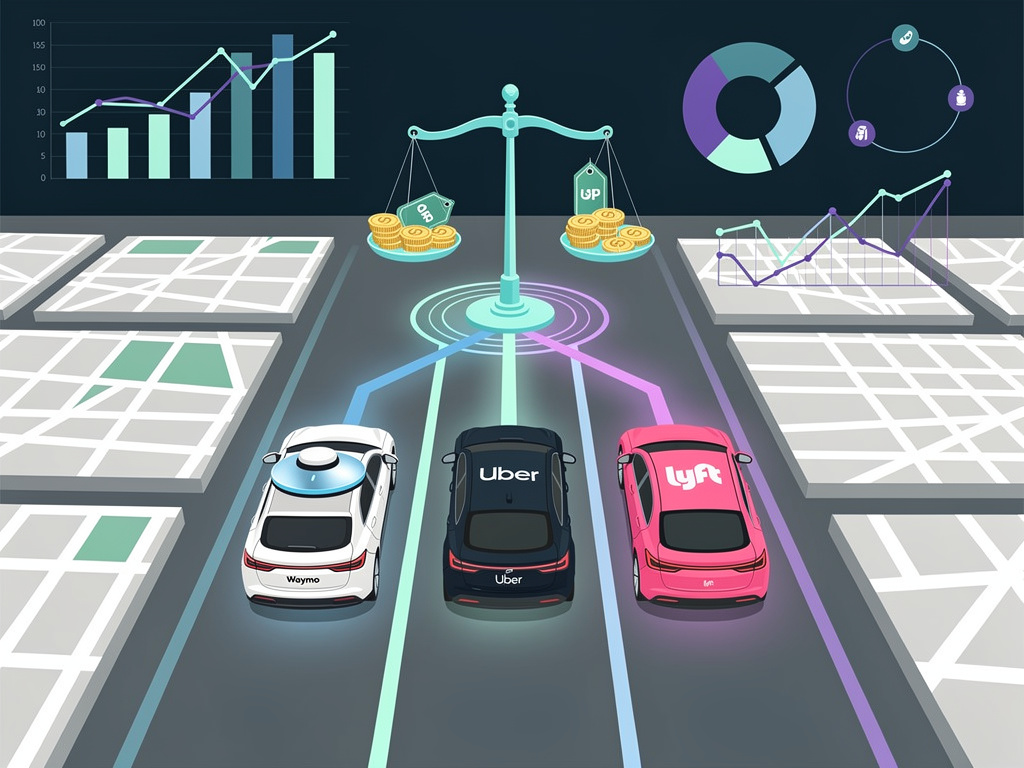
According to extensive data analysis reported by Wired, the pricing gap between Waymo’s autonomous fleet and the human-driven services of Uber and Lyft has effectively vanished in mature markets. The analysis, which utilized data from The Rideshare Guy contributor Harry Campbell, involved over 1,200 miles of side-by-side testing in San Francisco. The results defy the skepticism that has plagued the sector since the capital crunch of 2022: Waymo was not only price-competitive but frequently cheaper than its human counterparts. In one series of tests, the autonomous service averaged significantly lower fares than Uber, challenging the assumption that the heavy hardware costs of Lidar and radar arrays would necessitate premium pricing structures indefinitely.
Emerging datasets from high-density urban environments suggest that the long-promised economic convergence of autonomous systems and gig-economy labor is finally materializing, driven by high utilization rates rather than hardware cost reductions alone.
The speed differential, once a major pain point for cautious autonomous vehicles (AVs), is also narrowing. While early iterations of the technology were notorious for overly hesitant driving behaviors that frustrated passengers and surrounding traffic, the current generation of software has become more assertive. The data indicates that while Waymo vehicles are still marginally slower—approximately six minutes longer on a typical cross-town trip compared to a human driver—the consistency of the service is winning over users. Unlike human drivers, who may cancel rides, take circuitous routes to maximize fares, or drive aggressively, the algorithmic driver offers a standardized product. This consistency is proving to be a valuable currency in a market where variance in service quality has long been a consumer complaint.
However, the battle for dominance is not merely about the ride; it is about the network. Uber, recognizing the existential threat posed by a cheaper, safer supply of labor-free vehicles, has aggressively pivoted from competitor to aggregator. As noted by Reuters, Uber has entered into strategic partnerships with autonomous developers, including Avride and Waymo, to deploy robotaxis on its platform in Austin and Atlanta. This strategy acknowledges a hard reality: Uber does not need to own the cars to win; it needs to own the demand. By effectively becoming the operating system for AV fleets, Uber secures its position regardless of which hardware manufacturer ultimately wins the autonomy race.
As the technology matures, the industry is witnessing a strategic pivot from winner-take-all competition to symbiotic partnerships, where legacy ride-sharing networks provide the demand aggregation that capital-intensive autonomous fleets require to survive.
This cooperative model stands in stark contrast to the vision recently presented by Tesla. During the company’s “We, Robot” event, CEO Elon Musk unveiled the Cybercab, a steering-wheel-free two-seater aimed at a sub-$30,000 price point. While the presentation was heavy on futurism, industry analysts noted a distinct lack of immediate operational details compared to Waymo’s active commercial deployment. As The Verge reported, Tesla’s approach relies entirely on vision-based neural networks, eschewing the expensive Lidar sensors used by competitors. This significantly lowers the bill of materials but raises questions about regulatory approval for unsupervised driving, a hurdle Waymo has already cleared in multiple jurisdictions.
The divergence in strategy highlights a schism in the sector. On one side are the “supervised” systems that rely on massive fleets of user-owned vehicles gathering data (Tesla), and on the other are the “unsupervised” purpose-built fleets operating as public utilities (Waymo, Zoox). The market’s reaction to Tesla’s announcement—a temporary dip in stock price—suggests that institutional investors are beginning to favor the tangible revenue metrics of operational robotaxis over the theoretical margins of future deployments. Waymo’s ability to execute over 100,000 paid trips per week signals that the technology has graduated from R&D project to revenue-generating business unit.
Investor confidence is increasingly bifurcated between the tangible operational metrics of current fleets, which are proving the unit economics in real-time, and the aspirational promises of vision-only systems that have yet to secure necessary regulatory clearances for driverless operation.
Safety remains the ultimate arbiter of expansion speed. The industry is still recovering from the reputational damage caused by GM’s Cruise unit, which grounded its entire fleet following a severe pedestrian incident in San Francisco. However, the data is beginning to tell a compelling story about risk. A recent study by reinsurer Swiss Re found that Waymo’s autonomous driver was significantly safer than human benchmarks, with a 76% reduction in property damage claims frequency compared to human drivers. Bloomberg reports that this safety record has emboldened Alphabet to double down, recently closing a $5.6 billion funding round to fuel expansion. This massive capital injection serves as a barrier to entry, signaling that the next phase of the AV war will be fought with balance sheets as much as with code.
The geographic expansion of these services serves as the ultimate stress test for the financial viability of the driverless model. While San Francisco and Phoenix offer favorable conditions—dense populations and mapped grids—expanding into the erratic traffic patterns of Atlanta or the harsh winters of northern cities presents new variables. The cost of mapping, teleoperation support, and vehicle maintenance must be amortized over a massive volume of rides to achieve true profitability. The current price parity observed in San Francisco is likely subsidized by investor capital to capture market share, a classic Silicon Valley tactic. The question remains: can these unit economics hold without the subsidy?
The path to long-term profitability remains a capital-intensive endurance run that favors deep-pocketed tech conglomerates capable of sustaining high burn rates while navigating the complex regulatory moats that protect incumbent operators.
Furthermore, the consumer psychology of the “robotaxi” is shifting. What was once a novelty for tech tourists is becoming a mundane utility for commuters. The reliability of the pricing model—devoid of the volatility of surge pricing caused by driver shortages—appeals to the budget-conscious rider. If an algorithm knows exactly how many cars are needed in a specific grid at 8:00 AM, it can optimize fleet distribution more efficiently than a decentralized network of gig workers reacting to heat maps on their phones. This efficiency gain is the hidden margin that AV companies are banking on.
Ultimately, the sector is moving away from the “move fast and break things” ethos toward a “move safely and integrate” approach. The collaboration between hardware developers and ride-hailing networks suggests a maturity that was absent five years ago. As TechCrunch notes, strategic alliances, such as Waymo’s talks with Hyundai to manufacture vehicles, indicate a shift toward industrial-scale deployment. The era of retrofitting minivans is ending; the era of mass-produced, purpose-built autonomous transit is beginning.
As the industry consolidates around a few key players who have mastered both the software stack and the operational logistics, the autonomous vehicle sector is transitioning from a speculative venture capital bet into a foundational component of modern urban infrastructure.
The data from San Francisco is a leading indicator for the rest of the country. If robotaxis can compete on price and speed in one of the most complex driving environments in America, the technical argument is largely settled. The remaining hurdles are political and financial. With Alphabet committing billions and Uber opening its network, the smart money is betting that the driverless car is no longer just coming—it is here, and it is ready to pick you up.


 WebProNews is an iEntry Publication