
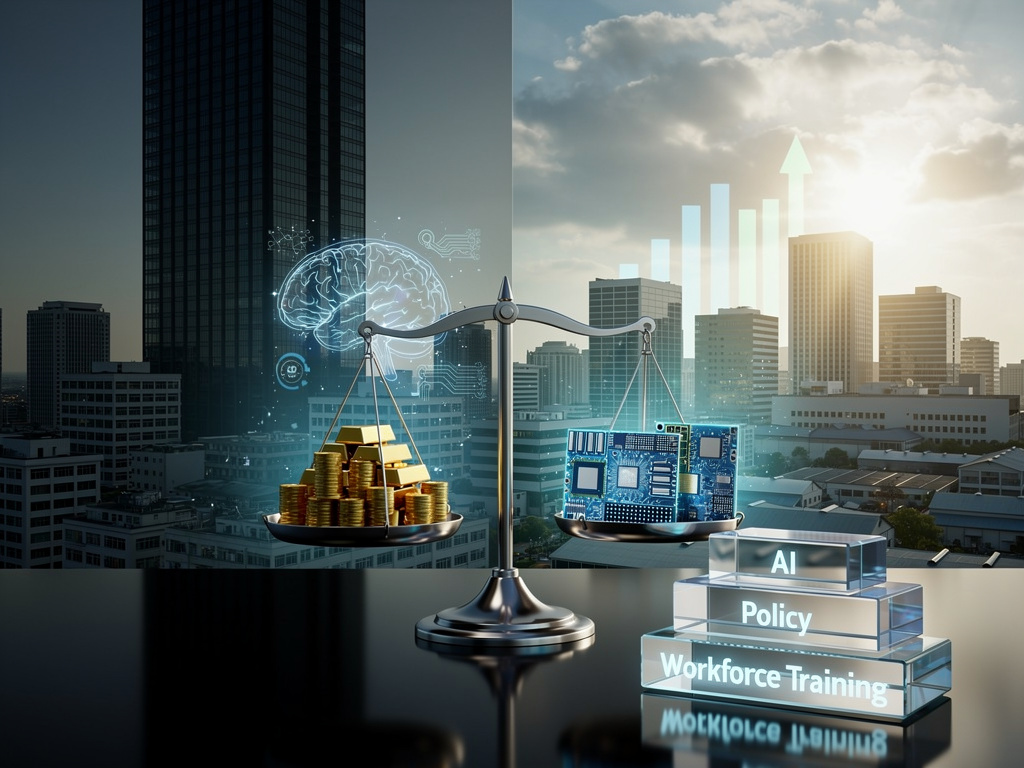
As artificial intelligence reshapes the global economy at unprecedented speed, a stark warning from one of the world’s most influential financial leaders has crystallized a concern that economists and policymakers have been grappling with for years: AI could dramatically widen the chasm between the wealthy and everyone else. BlackRock CEO Larry Fink’s recent acknowledgment that AI threatens to exacerbate wealth inequality has sparked renewed debate about whether this transformative technology will ultimately serve as an economic equalizer or accelerate the concentration of capital in fewer hands.
The question is no longer whether AI will disrupt labor markets—that disruption is already underway across industries from manufacturing to professional services. Instead, the critical issue facing business leaders, workers, and governments is whether the productivity gains from AI will be broadly shared or captured primarily by capital owners and highly skilled workers. According to research from the Brookings Institution, the answer depends largely on deliberate choices made by employers, educators, and policymakers in the coming years.
Unlike previous technological revolutions, AI’s impact on employment follows a different pattern. While automation historically displaced manual labor, AI is now reaching into cognitive work that was previously considered immune to mechanization. A Goldman Sachs analysis estimates that generative AI could expose the equivalent of 300 million full-time jobs to automation globally, with administrative and legal professions among the most vulnerable. Yet the same research suggests AI could increase global GDP by 7% over a decade, creating enormous wealth—the distribution of which remains an open question.
The Productivity Paradox: Who Captures the Gains?
Economic history offers both encouraging and cautionary precedents. The Industrial Revolution eventually raised living standards broadly, but only after decades of worker displacement and social upheaval. More recently, the digital revolution of the 1990s and 2000s contributed to rising inequality as returns disproportionately flowed to technology companies, their shareholders, and highly educated workers who could leverage new tools. Research from the National Bureau of Economic Research shows that automation between 1990 and 2007 accounted for more than half of the increase in wage inequality during that period.
The key distinction with AI, according to economists studying the technology’s impact, lies in its potential to augment rather than simply replace human workers. A study published in Science found that when customer service workers were given access to AI assistance, productivity increased by 14% on average—but the gains were concentrated among less experienced workers, whose performance improved by 35%. This suggests AI could actually reduce skill-based wage gaps if deployed thoughtfully.
However, realizing this potential requires intentional strategies from employers. “The technology itself is neutral,” explains Erik Brynjolfsson, director of the Stanford Digital Economy Lab, in research published by the Stanford Institute for Economic Policy Research. “Whether AI increases or decreases inequality depends on whether we use it to replace workers or to empower them.” Companies that invest in training employees to work alongside AI systems, rather than simply substituting machines for people, are more likely to see broad-based productivity gains.
The Skills Gap and the Training Imperative
The challenge of workforce adaptation is substantial. According to the McKinsey Global Institute, up to 375 million workers globally may need to switch occupational categories by 2030 due to automation and AI. This transition requires massive investment in retraining and education—investment that historically has been inadequate during technological transitions.
Progressive employers are beginning to recognize that human capital development is essential to capturing AI’s benefits. Companies like IBM and Amazon have committed billions to reskilling programs, understanding that their future competitiveness depends on workers who can leverage AI tools effectively. A PwC survey found that 74% of CEOs are concerned about the availability of key skills, yet only 18% have made significant progress in establishing comprehensive AI training programs.
The most successful approaches combine technical training with development of uniquely human skills that complement AI capabilities. Research from the MIT Sloan School of Management indicates that workers who combine domain expertise with AI literacy command significant wage premiums. These workers don’t need to become data scientists; rather, they need to understand how to effectively collaborate with AI systems, interpret their outputs, and apply judgment to AI-generated insights.
Policy Interventions and the Social Safety Net
While corporate training initiatives are necessary, they’re insufficient without supportive public policy. Economists point to several interventions that could help ensure AI’s benefits are broadly distributed. Universal access to education and retraining programs, funded through mechanisms like Singapore’s SkillsFuture initiative, can help workers transition to new roles. The Organisation for Economic Co-operation and Development recommends that countries invest 1% of GDP in lifelong learning programs to manage the AI transition.
Tax policy also plays a crucial role. Some economists advocate for adjusting capital gains taxes and corporate tax structures to ensure that productivity gains from AI contribute to public coffers that can fund transition support. Others propose more novel approaches: a paper from the International Monetary Fund explores how taxation could be restructured to discourage pure labor replacement while encouraging productivity-enhancing automation.
The social safety net requires modernization for an AI-driven economy. Traditional unemployment insurance was designed for temporary job displacement, not the structural shifts AI may cause. Proposals for portable benefits, universal basic income pilots, and wage insurance all attempt to address this challenge. Denmark’s “flexicurity” model, which combines labor market flexibility with strong social protections and active retraining, offers one template that has successfully managed previous technological transitions.
The Competitive Dynamics of AI Adoption
Market forces create pressure for companies to adopt AI aggressively, potentially prioritizing cost-cutting over workforce development. Firms that rapidly deploy AI to reduce headcount may gain short-term competitive advantages, creating a race to the bottom that leaves workers behind. However, research suggests this approach may be shortsighted. A Harvard Business Review analysis found that companies pursuing “augmentation” strategies—using AI to enhance worker capabilities—achieved better long-term outcomes than those focused purely on automation.
The concentration of AI capabilities among a few large technology companies presents another inequality risk. The massive computational resources and data required to develop cutting-edge AI systems favor established tech giants, potentially entrenching their market power. Antitrust enforcement and policies promoting AI model transparency and interoperability could help democratize access to these tools. The Federal Trade Commission has signaled increased scrutiny of AI-related market concentration.
International Dimensions and the Global Workforce
The AI wealth divide has international dimensions that could reshape global economic hierarchies. Countries with advanced AI capabilities and highly educated workforces may capture disproportionate benefits, while developing nations risk being left behind. However, AI also creates opportunities for emerging economies. Remote work enabled by AI tools could allow workers in developing countries to access global labor markets more easily. The United Nations Conference on Trade and Development emphasizes that developing nations must invest in digital infrastructure and education to participate in the AI economy.
Language barriers, which historically limited economic participation, are diminishing as AI translation improves. This could democratize access to information and opportunities—or it could enable developed-world companies to more easily offshore work to lower-wage markets, creating downward pressure on wages. The outcome depends partly on whether countries implement policies protecting worker rights and ensuring fair competition in global digital labor markets.
The Path Forward: Making AI Work for Everyone
Creating an AI-powered economy that generates broad-based prosperity requires coordinated action across multiple domains. Employers must move beyond viewing workers as costs to be minimized and instead invest in human capital development. This means not only training programs but also organizational cultures that encourage experimentation with AI tools and reward workers who develop new ways to leverage them productively.
Educational institutions need to fundamentally rethink curricula for an AI era. This doesn’t mean everyone needs to study computer science, but it does require integrating AI literacy across disciplines and emphasizing skills like critical thinking, creativity, and emotional intelligence that complement machine capabilities. Partnerships between industry and academia, like those highlighted by the World Economic Forum, can help ensure education remains relevant to evolving labor market needs.
Government policy must balance encouraging innovation with ensuring its benefits are widely shared. This includes competition policy that prevents excessive market concentration, labor regulations that protect workers while allowing flexibility, and social programs that provide security during transitions. The Biden administration’s executive order on AI represents an initial attempt to establish guardrails, though comprehensive legislation remains elusive.
Ultimately, whether AI exacerbates or alleviates inequality is not predetermined by the technology itself but by the choices society makes in deploying it. Larry Fink’s warning should serve not as a fatalistic prediction but as a call to action. With deliberate strategies that prioritize worker empowerment, invest in widespread skill development, and ensure productivity gains are broadly shared, AI can indeed become the rising tide that lifts all boats. The alternative—allowing market forces alone to determine outcomes—risks creating an economy where AI’s enormous wealth generation flows primarily to those who already hold capital, leaving workers to compete for an ever-shrinking share of economic gains. The decisions made in boardrooms, classrooms, and legislative chambers over the next few years will determine which future we inhabit.


 WebProNews is an iEntry Publication