
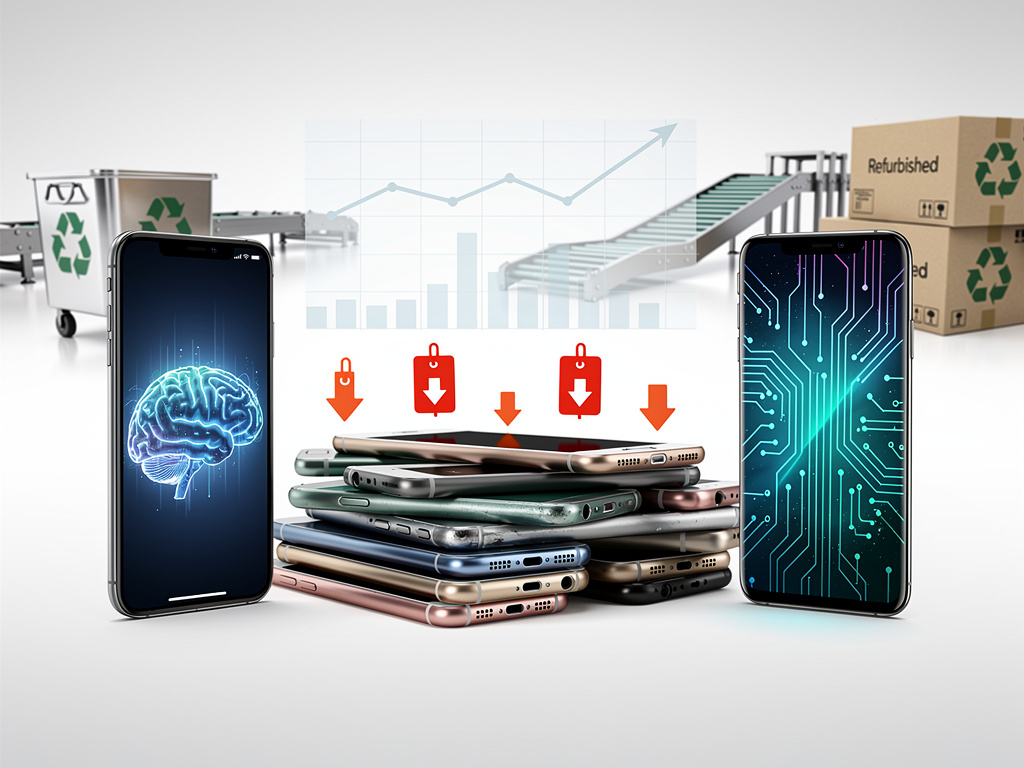
For years, the global smartphone resale market operated on a relatively predictable depreciation curve. A flagship device from Apple or Samsung would lose a portion of its value each year, but retain enough worth to make trade-ins and secondhand sales a meaningful part of the consumer electronics economy. That calculus is now being disrupted — not by hardware failures or cosmetic wear, but by artificial intelligence.
According to a report from MSN, companies in the smartphone recycling and refurbishment industry are sounding the alarm that AI-driven features baked into the latest generation of phones are accelerating the depreciation of older models at an unprecedented rate. The phenomenon is creating a widening gap between devices that can run on-device AI and those that cannot, effectively splitting the used phone market into two tiers.
A New Depreciation Curve Driven by Software, Not Hardware
The traditional factors that determined a used smartphone’s value — screen condition, battery health, storage capacity, and camera quality — still matter. But industry insiders say a new variable has entered the equation: AI capability. When Apple introduced Apple Intelligence across its latest iPhone lineup, and Samsung rolled out Galaxy AI features on its newer Galaxy S series, both companies drew a hard line in the sand. Devices older than a certain generation were simply excluded from these features, regardless of whether their processors could theoretically handle some of the workloads.
This exclusion has had a tangible effect on consumer perception. Buyers in the secondhand market are increasingly asking whether a device supports AI features before making a purchase, according to recycling firms. A phone that is only two years old but lacks support for the latest AI tools is now being treated by buyers as though it were significantly more dated. The result is a faster-than-expected collapse in resale prices for models that fall on the wrong side of the AI divide.
Recyclers and Refurbishers Feel the Squeeze
The impact is being felt most acutely by companies whose business models depend on predictable residual values. Firms that buy used phones in bulk, refurbish them, and resell them into secondary markets — both domestically and internationally — rely on forecasting what a device will be worth six, twelve, or eighteen months from now. AI feature exclusivity has made those forecasts significantly harder.
As MSN reported, recycling businesses are finding that inventory they acquired expecting steady depreciation is now losing value much faster than anticipated. The problem is compounded by the marketing muscle that Apple and Samsung are putting behind their AI capabilities. Every advertisement that highlights generative AI photo editing, real-time translation, or intelligent summarization tools reinforces the message that older phones are missing out on the defining features of the current generation.
Apple Intelligence and Galaxy AI: The Dividing Lines
Apple’s approach has been particularly consequential for the resale market. Apple Intelligence, the company’s branded AI initiative, requires an iPhone 15 Pro or later, effectively cutting off the standard iPhone 15, the entire iPhone 14 lineup, and everything before it. Given that millions of iPhone 14 and iPhone 13 devices are still in active circulation and entering the used market, the pricing implications are enormous.
Samsung has drawn its own boundaries with Galaxy AI. While the company initially offered some AI features on the Galaxy S23 series, the full range of capabilities — including on-device processing for certain tasks — is reserved for the Galaxy S24 and newer models. This means that Galaxy S22 and S21 devices, which remain perfectly functional smartphones by any hardware measure, are being devalued in the eyes of consumers who want access to the latest AI tools.
The Psychology of Obsolescence
What makes this depreciation particularly notable is that it is driven almost entirely by perception rather than functional degradation. An iPhone 14 Pro still takes excellent photographs, runs current apps without issue, and receives the latest iOS security updates. But the absence of Apple Intelligence features creates a psychological sense of obsolescence that did not exist in previous upgrade cycles. In earlier years, the difference between one generation and the next was often measured in incremental camera improvements or modest processor speed gains — differences that many consumers found easy to ignore.
AI features, by contrast, represent a category of functionality that is either present or absent. There is no halfway point. A phone either offers generative AI photo editing or it does not. It either provides real-time transcription and summarization or it does not. This binary nature makes the gap between AI-capable and AI-incapable devices feel much larger than the gap between, say, a 12-megapixel and a 48-megapixel camera sensor.
Carrier Trade-In Programs Adjust to the New Reality
The shifting dynamics are also affecting carrier trade-in programs, which have become a primary mechanism through which consumers upgrade their devices. Carriers like AT&T, Verizon, and T-Mobile offer trade-in credits that are pegged to the estimated residual value of a device. As AI-incapable phones lose value faster, trade-in offers for those devices are declining, which in turn may push more consumers to upgrade sooner — a dynamic that benefits device manufacturers but hurts consumers who expected their phones to hold value longer.
There is an irony here that industry observers have noted: the very companies creating the AI features that devalue older phones are also the ones most likely to benefit from the accelerated upgrade cycle those features produce. Apple and Samsung have every incentive to make AI capabilities as compelling and as exclusive to new hardware as possible, because doing so drives sales of their latest devices. The recycling and refurbishment industry, which depends on older devices retaining meaningful value, finds itself caught in the middle.
Environmental Implications of Faster Turnover
The environmental consequences of this accelerated obsolescence cycle deserve attention. One of the key arguments in favor of a healthy smartphone resale market is that it extends the useful life of devices, keeping them out of landfills and reducing the demand for new manufacturing. If AI features cause consumers to abandon functional phones sooner, the volume of electronic waste could increase, even as recycling firms struggle to find buyers for devices that no longer command attractive prices.
Environmental groups have long pushed for longer software support cycles and repairability standards to combat electronic waste. The AI-driven depreciation trend adds a new wrinkle to that advocacy. It is no longer sufficient to ensure that a phone receives software updates for five or seven years if the most marketed features of each new software generation are gated behind hardware that only the latest models possess.
What Comes Next for the Used Phone Market
Looking ahead, the used smartphone market faces a period of significant adjustment. Recycling firms will need to recalibrate their pricing models to account for AI capability as a primary value driver. Consumers selling older devices should expect lower returns than historical patterns would suggest. And manufacturers face growing scrutiny over whether their AI hardware requirements are genuinely necessary or strategically designed to accelerate upgrade cycles.
Some analysts believe the market will eventually stabilize as AI features become standard across a wider range of price points and device generations. Once mid-range phones routinely include on-device AI processing, the gap between AI-capable and AI-incapable devices will narrow, and the resale market will find a new equilibrium. But that stabilization could take several years, and in the interim, the companies that buy, refurbish, and resell smartphones are facing a fundamental challenge to their business models.
The smartphone industry has always been driven by cycles of innovation and obsolescence. But the speed at which AI is reshaping the value proposition of older devices represents something qualitatively different from previous transitions. For the recycling business, the message is clear: in a market increasingly defined by artificial intelligence, the phones that lack it are becoming artificially worthless.


 WebProNews is an iEntry Publication