
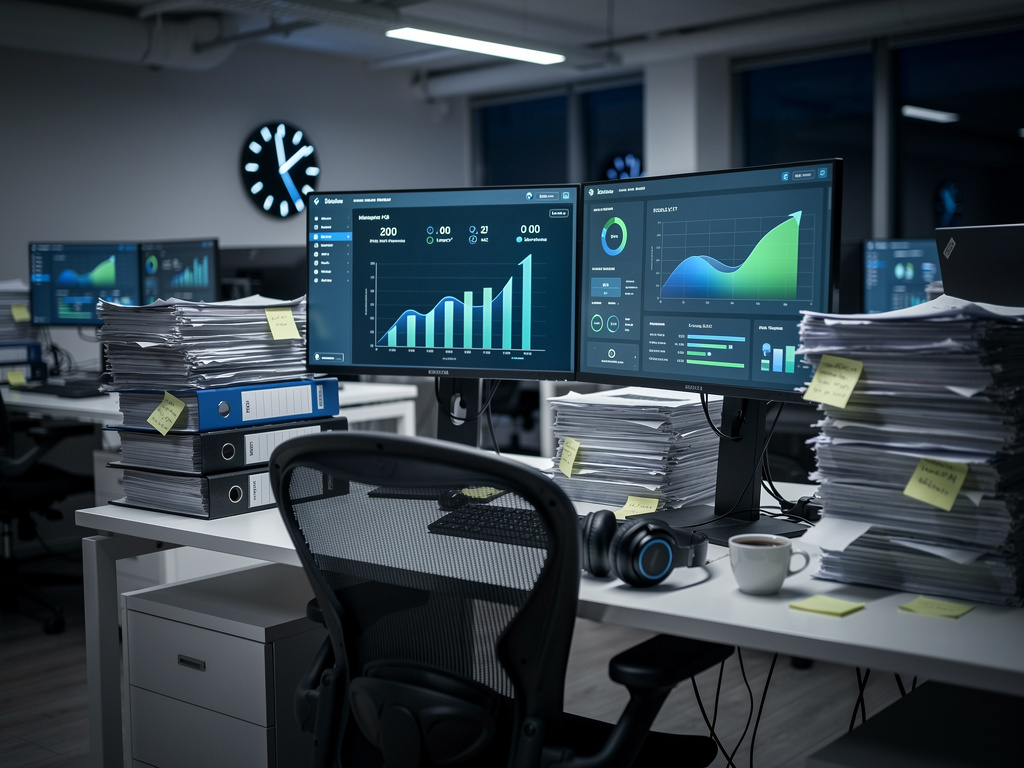
For years, artificial intelligence was sold as the great liberator of the modern workforce — a tireless digital assistant that would shoulder the drudgery, compress timelines, and finally give knowledge workers room to breathe. But a growing body of research and firsthand accounts from the front lines of AI-augmented work tells a starkly different story. The employees who leaned in hardest, who mastered the prompts and automated the workflows and evangelized the tools to their peers, are now showing the earliest and most acute signs of burnout.
The phenomenon is not a fringe observation. It is emerging across industries, from marketing agencies and law firms to software development shops and media organizations. And it is forcing a difficult reckoning with a question that corporate leaders have largely avoided: What happens when a tool designed to increase human capacity simply increases human expectations?
When Doing More Becomes the New Baseline
As TechCrunch reported in a detailed investigation, the first signs of AI-driven burnout are surfacing among the very people who embraced the technology most enthusiastically. Because employees could suddenly do more — drafting documents in minutes instead of hours, generating analysis at machine speed, producing creative assets on demand — work began bleeding into lunch breaks and late evenings. Their to-do lists expanded to fill every newly freed minute, and then some. The productivity gains that were supposed to create breathing room instead became the justification for piling on additional responsibilities.
The pattern is insidious precisely because it starts with genuine excitement. Early adopters often describe an initial honeymoon phase: the thrill of automating tedious tasks, the satisfaction of delivering work at unprecedented speed, the professional cachet of being the team’s AI expert. But that honeymoon curdles when managers and clients recalibrate their expectations. A marketing strategist who once had a week to develop a campaign concept now faces the implicit — and sometimes explicit — expectation of delivering three concepts in two days. A junior associate at a law firm who uses AI to accelerate legal research finds that the time saved is immediately reallocated to more billable tasks, not to rest or professional development.
The Intensification Trap: Academic Research Sounds the Alarm
The academic evidence is catching up to the anecdotal reports. A rigorous analysis published by the Harvard Business Review laid out the case with clinical precision: AI doesn’t reduce work — it intensifies it. The authors argued that the prevailing corporate narrative around AI adoption focuses almost exclusively on efficiency metrics while ignoring the human cost of perpetual acceleration. When AI compresses the time required for individual tasks, organizations rarely respond by reducing total workload. Instead, they respond by increasing throughput expectations, adding new deliverables, or reducing headcount, all of which concentrate more pressure on the remaining human workers.
The HBR analysis drew on surveys of knowledge workers across multiple sectors and found a consistent pattern. Employees who reported the highest levels of AI tool usage also reported higher levels of cognitive fatigue, decision fatigue, and emotional exhaustion compared to peers who used AI tools less frequently. The researchers noted that AI-augmented work often requires a different kind of mental effort — not less effort, but a shift from production to supervision, editing, and quality control. Workers spend less time creating from scratch but more time reviewing, correcting, and refining AI-generated outputs, a process that demands sustained attention and critical judgment.
A Global Problem With Local Consequences
The concern has reached international policy circles. As reported by DiploFoundation’s Digital Watch observatory, recent research has warned explicitly about AI-driven burnout risks at a systemic level. The analysis highlighted that the problem extends beyond individual workplaces to entire sectors and economies. When AI adoption accelerates without corresponding adjustments to work norms, labor protections, and organizational culture, the result is not a more productive society but a more exhausted one. The research called for policymakers and business leaders to treat AI-related burnout not as an individual wellness issue but as a structural challenge requiring institutional responses.
The international dimension matters because AI adoption is not happening uniformly. In markets where labor protections are weaker and the pressure to demonstrate productivity gains is stronger, the burnout risk is amplified. Workers in competitive, output-driven environments — advertising, consulting, technology startups, financial services — are particularly vulnerable because the cultural expectation is already tilted toward overwork. AI doesn’t create that culture, but it supercharges it by removing the natural speed limits that previously constrained how much any single person could produce in a given day.
The Workload Paradox: Gains for the Company, Losses for the Worker
The HR Digest explored this dynamic in depth, noting that while organizations are capturing significant productivity gains from AI deployment, those gains are accruing almost entirely to the enterprise rather than to the individual employee. Workers are producing more, but they are not working less, earning proportionally more, or experiencing greater job satisfaction. In many cases, the opposite is true. The publication reported that employees frequently describe feeling like they are running on a treadmill that keeps accelerating — every efficiency they unlock is immediately consumed by new demands.
This asymmetry is not lost on workers, and it is beginning to erode the goodwill that initially surrounded AI adoption. The HR Digest noted that employee sentiment toward AI tools is shifting from enthusiasm to ambivalence, and in some cases, to outright resentment. When workers perceive that AI is being used primarily to extract more labor from them rather than to improve their working conditions, trust in organizational leadership deteriorates. This creates a secondary problem for companies: the very employees who are most skilled at using AI — and therefore most valuable — are also the most likely to disengage or leave.
Social Media Managers and the Agency Burnout Crisis
One sector where the burnout crisis has become particularly acute is social media management. As detailed by the National Law Review, the marketing and communications industry is confronting what some are calling an agency burnout crisis. Social media managers — already among the most overextended professionals in the marketing ecosystem — have found that AI tools, while powerful, have dramatically increased the volume of content they are expected to produce and manage. New AI toolkits are being developed specifically to help these professionals scale their operations, but the underlying problem remains: scaling without boundaries is just burnout with better tools.
The agency world offers a particularly instructive case study because the economics are transparent. When an agency adopts AI and its team can produce twice the output, clients expect twice the deliverables for the same fee — or the agency is expected to take on twice the clients with the same headcount. Either way, the human workers absorb the pressure. The National Law Review report noted that new AI-powered platforms are attempting to address this by building in workflow management and capacity planning features, but the effectiveness of these tools depends entirely on whether organizational leaders are willing to set and enforce sustainable workload limits.
The Cognitive Cost of Constant Supervision
One of the least discussed dimensions of AI-driven burnout is the cognitive toll of supervising machine-generated work. Traditional burnout research has focused on the exhaustion that comes from doing too much. AI-era burnout introduces a new variant: the exhaustion that comes from checking too much. Every AI-generated email, report, legal brief, or social media post requires human review. The worker must maintain enough domain expertise and critical attention to catch errors, hallucinations, tone-deaf phrasing, and factual inaccuracies — all while processing output at a pace that would have been unimaginable just two years ago.
This supervisory burden is cognitively expensive. Research in cognitive psychology has long established that error detection and quality assurance tasks are among the most mentally draining forms of work, precisely because they require sustained vigilance without the creative satisfaction of original production. Workers who spend their days editing and approving AI outputs often report a peculiar form of fatigue: they feel simultaneously underutilized and overwhelmed. Their creative muscles atrophy while their editorial muscles are pushed to the breaking point. The Harvard Business Review analysis specifically flagged this shift from creator to supervisor as a key driver of dissatisfaction among high-frequency AI users.
What Companies Must Do Before the Talent Exodus Begins
The implications for corporate strategy are significant and urgent. Organizations that fail to address AI-driven burnout risk losing their most capable and forward-thinking employees — the exact people they need to navigate an era of rapid technological change. The solution is not to slow AI adoption, which would be both impractical and counterproductive. The solution is to fundamentally rethink how productivity gains are distributed and how workload expectations are set in an AI-augmented environment.
This means, at a minimum, establishing clear policies around workload caps, ensuring that time saved through AI is partially returned to employees in the form of reduced hours or dedicated development time, and training managers to resist the reflexive urge to fill every efficiency gain with new tasks. It also means investing in organizational research to understand how AI is actually affecting employee well-being, rather than relying on productivity dashboards that capture output but ignore human cost. As Digital Watch emphasized, the response must be institutional, not individual. Telling burned-out workers to practice better self-care while simultaneously demanding more from them is not a strategy — it is a contradiction.
The Reckoning That AI’s Biggest Boosters Didn’t See Coming
The irony at the heart of this emerging crisis is difficult to overstate. The workers who believed most fervently in AI’s promise — who invested their time in learning the tools, who championed adoption within their organizations, who built their professional identities around being at the cutting edge — are the ones paying the highest price. They are not burning out because they rejected the future. They are burning out because they embraced it, and the institutions around them failed to evolve at the same pace.
The coming months will test whether corporate leaders can move beyond the simplistic narrative of AI as a pure productivity multiplier and confront the more complex reality: that technology which amplifies human capability also amplifies human vulnerability. The companies that get this right — that treat AI adoption as a human challenge as much as a technical one — will retain their best people and build sustainable competitive advantages. The companies that don’t will find themselves with powerful tools and no one left who wants to use them.


 WebProNews is an iEntry Publication