
The promise of artificial intelligence as a workplace productivity engine has captivated boardrooms and C-suites across every major industry. But a growing body of evidence suggests that the return on investment from AI tools is far less impressive than the glossy vendor pitches would have organizations believe. A significant portion of the time saved by AI is being quietly consumed by a hidden tax: the hours employees spend correcting, editing, and reworking AI-generated output that falls short of professional standards.
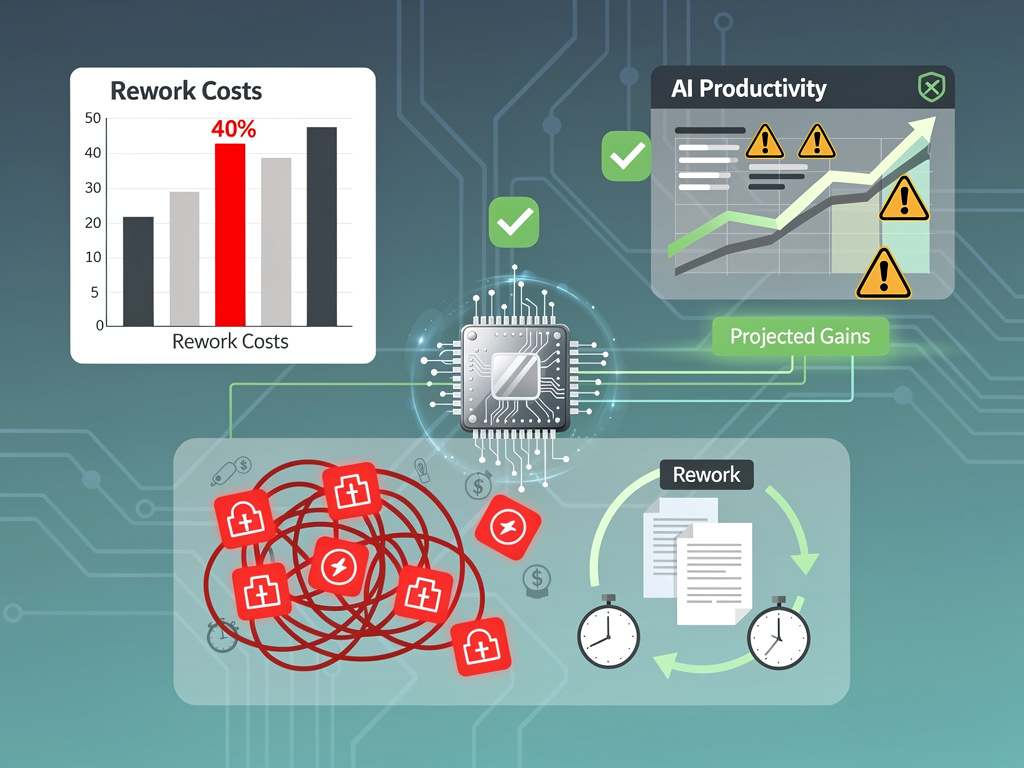
According to a study highlighted by HC Magazine, organizations implementing artificial intelligence tools are losing nearly 40% of expected productivity gains to employees fixing errors and inadequacies in AI-generated work. The finding strikes at the heart of the prevailing narrative that AI adoption is an unambiguous accelerant for business performance, and it raises urgent questions about how companies should be measuring—and managing—their AI investments.
The Hidden Cost of AI-Generated Output
The core issue is deceptively simple. AI tools—particularly large language models and generative AI platforms—can produce drafts, code, reports, and communications at remarkable speed. But speed is not synonymous with quality. In practice, much of what these systems generate requires substantial human intervention before it can be used in any professional context. Employees must fact-check claims, restructure arguments, correct tone, fix coding errors, and ensure compliance with organizational standards. This rework cycle, often invisible in productivity metrics, is eating into the very gains that justified the AI investment in the first place.
The study’s finding that roughly 40% of productivity gains are offset by rework costs represents a sobering recalibration for enterprises that have rushed to deploy AI across their operations. For organizations that have staked strategic plans and headcount decisions on projected AI efficiencies, the implications are significant. If nearly two-fifths of the expected time savings evaporate in quality-control loops, the business case for many AI deployments becomes considerably weaker than initially modeled.
Why AI Errors Are More Insidious Than They Appear
What makes AI-generated errors particularly dangerous is their surface plausibility. Unlike a blank page or an obvious system failure, AI output often looks polished and authoritative—even when it contains factual inaccuracies, logical inconsistencies, or subtle misinterpretations of context. This phenomenon, widely known as “hallucination” in the AI research community, means that employees must engage in a more cognitively demanding form of review than they would with traditional tools. Rather than simply proofreading, they must critically evaluate every assertion, every data point, and every recommendation the AI produces.
This cognitive burden is not trivial. Research from multiple sources has shown that reviewing AI-generated content for errors can be more mentally taxing than producing the content from scratch, particularly for complex or specialized tasks. The irony is acute: a tool designed to reduce cognitive load can, in certain contexts, actually increase it. Workers who once spent their time creating now spend a disproportionate share of their hours auditing, a shift that many find neither satisfying nor efficient.
The Measurement Problem: What Companies Are Getting Wrong
A fundamental challenge facing organizations is how they measure AI productivity. Most companies track adoption rates—how many employees are using AI tools, how frequently, and for which tasks. Far fewer have developed robust methodologies for measuring net productivity, which would account for the full lifecycle of AI-assisted work, including the time spent on correction and rework. This measurement gap means that many organizations are operating with an inflated sense of AI’s contribution to their bottom line.
The HC Magazine report underscores that this is not merely a technical problem but an organizational one. When leadership teams set expectations based on gross productivity gains without accounting for rework, they create misaligned incentives. Employees may feel pressured to use AI tools even in situations where manual work would be faster and produce higher-quality results. Managers may reduce staffing levels based on projected efficiencies that never fully materialize, leading to burnout and quality degradation across teams.
Industry Voices Sound the Alarm
The findings align with a growing chorus of concern from industry analysts and technology leaders who have cautioned against uncritical AI enthusiasm. Recent discussions on platforms like X (formerly Twitter) have featured prominent technologists and management consultants warning that enterprises are over-indexing on AI deployment speed and under-investing in the governance, training, and quality-assurance infrastructure needed to make AI tools genuinely productive. The consensus emerging among seasoned practitioners is that AI is a powerful augmentation tool, but only when embedded within workflows that include rigorous human oversight.
Several recent analyses from management consulting firms have echoed this sentiment, noting that the organizations seeing the greatest net returns from AI are those that have invested heavily in prompt engineering, employee training, and structured review processes. These companies treat AI not as a replacement for human judgment but as a first-draft generator that accelerates the early stages of work while preserving human expertise as the final arbiter of quality. The distinction is critical: companies that skip the governance layer in pursuit of speed are the ones most likely to see their productivity gains consumed by rework.
The Skills Gap Compounds the Problem
Another dimension of the rework challenge is the uneven distribution of AI literacy across the workforce. Employees who understand the limitations of AI tools—who know when to trust the output and when to question it—tend to use them more effectively and spend less time on corrections. But many workers have received little or no formal training on how to interact with AI systems, how to craft effective prompts, or how to efficiently evaluate generated content. This skills gap means that the rework burden falls disproportionately on less-trained employees, who may not even recognize errors when they encounter them.
The training deficit is compounded by the rapid pace of AI tool evolution. Models are updated frequently, capabilities shift, and the nature of their errors changes over time. An employee who has learned the quirks of one version of a generative AI tool may find that a new release introduces different failure modes. Keeping the workforce current with these changes requires ongoing investment in education and support—costs that rarely appear in the initial AI deployment budget but that are essential to realizing sustained productivity gains.
What Smart Organizations Are Doing Differently
The organizations that are navigating this challenge most effectively share several common traits. First, they have established clear guidelines for when and how AI tools should be used, distinguishing between tasks where AI excels (such as generating initial drafts, summarizing large volumes of text, or automating routine data processing) and tasks where human judgment remains superior (such as strategic analysis, nuanced communication, and creative problem-solving). Second, they have built review and quality-assurance steps directly into their AI-augmented workflows, ensuring that rework is anticipated and resourced rather than treated as an afterthought.
Third, and perhaps most importantly, these organizations measure what matters. They track not just how much AI is being used, but how much net time is being saved after accounting for all downstream corrections. They survey employees about their experiences with AI tools, identifying pain points and areas where the technology is creating more work than it eliminates. And they use this data to continuously refine their AI strategies, doubling down on use cases that deliver genuine value and pulling back from those that don’t.
The Road Ahead for Enterprise AI Adoption
The revelation that nearly 40% of AI productivity gains are being lost to rework should not be interpreted as an indictment of artificial intelligence itself. The technology is genuinely transformative in many contexts, and its capabilities are improving rapidly. But the finding is a powerful corrective to the hype cycle that has driven many organizations to adopt AI tools without adequate preparation, governance, or realistic expectations.
For business leaders, the message is clear: AI productivity is not automatic. It must be engineered, managed, and measured with the same rigor that organizations apply to any other major operational investment. The companies that will emerge as true AI leaders are not those that deploy the most tools the fastest, but those that build the organizational infrastructure—training, governance, measurement, and continuous improvement—needed to turn AI’s raw potential into reliable, net-positive results. The 40% rework tax is not inevitable; it is a symptom of immature implementation. And for those willing to invest in doing AI right, the upside remains enormous.


 WebProNews is an iEntry Publication