
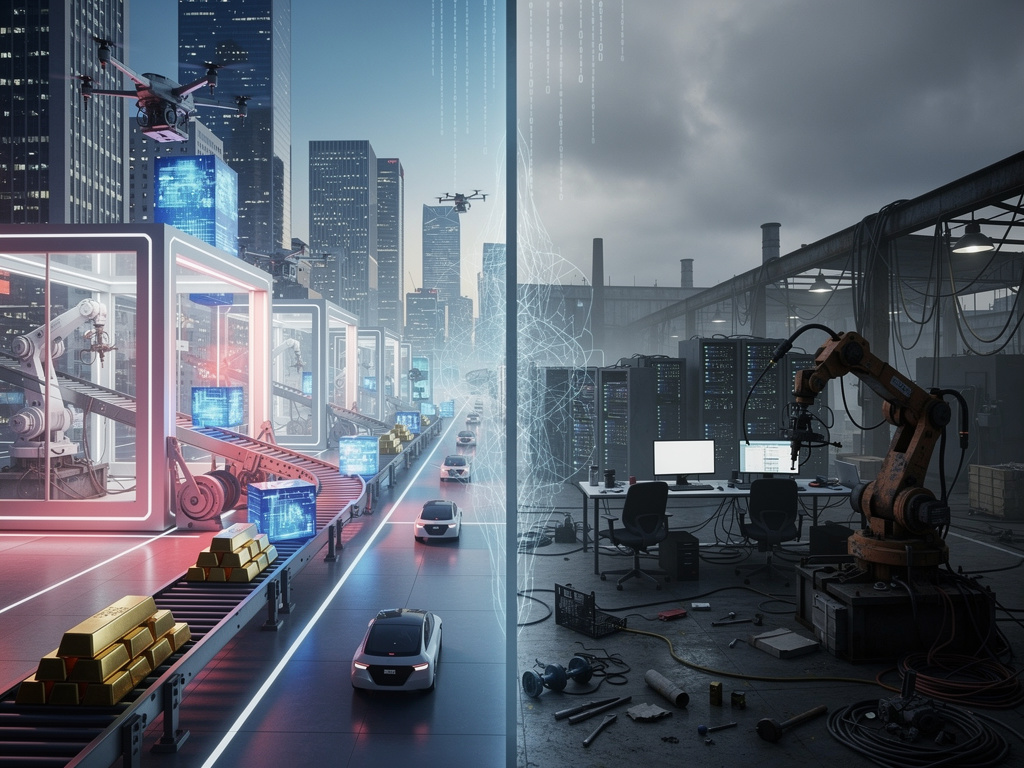
A stark gap splits how Americans view artificial intelligence. Ordinary citizens eye the technology with suspicion and dread. Industry leaders and researchers radiate confidence. This divide runs deeper than simple misunderstanding. It reflects competing visions of what AI means for work, wealth and power.
Nearly two-thirds of U.S. adults expect AI to slash available jobs over the next 20 years. Only 5 percent anticipate more opportunities. AI experts see matters differently. Just 39 percent of them forecast net job losses. The Stanford HAI 2026 AI Index lays out the numbers in cold detail. On impacts to how people perform their jobs, 73 percent of experts predict positive effects. Among the public that figure drops to 23 percent. A 50-point chasm. Similar gaps appear on economic effects and medical advances.
But. The optimism gap masks a harder truth. Some of the very leaders building these systems have begun to describe a future in which large segments of the population lose economic relevance. They speak of an underclass not as distant possibility but as logical outcome.
Dario Amodei, chief executive of Anthropic, has been blunt. In a lengthy essay published on his personal site in January he warned that AI could produce “an unemployed or very-low-wage ‘underclass’” among those with “lower intellectual ability.” That group, he suggested, would expand as systems grow more capable. Democracy itself sits in the crosshairs. “The balance of power of democracy is premised on the average person having leverage through creating economic value. If that’s not present, I think things become kind of scary,” Amodei told Axios last year.
His concerns extend beyond entry-level white-collar roles. Amodei has predicted that 50 percent of such positions could vanish by 2030. Yet even at Anthropic the conversation has turned speculative. “It may be feasible to pay human employees even long after they are no longer providing economic value in the traditional sense. Anthropic is currently considering a range of possible pathways for our own employees,” he wrote.
Sam Altman of OpenAI sketched a similar trajectory years ago. In a 2021 blog post he forecast that “unstoppable” AI would handle nearly any human task and shift power from labor to capital. “If public policy doesn’t adapt accordingly, most people will end up worse off than they are today,” Altman wrote. The company has since released policy papers calling for progressive measures. A shorter workweek. Higher taxes on capital. Even a public wealth fund giving citizens equity stakes in AI firms.
These statements land against a backdrop of real-world friction. In Box Elder, Utah, residents clashed with law enforcement at a county meeting over a massive data center project backed by investor Kevin O’Leary. Some younger employees quietly sabotage AI tools at work. Others have torn surveillance cameras from walls. Resentment brews. Fear simmers.
A recent guest essay in The New York Times captured the mood inside Silicon Valley. “Most people I know in the A.I. industry think the median person is screwed, and they have no idea what to do about it,” wrote Jasmine Sun. Venture capitalists, founders and researchers share a bleak consensus. Advanced AI will generate enormous value yet concentrate it among those who own the models and the capital that deploys them.
The mechanics appear straightforward. AI systems now achieve 80 percent win rates against human professionals on benchmarks covering dozens of occupations. OpenAI’s GDPVal test and the AI Productivity Index measure performance on roles from investment banking to primary care. Progress arrives fast. Models improve. Companies accelerate layoffs and hesitate on hiring. Jack Dorsey, after cutting nearly half the staff at Block, noted that advanced coding agents “presented an option to dramatically change how any company is structured.” Investors rewarded the move.
Data from Anthropic itself reveals how unevenly the technology spreads. Its March 2026 Economic Index shows usage heavily concentrated. The top 20 countries account for 48 percent of per-capita interactions with Claude, up from 45 percent earlier. Within the United States, high-education, high-wage tasks still dominate early adoption. Long-tenure users enjoy 10 percent higher success rates. They iterate more. They delegate less. These patterns suggest self-reinforcing advantages. “These observed differences in success rates could deepen inequalities in the labor market,” the report states.
Economists have tracked parallel forces. An International Monetary Fund paper from 2025 found AI might compress wage inequality by displacing higher earners yet widen wealth gaps through rising capital returns. The wealth Gini coefficient could climb more than 7 points. Labor share of income shrinks when automation scales. Worker bargaining power erodes. Research from Lawrence Katz at Harvard and others shows AI continues trends from previous waves of technology. Polarization. Hollowing of middle-skill roles. Gains captured unevenly.
Yet history offers counterpoints. Past automation displaced specific tasks but expanded total employment. New industries appeared. Demand for human labor proved elastic. Some analysts argue AI will follow suit. It collapses the cost of cognition. It multiplies output. It creates unforeseen opportunities. Others counter that cognitive work differs from previous mechanical shifts. When machines outperform humans across domains the residual value of human labor narrows.
Global dimensions complicate the picture. A United Nations Development Programme analysis warns of a “Next Great Divergence” between nations. AI has reached 1.2 billion users in three years. Adoption rates vary wildly. Two in three people in some rich countries use the tools. In many poor nations the share hovers near 5 percent. Readiness gaps risk locking in disadvantages for developing economies.
Public anger has political weight. Palantir’s Alex Karp has warned that unrest could derail progress. “The biggest challenge to A.I. in this country is political unrest,” he said. “If I were sitting here in private with my peers, I’d be telling them the country could blow up politically and none of us are going to make any money when the country blows up.”
So policymakers face pressure on multiple fronts. Retraining programs. Tax reform. Wealth funds. Adjustments to education and safety nets. Without them protectionism becomes rational response for workers. Some executives already sense the stakes. “This is basically a societal choice,” observed Jack Clark, co-founder of Anthropic. Technology can race ahead. Or society can shape its deployment.
The perception gulf persists. Experts understand capability curves and benchmark gains. They witness productivity lifts in narrow domains. Ordinary people experience uncertainty, stagnant wages in exposed sectors, and headlines about mass displacement. They see data centers consuming power and land while their own prospects feel constrained. Trust erodes when the beneficiaries sound enthusiastic about disruption whose costs fall elsewhere.
Recent coverage amplifies the tension. A March 2026 Axios report on Anthropic’s data highlighted an emerging “AI fluency” divide. Early proficient users pull ahead. The skill gap hardens into something more permanent. Goldman Sachs economists have estimated hundreds of millions of full-time roles could face impact. Joseph Stiglitz, the Nobel laureate, has argued AI risks compounding both economic and political inequality by stripping labor from production and concentrating gains.
Whether a true permanent underclass materializes remains contested. Current AI still struggles with many real-world variables. New jobs will surely emerge. But the conversation has shifted. Leaders once focused on existential risk now grapple with mundane yet profound questions of economic inclusion. The window for shaping outcomes narrows with each capability jump.
Ordinary citizens sense this shift intuitively. Their skepticism isn’t ignorance. It’s pattern recognition. Tech insiders’ optimism isn’t blind faith. It’s informed by the math of ownership and leverage. Reconciling these views will test institutions, markets and social cohesion in the years ahead. The technology advances. The debate over who it serves has only begun.


 WebProNews is an iEntry Publication