
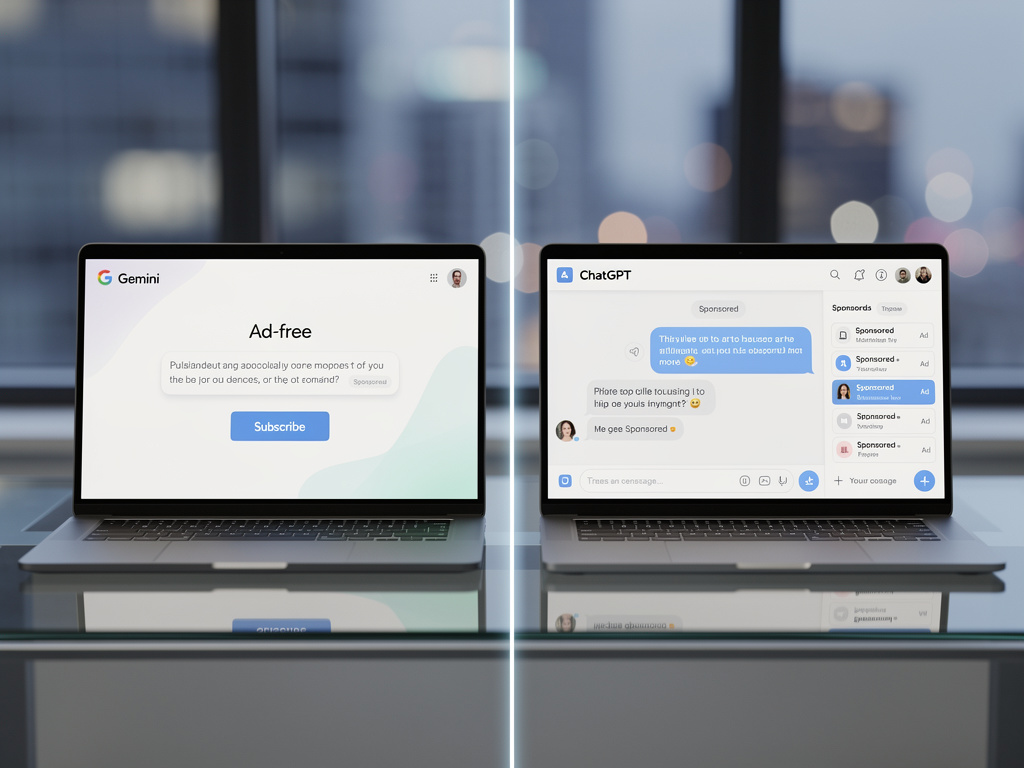
NEW YORK – In the dizzying race for artificial intelligence supremacy, a new front has opened, one that will define the user experience and economic foundation of the technology for years to come: monetization. As the industry grapples with the colossal costs of developing and running large language models, two of its biggest players are charting starkly different courses. Google, the undisputed king of digital advertising, is pointedly keeping its flagship AI chatbot, Gemini, ad-free, betting on a premium subscription model. Meanwhile, its chief rival, OpenAI, has begun quietly testing the waters of an ad-supported future for its wildly popular ChatGPT.
The divergence was thrown into sharp relief by Demis Hassabis, the chief executive of Google’s DeepMind AI lab. Speaking at a conference in London, Mr. Hassabis made Google’s current position unambiguous. “We don’t have any plans to do ads at the moment,” he said, confirming a strategy that prioritizes user growth and technological refinement over immediate ad revenue for its conversational AI. As reported by TechRadar, his statement positions Gemini as a premium tool, with its advanced capabilities locked behind a subscription paywall, bundled with the company’s Google One cloud storage service. This approach aims to build a direct revenue stream from its most engaged users, mirroring a classic software-as-a-service playbook.
A Calculated Gambit from the Advertising Titan
For a company that generated over $237 billion in advertising revenue last year, shunning ads in a major new product is a remarkable, and telling, decision. Industry analysts suggest Google is playing a long game. By establishing Gemini as a pristine, ad-free environment, the company hopes to build user trust and differentiate its product in a market where the quality and impartiality of AI-generated information are paramount. The fear is that integrating ads directly into a chatbot’s conversational flow could compromise its perceived objectivity, turning a helpful assistant into just another sales channel.
This strategy also serves to protect Google’s golden goose: Search. The company is already navigating the complex challenge of integrating AI-powered “Overviews” into its search results, a feature that has threatened to disrupt the delicate ecosystem of clicks and ad placements that fuels its profits. By keeping conversational AI separate and ad-free, Google can experiment with AI in Search—where ads are expected and understood—without tainting the user experience of its dedicated chatbot. It’s a strategic bifurcation designed to innovate without cannibalizing its core business.
OpenAI’s Pragmatic Push for New Revenue Streams
Across the aisle, OpenAI faces a different set of pressures. As a venture-backed startup with astronomical compute costs and a mission to build ever-more-powerful models, diversifying its revenue beyond its ChatGPT Plus subscriptions and API access is a financial necessity. The company has begun exploring what this might look like, with recent reports confirming it is testing a new ad format. According to Reuters, the experiment involves showing sponsored links relevant to a user’s conversation.
For example, a user asking ChatGPT for recommendations on the best credit cards for travel might see a sponsored link for a specific card from an advertiser. An OpenAI spokesperson framed the move as an attempt to create a model where “advertisers get value for reaching the right customers.” The goal is to make the ads useful and non-intrusive, a difficult balance to strike within a conversational interface. If successful, this could unlock a massive revenue opportunity from the millions of users on ChatGPT’s free tier, creating a sustainable freemium model that could fund its ambitious research and development goals.
The User Trust Tightrope
The central question for OpenAI, and any competitors who follow its lead, is whether users will tolerate advertising inside their AI conversations. The introduction of ads risks fundamentally altering the user’s relationship with the chatbot. An AI that is perceived as an impartial source of information could suddenly be viewed with suspicion, its recommendations potentially biased by commercial interests. The very utility of the tool—providing direct, trustworthy answers—could be eroded.
Early user sentiment on social platforms like X and Reddit indicates a high degree of skepticism toward the idea. Concerns range from the potential for manipulative advertising to the simple degradation of a clean, focused user interface. OpenAI’s challenge will be to implement these sponsored placements in a way that feels additive, or at least unobtrusive, rather than extractive. The company has stated it does not plan to use conversation data to build profiles for ad targeting, a move aimed at placating privacy concerns, but the execution will determine its ultimate acceptance.
Diverging Philosophies on the Future of AI Interaction
The split in strategy reflects a deeper philosophical divide on how generative AI will be integrated into daily life. Google’s subscription-first approach for Gemini treats it like a productivity tool, a premium enhancement for power users willing to pay for the best experience, much like Adobe’s Creative Cloud or Microsoft’s Copilot Pro. This model aligns the company’s success directly with user satisfaction, as customers can vote with their wallets each month. It suggests a future where the most powerful AI is a paid utility.
OpenAI’s exploration of ads, on the other hand, leans into a familiar internet model: subsidize free access for the masses with advertising. This democratizes access to powerful technology but introduces the classic trade-offs of the ad-supported web, including potential impacts on privacy and user trust. It envisions a future where AI is a ubiquitous, ad-funded public square. This path is fraught with peril, but if navigated successfully, it could ensure ChatGPT’s continued dominance in user numbers and cultural relevance.
The Long Road Ahead
It is crucial to note the careful phrasing from Google’s leadership. Mr. Hassabis’s assertion that there are no plans for ads “at the moment” leaves the door wide open for a future policy shift. Google’s current stance could be a temporary tactic to gain market share and establish Gemini’s reputation. If OpenAI proves the ad-supported model is both lucrative and palatable to users, it is hard to imagine the world’s largest advertising company sitting on the sidelines indefinitely.
For now, the battle lines are drawn. Google is leveraging its massive balance sheet to play the long game, betting that a superior, subscription-funded user experience will ultimately win out. OpenAI, driven by the relentless financial demands of the AI arms race, is taking a calculated risk to unlock a new revenue stream that could secure its financial future. The choices these two giants make today will not only determine their own fortunes but will also set the standards and expectations for how humans interact with, and pay for, artificial intelligence for the foreseeable future.


 WebProNews is an iEntry Publication