
The marketing industry stands at an inflection point as artificial intelligence fundamentally transforms how brands connect with consumers. According to Google’s official blog, the company has unveiled a comprehensive framework for marketers navigating the AI-driven future, signaling a dramatic shift in digital advertising strategies that will define competitive advantage through 2026 and beyond.
The implications extend far beyond simple automation. Google’s strategic vision reveals how AI is creating entirely new paradigms for customer engagement, measurement, and creative development. For industry insiders, understanding these shifts isn’t optional—it’s existential. Companies that master AI-powered marketing tools will capture disproportionate market share, while those that lag risk obsolescence in an increasingly algorithm-driven marketplace.
This transformation arrives as global digital advertising spending approaches $700 billion annually, with AI-powered tools now influencing everything from bid optimization to creative asset generation. The stakes have never been higher for CMOs and marketing executives tasked with delivering measurable ROI in an environment where consumer behavior evolves faster than traditional research methodologies can track.
The Three Pillars of Google’s AI Marketing Framework
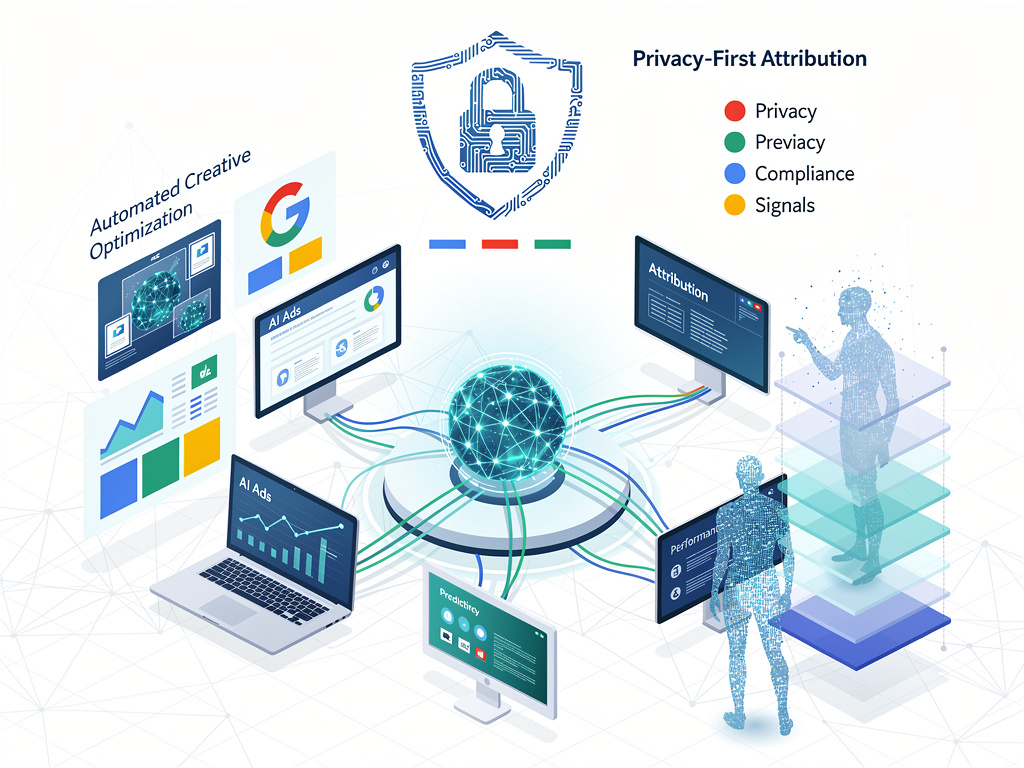
Google’s strategy centers on three interconnected capabilities that represent the foundation of next-generation marketing: AI-powered search evolution, automated creative optimization, and predictive audience modeling. Each pillar addresses specific pain points that have historically limited marketing effectiveness, from the inefficiency of manual campaign management to the challenge of personalizing content at scale.
The search evolution component reflects fundamental changes in how consumers discover products and services. With generative AI now integrated into search experiences, traditional keyword strategies are giving way to intent-based modeling that anticipates user needs before explicit queries are formulated. Google emphasizes that marketers must shift from optimizing for specific search terms to building comprehensive topic authority that AI systems can recognize and surface across multiple touchpoints.
Automated Creative: From Concept to Conversion
The creative automation capabilities represent perhaps the most disruptive element of Google’s framework. Performance Max campaigns now leverage machine learning to generate, test, and optimize creative assets across Google’s entire advertising ecosystem—Search, Display, YouTube, Gmail, and Discovery—without requiring manual intervention for each placement.
Early adopters report transformative results. Brands using AI-powered creative tools are seeing 30-50% improvements in conversion rates compared to traditional static campaigns, according to Google’s analysis. The system continuously learns from performance data, automatically adjusting messaging, imagery, and calls-to-action based on real-time engagement patterns across audience segments.
This capability addresses a longstanding challenge in digital marketing: the resource intensity of producing variations for different channels and audiences. Where traditional campaigns might test a handful of creative variations, AI systems can generate and evaluate thousands of permutations, identifying winning combinations that human marketers might never conceive. The technology doesn’t replace creative teams but amplifies their output, allowing strategists to focus on high-level positioning while algorithms handle tactical execution.
Predictive Modeling and the End of Reactive Marketing
Google’s third pillar—predictive audience modeling—represents a fundamental shift from reactive to proactive marketing strategies. Traditional digital advertising has operated largely on historical data: targeting users based on past behaviors and demographic profiles. AI-powered predictive models flip this paradigm, identifying likely future purchasers before they exhibit explicit buying signals.
The technology combines first-party data from advertisers with Google’s vast behavioral dataset to create probabilistic models of purchase intent. These models factor in hundreds of signals—from search patterns and content consumption to seasonal trends and competitive dynamics—to forecast which users are entering the consideration phase for specific product categories. Marketers can then reach these high-probability prospects with tailored messaging before competitors even recognize the opportunity.
The implications for customer acquisition costs are profound. By targeting users earlier in their decision journey, brands can influence consideration sets rather than simply competing for attention at the point of purchase. Early data suggests this approach can reduce acquisition costs by 20-40% while simultaneously improving conversion quality, as earlier engagement allows for more sophisticated nurturing sequences.
Privacy-First Attribution in a Cookieless World
Underpinning Google’s entire framework is a reimagined approach to measurement and attribution that acknowledges the death of third-party cookies and increasing privacy regulations. The company’s Privacy Sandbox initiative aims to preserve advertising effectiveness while eliminating individual user tracking—a balance many industry observers initially deemed impossible.
The solution relies on aggregated, anonymized data processed through privacy-preserving technologies like differential privacy and federated learning. Rather than tracking individual users across sites, the system identifies patterns at the cohort level, allowing marketers to understand campaign effectiveness without accessing personally identifiable information. Google maintains that these methods can deliver 95% of the insights provided by cookie-based tracking while eliminating privacy concerns that have eroded consumer trust.
Implementation Challenges and Organizational Readiness
Despite the compelling capabilities, implementing AI-powered marketing at scale presents significant organizational challenges. The technology requires fundamental changes to team structures, workflows, and success metrics that many companies are unprepared to navigate. Marketing departments built around channel specialists—separate teams for search, social, display, and video—struggle to leverage tools designed for cross-channel optimization.
The skills gap is equally daunting. Effective use of AI marketing tools demands fluency in data science concepts, statistical modeling, and algorithmic thinking that traditional marketing curricula haven’t emphasized. Forward-thinking organizations are investing heavily in upskilling programs and hybrid roles that blend marketing expertise with technical capabilities. Some are establishing dedicated AI marketing centers of excellence to develop internal best practices and accelerate adoption across business units.
Budget allocation represents another friction point. AI-powered campaigns often require higher upfront investment in data infrastructure and testing before delivering superior returns. CFOs accustomed to predictable quarterly marketing spend face pressure to approve experimental budgets with uncertain near-term payoffs. The companies succeeding in this transition treat AI marketing capabilities as strategic infrastructure investments rather than tactical campaign expenses.
Competitive Dynamics and Market Consolidation
Google’s AI marketing framework doesn’t exist in a vacuum. Meta, Amazon, and emerging adtech platforms are racing to develop comparable capabilities, creating a fragmented ecosystem where marketers must master multiple AI systems with different strengths and limitations. This complexity favors larger advertisers with resources to maintain expertise across platforms, potentially accelerating market consolidation as smaller competitors struggle to keep pace.
The competitive implications extend beyond the advertiser side. Publishers and content creators face existential questions about their role in an AI-mediated advertising ecosystem. As algorithms become more sophisticated at matching ads to content and audiences, the premium commanded by premium publisher inventory may erode. Conversely, publishers with robust first-party data and direct audience relationships may find their negotiating position strengthened as third-party data becomes less available.
Regulatory Scrutiny and the Path Forward
The rapid advancement of AI marketing capabilities has attracted increased regulatory attention, particularly in the European Union where the AI Act and Digital Markets Act impose strict requirements on algorithmic systems. Regulators worry about potential discrimination in ad targeting, market manipulation through personalized pricing, and the concentration of power among a handful of platform providers.
Google’s response emphasizes transparency and control, with new tools allowing advertisers to understand why specific optimization decisions were made and override algorithmic recommendations when necessary. Whether these measures will satisfy regulators remains uncertain, but the direction is clear: AI marketing systems will face ongoing scrutiny, and providers must balance performance optimization with explainability and fairness considerations.
For marketing executives, the message from Google’s 2026 framework is unambiguous: AI isn’t coming to marketing—it has arrived and is rapidly becoming table stakes for competitive performance. The companies that will thrive are those treating this transition as a strategic imperative, investing in capabilities, talent, and organizational change required to harness these tools effectively. Those viewing AI as merely another channel or tactic risk finding themselves outmaneuvered by more adaptive competitors who recognize this moment as a fundamental reset in how marketing creates value.
The next two years will separate marketing organizations into two camps: those that successfully integrate AI into their strategic and operational DNA, and those that continue operating with incrementally improved versions of legacy approaches. The performance gap between these groups will likely exceed anything the industry has witnessed in previous technological transitions, making the current moment one of unusual opportunity and risk for brands across every sector.


 WebProNews is an iEntry Publication