
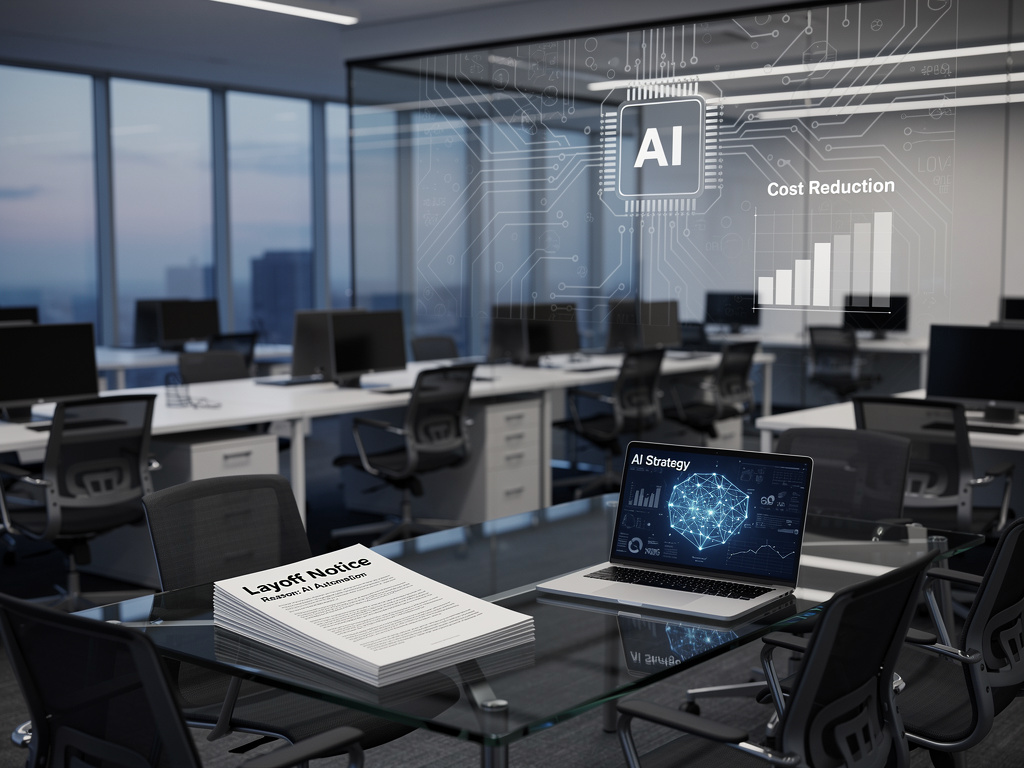
As artificial intelligence continues its march through corporate America, a troubling pattern has emerged: companies are increasingly citing AI adoption as justification for workforce reductions, yet the evidence suggests many of these layoffs have little to do with actual automation and everything to do with traditional cost-cutting dressed in technological clothing. This phenomenon, which critics have dubbed “AI washing,” represents a potentially dangerous conflation of legitimate technological transformation with opportunistic downsizing that could undermine both worker trust and the credible deployment of AI systems.
The practice has become so prevalent that it’s reshaping how we understand the relationship between technological advancement and employment. According to Slashdot, the question of whether AI is genuinely displacing workers or simply providing convenient cover for routine restructuring has become central to the current discourse around workplace automation. The stakes extend beyond individual companies to the broader social contract between employers and employees, with implications for how society prepares for and manages technological change.
Recent data paints a complex picture. While some organizations have implemented AI systems that genuinely reduce the need for certain roles, many announcements of “AI-driven” layoffs appear to follow the same patterns as traditional downsizing, targeting similar departments and using familiar justifications wrapped in new terminology. The distinction matters enormously: genuine AI displacement requires retraining programs, transition support, and thoughtful workforce planning, while AI washing simply exploits technological anxiety to make cost-cutting more palatable to investors and the public.
The Mechanics of AI Washing in Modern Corporations
The term “AI washing” draws parallels to “greenwashing,” where companies exaggerate their environmental credentials. In this case, organizations attribute workforce reductions to AI implementation when the technology either doesn’t exist, isn’t deployed at the scale claimed, or hasn’t actually replaced the functions performed by terminated employees. This practice serves multiple corporate purposes: it positions the company as technologically forward-thinking, provides a more defensible rationale than simple profit margin expansion, and potentially deflects criticism by framing layoffs as inevitable technological progress rather than management decisions.
Several telltale signs distinguish genuine AI-driven workforce changes from AI washing. Legitimate automation typically involves significant capital investment in technology infrastructure, extended implementation timelines, and detailed documentation of which specific tasks AI systems will perform. Companies engaging in AI washing, by contrast, often announce layoffs and AI adoption simultaneously without evidence of prior technology deployment, lack specific details about which AI systems are being implemented, or terminate workers in roles where no credible AI replacement exists. The timing itself can be revealing: announcements that coincide with poor quarterly earnings or activist investor pressure suggest financial motivations rather than technological imperatives.
Case Studies in Corporate Misdirection
The technology sector, ironically, has provided some of the most questionable examples of AI-attributed layoffs. Multiple tech companies that announced workforce reductions citing AI efficiency gains later revealed in regulatory filings that the cuts were part of broader restructuring efforts predating any AI initiatives. In some cases, the “AI systems” referenced in layoff announcements turned out to be basic automation tools that had existed for years, rebranded to capitalize on current AI enthusiasm.
The financial services industry has similarly embraced AI rhetoric while pursuing conventional downsizing. Several major banks announced reductions in back-office staff attributed to AI processing capabilities, yet investigations revealed that much of the work was simply being offshored to lower-cost locations or eliminated through process consolidation that had nothing to do with artificial intelligence. The AI narrative provided better optics than admitting to outsourcing or acknowledging that the work was deemed unnecessary regardless of automation capabilities.
The Real State of AI Job Displacement
To understand AI washing, one must first understand what genuine AI displacement looks like. Authentic automation-driven workforce changes typically occur gradually, with clear documentation of which specific tasks AI systems have assumed. Organizations serious about AI transformation invest heavily in change management, worker retraining, and transition programs because they recognize that successful AI implementation requires human expertise to deploy, monitor, and refine the systems. The process is messy, expensive, and rarely produces immediate headcount reductions.
Research from labor economists suggests that current AI technologies are more likely to augment human workers than replace them entirely, at least in the near term. Most AI systems excel at specific, well-defined tasks but struggle with the contextual judgment, creative problem-solving, and interpersonal dynamics that characterize many jobs. When companies claim that AI has eliminated the need for entire departments overnight, skepticism is warranted. The technology simply isn’t that mature, and successful implementation requires the kind of careful integration that takes months or years, not the weeks between an earnings call and a layoff announcement.
Regulatory and Ethical Implications
The AI washing phenomenon raises significant regulatory questions. If companies are misrepresenting the reasons for workforce reductions, they may be violating securities laws by providing misleading information to investors. The Securities and Exchange Commission has begun scrutinizing AI-related claims more carefully, recognizing that inflated automation capabilities could constitute material misrepresentation. Several companies have already faced investor lawsuits alleging that AI-attributed layoffs were actually disguised cost-cutting measures that management had planned regardless of technological developments.
Beyond legal considerations, AI washing creates serious ethical problems. It erodes worker trust in management communications, making employees skeptical of legitimate automation initiatives and less willing to participate in necessary technological transitions. When workers believe that “AI transformation” is simply code for layoffs, they resist training on new systems and withhold the institutional knowledge necessary for successful implementation. This creates a self-fulfilling prophecy where AI initiatives fail precisely because the AI washing narrative has destroyed the collaborative environment needed for success.
The Impact on Workforce Development and Public Policy
AI washing also distorts public policy responses to technological change. When policymakers hear that AI is rapidly displacing workers across industries, they may rush to implement retraining programs, unemployment insurance reforms, or even universal basic income proposals based on inflated displacement projections. If much of the reported AI displacement is actually traditional downsizing, these policies address a problem different from the one they’re designed to solve. Resources get allocated to prepare workers for an AI transition that isn’t happening at the claimed pace, while actual workforce challenges go unaddressed.
Educational institutions face similar distortions. Universities and training programs are redesigning curricula based on industry claims about AI’s impact on various professions. If these claims are exaggerated or misleading, students may be steered away from viable career paths or toward skills that aren’t actually in demand. The opportunity cost is significant: time and money spent preparing for an AI-transformed workplace that doesn’t materialize represents resources unavailable for developing skills that employers actually need.
Distinguishing Signal from Noise
For workers, investors, and policymakers trying to understand the true relationship between AI and employment, several analytical frameworks can help separate genuine automation from AI washing. First, examine the timeline: has the company been investing in and deploying AI systems for an extended period, or did AI suddenly appear in the same announcement as layoffs? Second, assess specificity: does the company provide detailed information about which AI systems are performing which tasks, or does it speak in vague generalities about “AI-driven efficiency”? Third, follow the money: are technology investments increasing alongside workforce reductions, or are headcount cuts the primary source of projected savings?
Industry observers should also consider the nature of the affected roles. If a company claims AI has eliminated the need for positions requiring complex judgment, interpersonal skills, or creative problem-solving, scrutiny is warranted. Current AI systems, despite impressive capabilities in narrow domains, still struggle with these fundamentally human competencies. Conversely, when companies reduce headcount in roles involving repetitive data processing, pattern recognition, or routine decision-making while demonstrating significant AI infrastructure investment, the automation claim gains credibility.
The Path Forward for Transparent Workforce Transformation
Addressing AI washing requires action from multiple stakeholders. Regulators should demand greater specificity in corporate disclosures about AI implementation and its workforce impacts, potentially requiring companies to document the specific systems deployed, tasks automated, and timeline of implementation. Investors should ask harder questions during earnings calls, pushing management to provide concrete evidence of AI capabilities rather than accepting vague assertions about technological transformation.
Labor organizations and worker advocacy groups have a role in documenting actual workplace AI deployment and challenging unsupported automation claims. By collecting data on which AI systems are actually being used and how they affect day-to-day work, these organizations can provide a reality check on corporate narratives. Media outlets covering layoff announcements should similarly adopt a more skeptical stance, asking companies to demonstrate the AI systems they claim are driving workforce changes rather than simply repeating corporate talking points.
Redefining Corporate Responsibility in the AI Era
Ultimately, the AI washing phenomenon reveals a broader crisis of corporate communication and responsibility. Companies have legitimate reasons to restructure workforces in response to changing business conditions, market pressures, or strategic pivots. Disguising these decisions as inevitable technological progress, however, undermines trust and prevents honest discussion about the real challenges facing workers and organizations. It also does a disservice to genuine AI innovation by associating the technology with job losses that have nothing to do with its actual capabilities or deployment.
The solution isn’t to stop implementing AI or to prevent necessary workforce adjustments. Rather, it’s to demand honesty about the reasons for organizational changes and to distinguish between layoffs driven by business decisions and those genuinely resulting from automation. This transparency benefits everyone: workers can make informed decisions about skill development and career planning, investors can accurately assess company strategies and prospects, and policymakers can design interventions based on actual rather than imagined technological displacement. As AI continues to evolve and genuinely transform certain aspects of work, maintaining this distinction becomes ever more critical to ensuring that the technology’s deployment serves broad social benefit rather than narrow corporate interests disguised as innovation.


 WebProNews is an iEntry Publication