
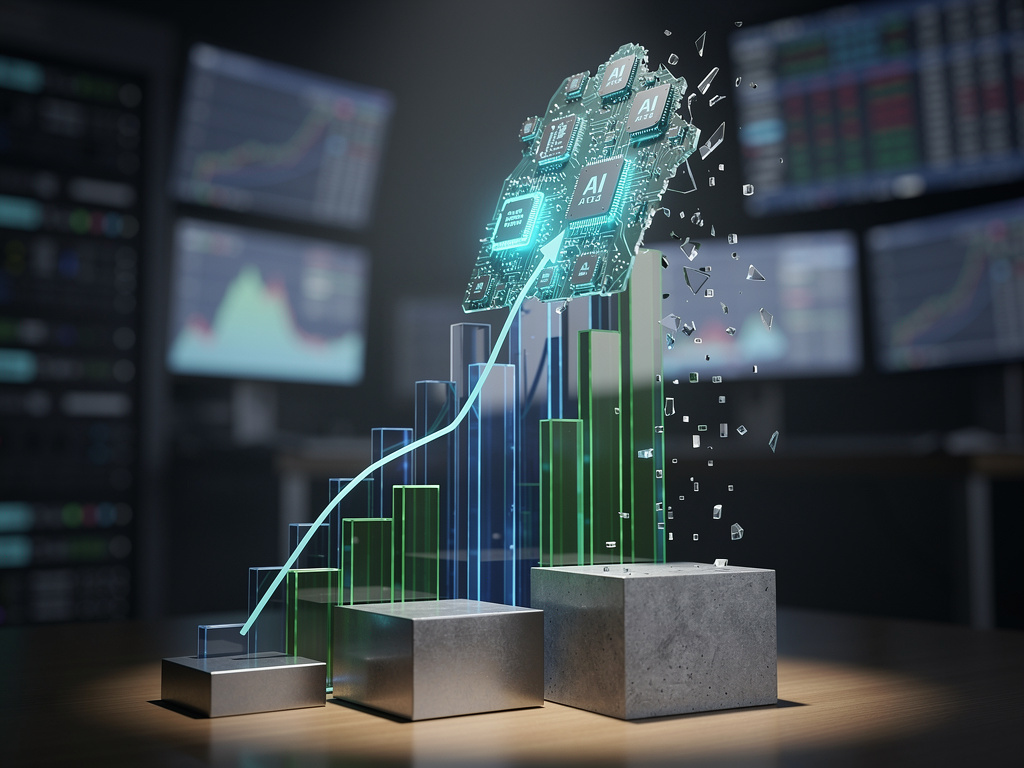
The most crowded trade on the planet has a problem. Not a fatal one — not yet — but the kind that tends to humble investors who confuse momentum with merit. Artificial intelligence stocks have dominated equity markets for the better part of three years, minting trillions in market capitalization and reshaping portfolio allocations worldwide. But beneath the frenzy, a quieter force is reasserting itself. Fundamentals.
Wellington Management, the Boston-based investment giant overseeing roughly $1.3 trillion in assets, has been making this case with increasing conviction. In a recent analysis highlighted by Fortune, the firm argued that even in a market reshaped by AI enthusiasm, the old rules of valuation, cash flow generation, and earnings quality haven’t been suspended. They’ve merely been ignored — temporarily.
That distinction matters enormously.
Wellington’s thesis isn’t contrarian for the sake of it. The firm acknowledges the transformative potential of artificial intelligence and the genuine revenue growth materializing at companies like Nvidia, Microsoft, and Alphabet. What concerns Wellington’s strategists is the degree to which market participants have extrapolated that growth into perpetuity, assigning valuations that leave almost no margin for disappointment. When a stock prices in perfection, even strong results can trigger a selloff. And when an entire sector prices in perfection, the correction can be violent.
This isn’t hypothetical. The first quarter of 2025 offered a preview. Nvidia shares, despite posting another round of blockbuster earnings, experienced sharp drawdowns as investors questioned the sustainability of data center spending. Microsoft’s stock stalled after its Azure growth rate, while impressive by any historical standard, came in slightly below the whisper number. The pattern repeated across the AI supply chain — from semiconductor equipment makers to cloud infrastructure providers. Good wasn’t good enough. Only spectacular would do.
Wellington’s argument, as reported by Fortune, centers on a concept that sounds almost quaint in the current environment: mean reversion. Profit margins expand, then contract. Revenue growth accelerates, then decelerates. Multiples expand beyond what fundamentals justify, then compress — sometimes gradually, sometimes all at once. The AI cycle, Wellington contends, won’t be exempt from these dynamics, however powerful the underlying technology proves to be.
The firm draws parallels to previous technology booms. Not to suggest AI is a bubble in the late-1990s sense — Wellington is careful to distinguish between companies with real earnings and those that were little more than slide decks — but to illustrate how even legitimate technological shifts produce periods of overvaluation followed by painful recalibrations. The internet did change everything. It also destroyed enormous amounts of investor capital along the way.
So where does that leave allocators today?
Wellington’s answer is nuanced. The firm isn’t recommending wholesale abandonment of AI-exposed equities. Instead, it’s advocating for a return to disciplined security selection — the kind that distinguishes between a company generating free cash flow at a reasonable multiple and one trading at 40 times forward earnings on the assumption that every enterprise on earth will soon spend 20% of its IT budget on generative AI tools. The difference between those two investment cases is enormous, even if both companies happen to have “AI” in their investor presentation.
This message resonates with a growing contingent of institutional investors who’ve grown uneasy with concentration risk. The S&P 500’s top ten holdings now account for roughly 35% of the index’s total market capitalization, a level of concentration not seen since the early 1970s. Most of those top holdings are AI beneficiaries. For passive investors — and for active managers benchmarked against cap-weighted indices — this creates a peculiar dilemma: underweighting the biggest AI names means almost certainly lagging the benchmark in an up market, while overweighting them means taking on correlated risk that could prove devastating in a downturn.
Wellington isn’t alone in sounding this alarm. BlackRock’s Investment Institute has published research noting that equity market breadth remains historically narrow, a condition that typically precedes either a broadening rally or a correction in the leaders. Goldman Sachs strategists have flagged the risk that AI capital expenditure could disappoint relative to current expectations, particularly if enterprise adoption of large language models proves slower or less profitable than anticipated. And JPMorgan’s Marko Kolanovic, before his departure from the firm, repeatedly warned that the AI trade had become dangerously one-sided.
The counterargument is straightforward and not without merit. AI is different this time, proponents say, because the revenue is real. Nvidia’s data center segment generated over $47 billion in revenue in its most recent fiscal year. Microsoft’s AI-related cloud revenue is growing at triple-digit rates. Meta has rebuilt its advertising business around AI-driven recommendation algorithms. These aren’t speculative bets on future technology. They’re businesses printing money today.
True. But Wellington’s point isn’t that the revenue is fictitious. It’s that the valuation assigned to that revenue assumes a growth trajectory that may not materialize as smoothly as the market expects. Capital expenditure cycles are inherently lumpy. The hyperscalers — Amazon, Microsoft, Google, Meta — have collectively committed hundreds of billions of dollars to AI infrastructure over the next several years. That spending is Nvidia’s revenue. But corporate budgets aren’t infinite, and at some point, the buyers of AI chips will need to demonstrate returns on those investments to their own shareholders. If the payoff takes longer than expected, spending could plateau or even decline. And when spending declines, the companies supplying the picks and shovels feel it first.
There’s a historical rhyme here worth noting. In the late 1990s, telecommunications companies spent lavishly on fiber optic networks, creating a boom for equipment suppliers like Cisco, Nortel, and JDS Uniphase. The spending was real. The fiber was real. The capacity was real. But it far outstripped actual demand, and when the music stopped, the equipment makers suffered catastrophic declines. Cisco’s stock, at its peak in March 2000, wouldn’t recover its highs for over two decades.
Nobody at Wellington — or anywhere else — is predicting that Nvidia becomes the next Cisco. The comparison is imperfect in important ways. Nvidia’s competitive moat is deeper, its margins are fatter, and the demand for its products is more immediately tied to observable use cases. But the structural dynamic — massive capital expenditure driving supplier revenue that the market then extrapolates indefinitely — is uncomfortably similar.
And the market’s pricing reflects that extrapolation. Nvidia trades at roughly 30 times forward earnings, which sounds reasonable until you consider that those forward earnings estimates themselves embed assumptions of continued hypergrowth. If growth merely decelerates to a still-impressive 20% per year, the stock’s current multiple becomes far less attractive. For companies further down the AI value chain — software firms, consulting companies, smaller semiconductor players — the valuation math is even more precarious.
Wellington’s prescription, according to the Fortune report, involves looking beyond the obvious AI winners toward companies where fundamentals are strong but valuations haven’t been inflated by AI hype. Healthcare, industrials, and select financial services firms all offer earnings growth at more reasonable multiples. These aren’t sexy picks. They don’t generate breathless CNBC segments. But they tend to outperform over full market cycles, particularly when the premium for growth stocks narrows.
This is essentially a bet on reversion to the mean — the most reliable pattern in financial markets and the one investors are most prone to forgetting at precisely the wrong moment.
The timing question is, of course, the hardest part. Valuation alone has never been a reliable short-term timing tool. Expensive stocks can get more expensive. Cheap stocks can get cheaper. Wellington acknowledges this reality and frames its argument not as a market call but as a risk management framework. The point isn’t to predict when AI stocks will correct, but to ensure that portfolios are constructed to withstand such a correction without catastrophic consequences.
Recent developments add urgency to this framing. Trade policy uncertainty has intensified in early April 2025, with new tariff proposals from the White House creating fresh headwinds for technology supply chains. Semiconductor companies with significant manufacturing exposure in Taiwan and South Korea face particular risk, as geopolitical tensions in the region show no signs of abating. Meanwhile, the Federal Reserve’s interest rate path remains uncertain, and higher-for-longer rates disproportionately punish long-duration growth stocks — exactly the kind that dominate the AI trade.
There’s also the competitive dimension. The AI market is evolving rapidly, and today’s dominant players may not be tomorrow’s winners. Open-source models from Meta and Mistral are pressuring the pricing power of proprietary model providers. Chinese competitors, led by DeepSeek and Alibaba’s Qwen, are producing increasingly capable systems at a fraction of the cost. If AI capabilities commoditize faster than expected, the enormous margins currently enjoyed by the leading players could erode significantly.
Wellington’s view, distilled to its essence, is simple. Technology changes. Human nature doesn’t. The tendency to overpay for the future while undervaluing the present is as old as markets themselves. And the correction, when it comes, doesn’t discriminate between investors who understood the technology and those who didn’t. It punishes everyone who paid too much.
For institutional allocators managing pension funds, endowments, and sovereign wealth portfolios, the message carries particular weight. These investors operate on time horizons measured in decades, not quarters. They can’t afford to chase performance into concentrated positions that might deliver spectacular short-term returns but expose their beneficiaries to outsized downside risk. Diversification, the only free lunch in finance, has rarely looked less fashionable — or more necessary.
The irony of the current moment is that AI itself may eventually prove Wellington’s point. Machine learning models are increasingly being deployed in quantitative investment strategies, and one of their most consistent findings is that valuation and quality factors — precisely the fundamentals Wellington champions — generate superior risk-adjusted returns over long periods. The technology the market is so enamored with may ultimately confirm that the old rules still apply.
None of this means AI won’t transform industries, create enormous wealth, or reshape how businesses operate. It almost certainly will. But transformation and investment returns are different things. The railroad transformed America. Most railroad investors lost money. The internet transformed commerce. Most dot-com investors lost money. The pattern isn’t inevitable, but it’s common enough to warrant serious attention from anyone allocating capital today.
Wellington Management is making a fundamentally conservative argument in an environment that rewards aggression. That takes a certain kind of institutional courage. Whether the market validates that courage in 2025, 2026, or 2027 remains to be seen. But the historical record suggests that patience and discipline, however unfashionable, tend to win in the end.
They usually do.


 WebProNews is an iEntry Publication