
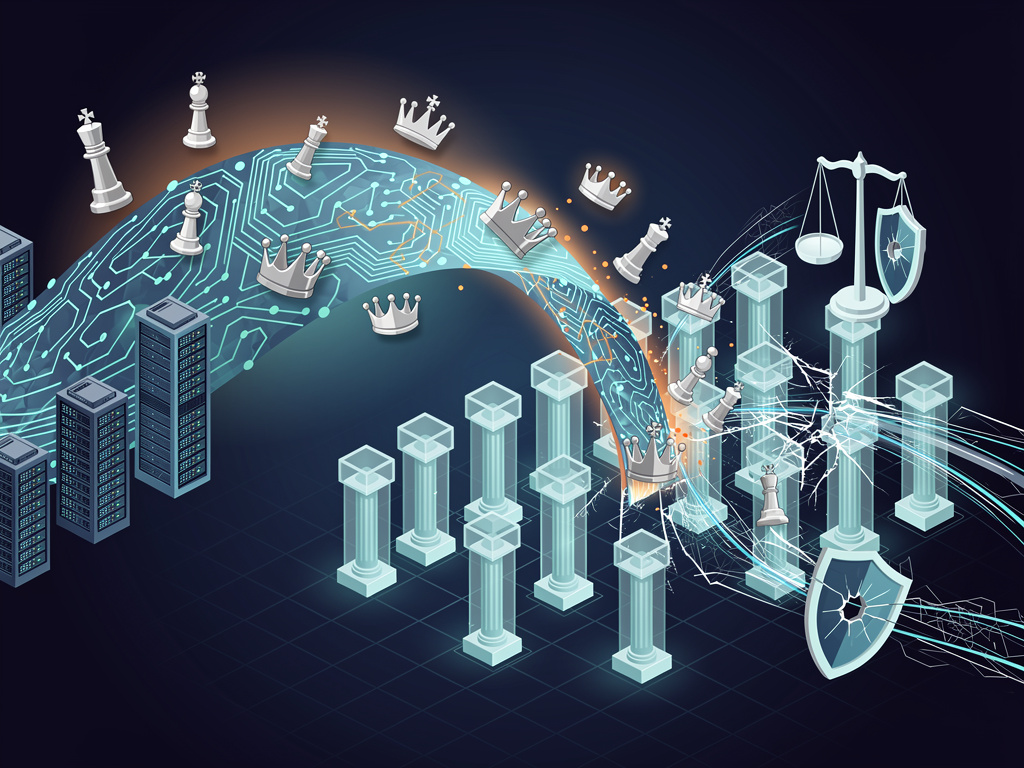
They built the most powerful technology companies on Earth. And now they’re leaving.
Over the past two years, an unusual pattern has emerged across the artificial intelligence industry: the people who founded, scaled, and led AI companies are resigning from their own creations at a striking rate. Not retiring quietly after decades of service. Not being pushed out in boardroom coups. Walking away — often citing the very technology they helped create as the reason.
The latest departure came in late June 2025, when Dario Amodei’s sister and co-founder Daniela Amodei reportedly began stepping back from day-to-day operations at Anthropic, the company behind the Claude AI assistant. But she’s just one name on a growing list that reads like a who’s who of artificial intelligence leadership. As Futurism reported, the trend of AI CEO departures has accelerated to the point where it demands serious scrutiny from investors, policymakers, and anyone paying attention to where this technology is headed.
Start with the most dramatic exit. In November 2023, OpenAI’s board fired Sam Altman as CEO in a move that stunned Silicon Valley. The official explanation was that Altman had not been “consistently candid” with the board. The unofficial story, pieced together over subsequent weeks, pointed to deeper disagreements about the pace of AI development and whether commercial pressures were overriding safety concerns. Altman was reinstated days later after a revolt by employees and pressure from Microsoft, OpenAI’s largest investor. But the episode exposed fault lines that haven’t healed.
What happened next was more telling than the firing itself. Ilya Sutskever, OpenAI’s co-founder and chief scientist — the man widely regarded as one of the most brilliant minds in machine learning — sided with the board in ousting Altman. Then, after Altman’s return, Sutskever found himself increasingly marginalized. He resigned in May 2024 and founded Safe Superintelligence Inc., a company whose name alone signals his priorities. His departure wasn’t just a career move. It was a statement.
Jan Leike, who co-led OpenAI’s superalignment team with Sutskever, left around the same time. His public comments were blunt. He said OpenAI’s “safety culture and processes have taken a backseat to shiny products.” That’s not diplomatic hedging from a disgruntled employee. That’s an alarm bell from someone who had direct visibility into how the world’s most prominent AI company makes decisions about existential risk.
The pattern extends well beyond OpenAI. Stability AI’s founder and CEO Emad Mostaque resigned in March 2024, stepping down from both his CEO role and his board seat. His stated reason: he wanted to pursue decentralized AI. But Stability had been burning through cash, facing copyright lawsuits, and struggling to compete with better-funded rivals. The company’s valuation had reportedly dropped significantly from its $1 billion peak. Mostaque’s departure looked less like a visionary pivoting and more like a founder recognizing that the walls were closing in.
Inflection AI tells a similar story with a different ending. Mustafa Suleyman, who co-founded DeepMind before starting Inflection, left his own company in March 2024 to run Microsoft’s consumer AI division. Microsoft simultaneously hired most of Inflection’s key technical staff and paid the startup roughly $650 million in a licensing deal that was widely interpreted as an acquisition in everything but name. Suleyman didn’t just leave — he effectively handed the keys to his company’s biggest competitor’s benefactor.
Then there’s Mira Murati. As OpenAI’s chief technology officer, she was the public face of ChatGPT’s launch and one of the most visible women in AI. She resigned in September 2024, followed almost immediately by two other senior leaders: Bob McGrew, the chief research officer, and Barret Zoph, a vice president of research. Three senior departures in rapid succession from the same company. That’s not coincidence. That’s an organization under strain.
So what’s actually driving this exodus?
The simplest explanation is money. AI companies have attracted staggering amounts of capital — OpenAI alone has raised over $13 billion from Microsoft — and early leaders may simply be cashing out while valuations remain astronomical. There’s nothing unusual about founders leaving after a big funding round or corporate restructuring. It happens in every tech cycle.
But money doesn’t explain Sutskever starting a safety-focused company. It doesn’t explain Leike’s pointed public criticism. And it doesn’t explain why so many departures cluster around the same few months, as if some invisible threshold had been crossed.
The more uncomfortable explanation is ideological. Many of these leaders helped build AI systems because they believed the technology could be developed responsibly. They wrote safety charters. They established alignment research teams. They gave TED talks about beneficial AI. And then they watched as commercial incentives overwhelmed every guardrail they’d put in place.
OpenAI’s transformation is the starkest example. Founded in 2015 as a nonprofit research lab, it became a “capped-profit” company in 2019, then began pushing toward a full for-profit conversion in 2024 and 2025. Each structural change moved the organization further from its original mission of ensuring AI “benefits all of humanity” and closer to a conventional tech giant optimizing for revenue and market share. For leaders who joined because of the mission, watching that transformation from the inside must have been disorienting at best. At worst, it felt like complicity.
As Futurism noted, there’s a recurring theme in the public statements of departing AI leaders: they express concern that development is moving too fast, that safety research is underfunded relative to product development, and that competitive pressure between companies is creating a race dynamic that nobody wanted but nobody knows how to stop.
This isn’t just an internal industry problem. It has real implications for regulation, national security, and public trust.
Consider the regulatory angle. Governments around the world are trying to write rules for AI development. The EU’s AI Act took effect in stages starting in 2024. The U.S. has relied primarily on executive orders and voluntary commitments from companies. China has implemented its own set of regulations. But all of these frameworks depend, to some degree, on the people inside AI companies raising concerns when something goes wrong. When those people leave — especially when they leave because their concerns were ignored — the internal checks that regulators are counting on disappear.
The national security dimension is equally concerning. AI development is now understood as a strategic competition between the United States and China. The U.S. government has placed export controls on advanced chips, restricted investment in Chinese AI companies, and treated domestic AI firms as national champions. But what happens when the leadership of those national champions is in constant flux? Institutional knowledge walks out the door with every departure. Relationships between companies and government agencies have to be rebuilt. And the revolving door creates opportunities for talent to scatter to competitors — including foreign ones.
There’s also the question of what these departures signal about the technology itself. When the people closest to a technology start expressing reservations about its trajectory, that carries informational weight. It’s the equivalent of a company’s CFO selling stock. Maybe it means nothing. Maybe it means everything. But it’s data that shouldn’t be ignored.
Not everyone reads the situation so grimly. Some industry observers argue that leadership turnover is natural and even healthy in a fast-growing sector. AI companies have scaled from small research labs to multibillion-dollar enterprises in just a few years. The skills required to run a 50-person research team are fundamentally different from those needed to manage a 3,000-person company with enterprise customers, regulatory obligations, and a global workforce. Founders leaving isn’t a crisis — it’s a maturation process.
There’s truth in that. But it doesn’t account for the tone of the departures. When Leike says safety has taken a backseat, when Sutskever starts a company explicitly focused on safe superintelligence, when multiple executives leave the same company within days of each other — the maturation narrative starts to feel insufficient.
The financial pressures on AI companies add another layer. OpenAI reportedly lost $5 billion in 2024 on revenues of $3.7 billion. Anthropic, despite raising billions from Amazon and Google, faces similar unit economics challenges. The cost of training and running large language models is enormous, and the path to profitability for most AI companies remains unclear. Leaders who joined to do research may find themselves increasingly pulled into decisions about cost-cutting, monetization, and corporate restructuring that have nothing to do with why they got into AI in the first place.
And the competitive dynamics are intensifying, not easing. Google, Meta, Amazon, Apple, and Microsoft are all pouring tens of billions into AI. Open-source models from Meta’s Llama family and others are eroding the moat that proprietary model companies thought they had. Startups that raised money at peak valuations are now facing down rounds or fire-sale acquisitions. The pressure to ship products faster, cut costs, and show returns to investors is immense. In that environment, safety-minded leaders become friction. And friction gets removed.
What comes next matters enormously. The people replacing these departing leaders tend to be more commercially oriented, more comfortable with aggressive timelines, and less likely to pump the brakes on deployment. That’s not a criticism of their competence — it’s an observation about selection effects. When safety-focused leaders leave and are replaced by growth-focused operators, the organizational culture shifts. Multiply that across an entire industry and you get a systemic change in how AI development decisions get made.
Some of the departed leaders are channeling their concerns into new ventures. Sutskever’s Safe Superintelligence Inc. has raised over $1 billion and is focused exclusively on building safe AI systems without the commercial pressures that distorted his experience at OpenAI. Murati has reportedly been exploring her own AI venture. These efforts may produce meaningful alternatives to the current development model — or they may get swallowed by the same market forces that pushed their founders out in the first place.
The pattern also raises uncomfortable questions about corporate governance in AI. OpenAI’s board fired its CEO over safety concerns, and within days, the CEO was back and the board was gutted. The lesson that every other AI company’s board internalized was clear: don’t challenge the CEO, don’t slow down development, and don’t let safety concerns interfere with the business plan. That’s a terrible lesson for an industry building technology that its own creators describe as potentially dangerous.
Investors, for their part, seem largely unbothered. OpenAI’s valuation has continued to climb despite the leadership turmoil, reportedly reaching $300 billion in early 2025. Anthropic’s valuation has risen similarly. The market is pricing in growth, not governance risk. Whether that’s rational depends entirely on whether you think the departing leaders’ concerns are overblown or prescient.
History offers some guidance, though imperfect. The early nuclear era saw similar dynamics — scientists who helped develop atomic weapons later became the loudest voices warning about their dangers. Robert Oppenheimer’s post-war advocacy for arms control got him stripped of his security clearance. The scientists’ concerns were eventually validated, but only after decades of near-misses and an arms race that brought humanity to the brink. The question is whether AI’s trajectory will follow a similar pattern, with today’s departing leaders playing the role of early Cassandras.
That comparison might be overwrought. AI isn’t a nuclear weapon. But the structural parallel — creators of a powerful technology losing control of how it’s deployed and walking away in protest — is hard to dismiss entirely.
For now, the departures continue. Each one gets a few days of headlines, a round of speculation on X, and then the industry moves on to the next product launch or funding round. But the cumulative effect is significant. The AI industry is losing its institutional conscience, one resignation at a time. And the people left in charge are the ones who either don’t share those concerns or have learned to keep them quiet.
That should worry everyone. Not because the departing leaders are necessarily right about every risk they’ve identified. But because an industry building the most powerful technology since the internet — and possibly the most powerful technology in human history — is systematically selecting against the people most inclined to ask whether it should slow down. The market rewards speed. The technology demands caution. And the people who understood that tension best are no longer in the room where the decisions get made.


 WebProNews is an iEntry Publication