
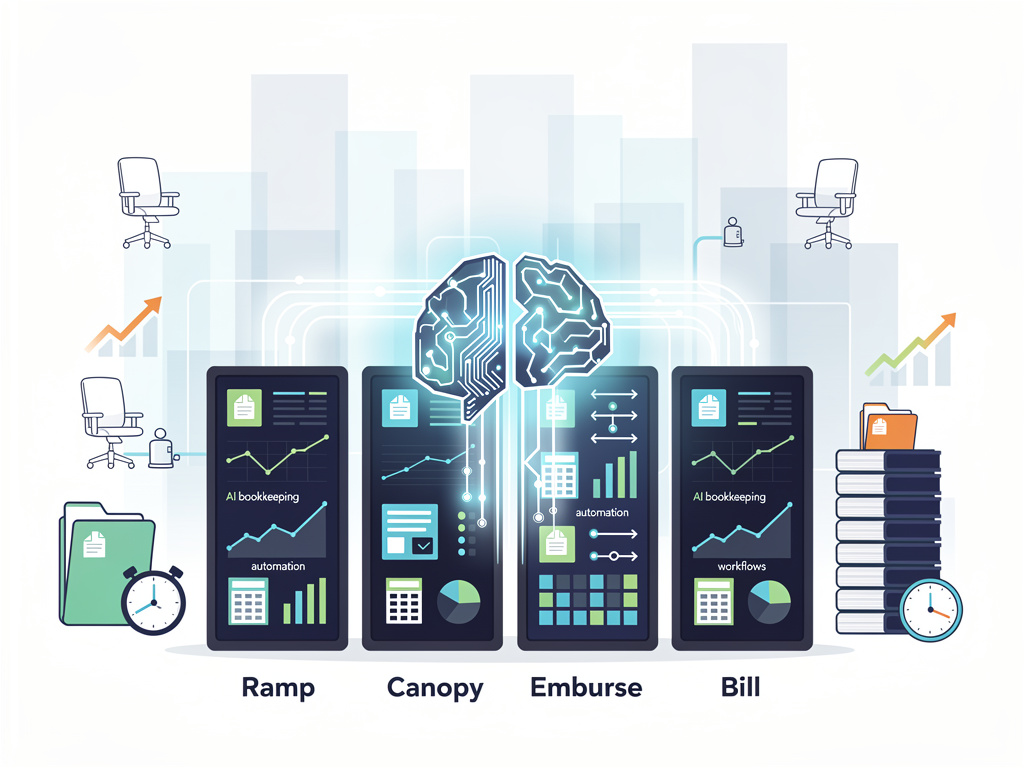
The accounting technology sector is undergoing a seismic transformation as multiple fintech companies simultaneously unveil artificial intelligence–powered tools designed to automate bookkeeping, eliminate human error, and reshape the relationship between businesses and their financial data. In a flurry of announcements that underscores the accelerating arms race in AI-driven finance, Ramp, Canopy, Emburse, and Bill have each rolled out new capabilities that promise to do for accounting what automation did for manufacturing — only faster.
The convergence of these product launches is no coincidence. As businesses of all sizes grapple with labor shortages in accounting, rising compliance complexity, and the relentless pressure to close books faster, technology vendors are betting that AI can fill the gap. The question is no longer whether artificial intelligence will transform bookkeeping, but which platform will dominate the new era of autonomous financial management.
Ramp Pushes Deeper Into AI-Powered Bookkeeping
Ramp, the corporate card and spend management platform that has rapidly expanded its footprint in the finance technology space, announced a suite of AI-powered bookkeeping features that represent its most ambitious foray yet into automating the accounting workflow. As reported by Accounting Today, Ramp’s new tools are designed to handle transaction categorization, receipt matching, and month-end close processes with minimal human intervention.
The company has been steadily building toward this moment. Over the past two years, Ramp has invested heavily in machine learning models trained on millions of corporate transactions, enabling its system to recognize spending patterns, flag anomalies, and automatically assign general ledger codes with increasing accuracy. The new bookkeeping solution takes this a step further by offering what amounts to a virtual bookkeeper — one that works around the clock, doesn’t take sick days, and learns from every correction a human accountant makes.
Canopy Targets Accounting Firms With Its Own AI Play
Canopy, a practice management platform built specifically for accounting firms, made its own AI-powered bookkeeping announcement in parallel with Ramp’s. While Ramp’s solution is aimed primarily at businesses managing their own finances, Canopy’s approach is tailored to the firms that serve those businesses — a critical distinction that reflects the bifurcated nature of the accounting technology market.
According to Accounting Today, Canopy’s AI bookkeeping tools are designed to help accounting professionals manage higher client volumes without proportionally increasing headcount. The platform leverages artificial intelligence to automate data entry, reconcile accounts, and generate preliminary financial statements that accountants can review and approve rather than build from scratch. For firms struggling to recruit qualified staff — the American Institute of CPAs has repeatedly warned about a pipeline crisis in the profession — this kind of automation isn’t a luxury; it’s a survival strategy.
Emburse Takes a Preventative Approach to Financial Errors
While Ramp and Canopy focus on automating bookkeeping tasks after the fact, Emburse is taking a fundamentally different approach: using AI to prevent errors before they occur. The expense management company’s new tool, also detailed by Accounting Today, applies machine learning algorithms to expense reports and financial submissions at the point of entry, flagging potential policy violations, duplicate charges, and miscategorized expenses in real time.
This preventative philosophy represents an important evolution in how AI is being deployed in financial operations. Rather than cleaning up messes after they’ve been made, Emburse’s system acts as a guardrail, intercepting problematic data before it enters the accounting system and cascades through downstream reports. For companies that have spent years and significant resources on audit remediation and restatements, the appeal of catching errors at the source is substantial. The tool also addresses a persistent pain point for finance teams: the back-and-forth cycle of rejecting and resubmitting expense reports, which consumes time disproportionate to the dollar amounts involved.
Bill Highlights New Capabilities in an Expanding Product Suite
Bill, the publicly traded accounts payable and receivable automation platform, is also touting new features that leverage AI to streamline financial workflows. The company, which serves hundreds of thousands of small and midsize businesses, has been integrating artificial intelligence into its invoice processing, payment routing, and cash flow forecasting tools. Bill’s latest enhancements focus on improving the accuracy and speed of invoice data extraction, reducing the manual effort required to match purchase orders with incoming bills, and providing smarter payment timing recommendations based on cash position analysis.
Bill’s position in the market is particularly noteworthy because of its scale. With a vast network of businesses and accounting firms already using its platform, the company has access to an enormous dataset from which to train its AI models. This data advantage creates a flywheel effect: the more transactions flow through Bill’s system, the smarter its algorithms become, which in turn attracts more users. It’s a competitive dynamic that smaller entrants will find increasingly difficult to replicate.
The Staffing Crisis Fueling the AI Automation Boom
Underlying all of these product announcements is a structural crisis in the accounting profession that shows no signs of abating. The number of students graduating with accounting degrees has declined steadily over the past decade, while experienced professionals are retiring in large numbers. The Bureau of Labor Statistics projects that demand for accountants and auditors will remain robust, but the supply side of the equation is deeply constrained. This imbalance has created a seller’s market for accounting talent, driving up salaries and making it prohibitively expensive for many small firms and businesses to maintain fully staffed finance departments.
AI-powered bookkeeping tools offer a pressure valve for this crisis. By automating routine tasks — data entry, bank reconciliation, transaction categorization, and basic financial reporting — these platforms free up human accountants to focus on higher-value advisory work. For accounting firms, this means the ability to serve more clients with the same team. For businesses, it means access to accurate, timely financial data without the overhead of a full-time bookkeeper. The economic logic is compelling, and it explains why venture capital and public market investors have poured billions of dollars into accounting technology companies over the past several years.
Competition and Consolidation Ahead
The simultaneous launch of AI bookkeeping tools by multiple major players raises inevitable questions about market consolidation. History suggests that when several well-funded companies pursue the same technological opportunity at the same time, the result is a period of intense competition followed by a wave of mergers and acquisitions. The accounting technology sector appears to be entering exactly this kind of phase.
Ramp, which has raised over $1.6 billion in funding, has the financial resources to compete aggressively. Bill, as a public company with a market capitalization in the billions, has the scale and distribution network to integrate AI features into an already entrenched product. Canopy occupies a defensible niche serving accounting firms directly, while Emburse’s preventative approach differentiates it from competitors focused on post-hoc automation. Each company has a plausible path to market leadership, but it is unlikely that all of them will thrive independently over the long term.
What This Means for Accountants and Finance Teams
For the professionals who actually use these tools, the implications are profound but nuanced. AI-powered bookkeeping does not eliminate the need for human judgment — at least not yet. Complex transactions, unusual business events, and the exercise of professional skepticism still require trained accountants. What AI does eliminate is the drudgery: the hours spent manually entering data, chasing receipts, and reconciling bank statements line by line.
This shift has the potential to make the accounting profession more attractive to younger workers who have been deterred by its reputation for tedium. If AI handles the mechanical aspects of bookkeeping, the remaining work — advising clients on tax strategy, analyzing financial performance, planning for growth — is more intellectually engaging and commands higher compensation. In this sense, the technology could help address the very staffing crisis that created the demand for it in the first place.
The coming months will be critical in determining which of these AI bookkeeping platforms gains traction and which struggles to find its audience. Early adoption patterns, integration partnerships with major accounting software providers like Intuit and Sage, and the accuracy of AI models in real-world conditions will all play decisive roles. What is already clear, however, is that the era of purely manual bookkeeping is drawing to a close — and the companies best positioned to manage that transition stand to capture enormous value.


 WebProNews is an iEntry Publication